
Do You Have to Fall to Be in Love?
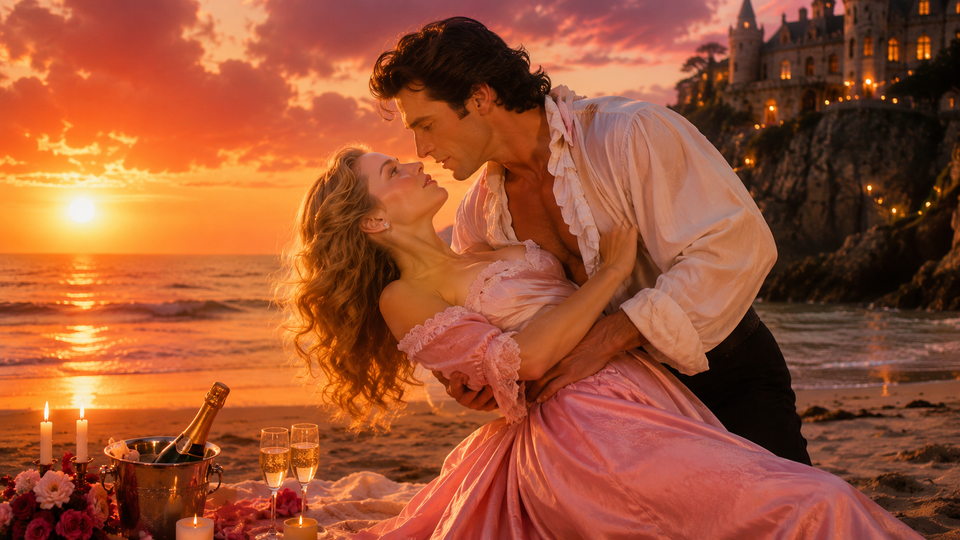
Once, when courting my now wife who lived in a different state, she was dropping me off at the airport after a visit when—and, I share this with great embarrassment—we proceeded to make out vigorously as we waited for my plane to board. How bad was it? A kid wandering past stared at us, said "Ewww," and walked on. I felt mildly bad. Then I thought: this is for love. Anything for love, right?
Fast-forward many years and many anniversaries. We would never do that now — not because we love each other any less, but because that kind of intensity isn't what's holding the marriage together. It peaked somewhere around year three.
Which raises a question. If we wouldn't say a couple who've been devoted to each other for fifty years isn't in love just because they don't behave like teenagers in an airport, then the public-make-out kind of love can't be what love itself really is. It's a kind of love. Probably a phase of it. Not the thing itself.
The anthropologist Geoffrey Gorer noticed something even stranger about this kind of love.
A Local Custom
In a 1955 essay called On Falling in Love, Gorer pointed out that the romantic-love-as-life-goal model — fall deeply in love with one unmarried person, marry them, sustain the marriage on that feeling, do this exactly once — is not a universal human experience. It is the cultural property of industrial-era Europe and America. Most societies through most of history have not organized their social institutions around romantic love. In fact, most have seen it as disruptive, since marriage in those societies was a social and economic arrangement, not a private emotional one.
We don't notice this is a local custom because we are so thoroughly inside it. Every Disney movie is about it. Almost every song is about it. We absorb from the time we can talk that finding "the one" is what makes a life successful — that if you haven't experienced the rapture, you've missed the point of being human.
Few human beings across history have organized their lives this way. And the ones who tried to live up to the full modern checklist almost never managed it, then or now.
Romance Is Younger Than You Think
Here's a piece of the history that makes Gorer's point sharper. The romantic-love-as-the-meaning-of-life thing didn't drop out of the sky. You can roughly date it to the 12th-century troubadours of southern France — the courtly love tradition, which idealized passionate, often unconsummated longing between a knight and a noble (usually married) lady. C.S. Lewis traced this in The Allegory of Love: courtly love was a literary innovation that gradually reshaped Western imagination about what love is supposed to feel like. It got picked up by the Romantic poets in the 19th century, exported through novels, and turbocharged in the 20th by movies, advertising, and pop music.
This isn't to say nobody felt romantic feelings before the troubadours. Of course they did. The point is that no civilization before then had told its members this feeling is what your life is supposed to be about. That was new. And it is still, in the long view, quite recent.
What Marriage Used to Mean
What did marriage look like before romance was load-bearing? It looked like a covenant. Two people made vows in front of their community to be faithful, to support each other, to raise children if children came, and to stay through circumstances they could not yet imagine. The romance might be there, might not be, might come and go. The vows were the thing.
The Christian tradition has held a version of this view for most of its history: marriage is constituted by consent and sustained by fidelity to that consent — not by the persistence of an emotional state. That doesn't make romance unwelcome, but it does make it secondary.
Perfect Pitch and Tone-Deaf
Here's the analogy that makes this land for me. The capacity to fall passionately, head-over-heels in love seems to be statistically rare and arbitrarily distributed — more like perfect pitch than like the ability to walk. Most people can approximate it well enough to get by. Some have it strongly. Some don't seem to have it at all, the way some people are tone-deaf.
A culture that treated singing as the meaning of life would be cruel to the tone-deaf. Our culture treats romance as the meaning of life and is correspondingly cruel to people who don't experience it. The friend who married someone they "settled for" and now seems quietly content forty years in isn't failing at love. They're living what most humans across history would recognize as a normal, even successful marriage. Your divorced friend who was crazy about their spouse for two years and watched it fall apart isn't more in touch with love — they might just be more in touch with our local mythology about it.
What I Take From This
I don't think romance is bad. Speaking from experience, it's fun. But I no longer think it's necessary, and I no longer think it's the highest kind of love. The people whose marriages I admire would mostly agree.
If you have perfect pitch for romance — enjoy it. If you don't, you haven't missed the point of being human. The point of being human is, among other things, the long faithful kind of love, and that kind is available to everyone.
Watch the Full Video
In the video I walk through Gorer's argument in more detail, work the perfect-pitch analogy harder, and consider what we should actually take from the realization that romance-as-life-goal is a local custom rather than a universal truth.