
Frankfurt Cases: Do We Really Need the Ability to Do Otherwise?
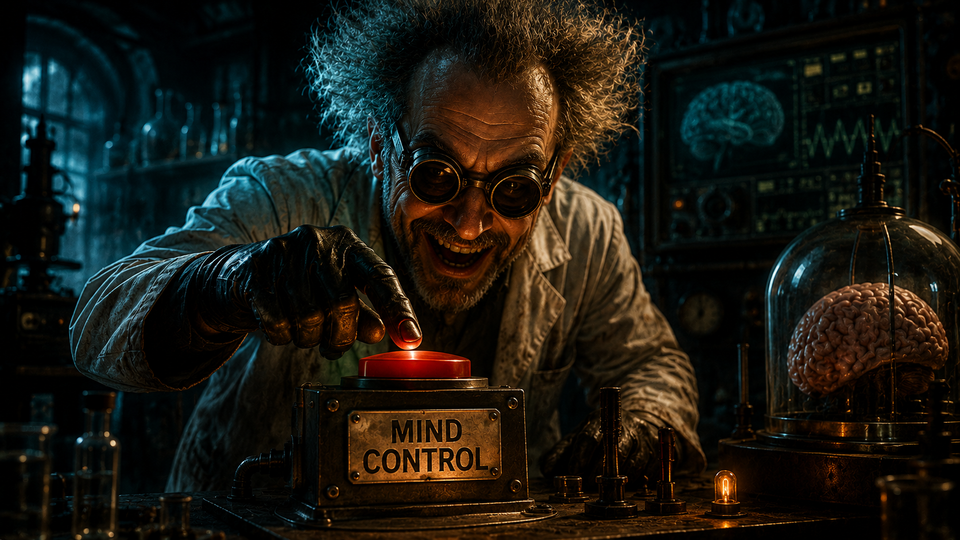
You're about to make a choice. What you don't know is that someone is hidden in the shadows, watching, ready to reach in and force your hand the moment you start leaning the wrong way. But you never lean the wrong way. You make the choice on your own, and the figure in the shadows never has to lift a finger.
Are you responsible for what you chose? Almost everyone says yes. And yet—you couldn't have done otherwise. If you'd tried, you'd have been stopped. So here's the question that's about to shake up the whole free will debate: does it actually matter that you couldn't have done otherwise?
Let's consider.
The Assumption Everyone Was Making
In the last episode we looked at the Consequence Argument, Peter van Inwagen's powerful case that if determinism is true, nobody could ever do otherwise than they actually do. We ran through the objections and the replies. But underneath that whole fight—and underneath nearly every free will debate before it—sat one quiet assumption that both sides simply took for granted:
Free will and moral responsibility require the ability to do otherwise.
That's the assumption Harry Frankfurt set out to demolish in a 1969 paper, and the debate has never fully recovered.
To see why it matters, notice that incompatibilists—the people who say free will can't coexist with determinism—have traditionally leaned on two pillars. The first is leeway: to be free and responsible, you need genuine alternatives, more than one path actually open to you. The second is sourcehood: you need to be the ultimate source of your action. The Consequence Argument is an assault on the first pillar. It says determinism robs you of leeway. But what if leeway was never required for responsibility in the first place? If Frankfurt is right, the incompatibilist loses one of his two best weapons before the fight even begins.
The Principle of Alternative Possibilities
Philosophers since Aristotle have assumed something like this:
The Principle of Alternative Possibilities (PAP): A person is morally responsible for what they've done only if they could have done otherwise.
It's hard to argue with. Picture a gunman who grabs your hand, wraps it around a weapon, and physically forces you to pull the trigger. We don't hold you responsible, and the reason is obvious: you couldn't have done otherwise. Coercion excuses precisely because it removes your alternatives. PAP seems to capture something deep about why we let people off the hook.
But there's an old crack in the principle, and it traces back to John Locke. Locke asks you to imagine a man carried, asleep, into a room. While he sleeps, the door is quietly locked from the outside. He wakes, finds a friend he's delighted to see, and happily decides to stay and talk—never once trying the door, never suspecting it's locked. He stays of his own free will. And yet he could not have left if he'd wanted to. His staying was voluntary even though he had no alternative. Locke saw it first: maybe "doing something freely" and "being able to do otherwise" aren't the same thing after all. Frankfurt picked up that thread and pulled.
Frankfurt's Counterexample: Black and Jones
Here's the case that did the damage.
A scheming neuroscientist named Black wants Jones to vote for a particular candidate. Black doesn't want to leave it to chance, so he secretly implants a device in Jones's brain. The device monitors Jones's neural activity, and if Jones shows the faintest inclination to vote the other way, it fires and forces him to vote the way Black wants. But—and this is the whole point—Jones, left to himself, decides to vote for Black's candidate anyway. The device sits idle. It never activates. Jones deliberates, chooses, and acts entirely on his own.
Now ask the two questions side by side:
- Could Jones have done otherwise? No. The instant he leaned the other way, Black's device would have stopped him.
- Is Jones morally responsible for his vote? Yes. He decided on his own. Black played no actual role in what happened.
If that's right, PAP is false. Jones is responsible and he couldn't have done otherwise. The ability to do otherwise turns out to be a wheel that isn't connected to anything—it spins, but it isn't what grounds responsibility. What grounds responsibility is the actual sequence: how Jones in fact arrived at his decision, not what would have happened on some path he never took.
The Flicker of Freedom
The first serious pushback came from van Inwagen, and it's called the flicker of freedom.
Look more carefully, the objection goes. Jones did have an alternative. He could have begun to form the intention to vote the other way. That beginning is exactly what would have triggered Black's device. So there was a sliver of something-otherwise available to Jones—the first flicker of a different choice—even if he couldn't have followed it all the way through. PAP survives, barely, because that flicker is the alternative possibility it requires.
Frankfurt's defenders answer with what are called prior-sign examples, and the upshot is a demand: not just any alternative will do. A flicker that Jones can't control, can't act on, and that does no work in explaining his decision is too thin to ground anything. For an alternative to matter, it has to be robust—a real, available option the agent could knowingly take and that would actually make a difference. That sharpens PAP into a stronger claim:
PAP (robust version): A person is morally responsible only if they had a robust alternative possibility.
And now the question becomes: do Frankfurt cases leave the agent any robust alternative? The libertarian says yes. The compatibilist says no. This is where it gets deep.
The Dilemma Defense
The strongest libertarian reply is the dilemma defense, developed by David Widerker and Robert Kane. It works by asking a simple question about Black's device: how does it know when to fire?
The device fires on a prior sign—some earlier indicator that Jones is about to decide the wrong way. So ask: is the connection between that prior sign and Jones's decision deterministic or indeterministic? Those are the only two options, and each one sinks the case.
Horn 1 — Determinism. Suppose the prior sign guarantees the decision. Then the scenario simply assumes determinism. But whether a person is responsible under determinism is the very thing under dispute. So the case has quietly assumed its own conclusion. It begs the question against the incompatibilist.
Horn 2 — Indeterminism. Suppose the connection is not guaranteed—the prior sign makes the decision likely but doesn't necessitate it. Then even after the "go ahead" sign appears, Jones could still have gone the other way. Which means the case never actually eliminated his alternatives. He had a robust one all along.
Either way the Frankfurt case fails to do what it promised. It either smuggles in determinism or leaves the alternative standing. For a while, this looked like it might be checkmate.
The Compatibilist Escape
So compatibilists went to work building Frankfurt cases engineered to slip between the horns. A few of the attempts:
Trumping preemption (Mele and Robb). Imagine two processes running at once inside Bob's head: his own indeterministic deliberation, and Black's deterministic backup, both racing toward the same decision. Bob's deliberation gets there first and "trumps" the backup—like Jonathan Schaffer's analogy of a general and a major shouting "March!" at the same instant. The soldiers march, and it's the general's order that counts, even though the major's would have done the job. The trouble shows up when you ask what happens if the two processes aim at different goals—Bob's deliberation heading toward not stealing while the backup churns toward stealing. Either the backup overrides him (and we've collapsed back into determinism) or his deliberation wins (and he could have done otherwise after all). The defenders say that in the actual case the conflict never arises. But the whole force of a Frankfurt case is supposed to come from what couldn't have happened, so hiding the problem in a scenario that "never arises" feels more like dodging than answering.
Blockage (David Hunt). What if, instead of a device that fires, we simply imagine every alternative neural pathway blocked in advance, so Jones's decision can only flow down one channel? The worry is immediate: if there's truly no pathway that could have gone differently—no atom that could have swerved, to borrow the image—then you haven't built a clever Frankfurt case. You've described a deterministic brain, which lands you right back on Horn 1.
The necessary-but-not-sufficient sign (Pereboom). This is the most ingenious attempt. Derk Pereboom imagines a man, Joe, weighing whether to evade his taxes. A device is set to intervene only if Joe reaches a certain level of moral attentiveness—really focusing on the reasons not to cheat. Here's the trick: reaching that level of attentiveness is necessary for Joe to refrain, but it isn't sufficient—he could attain it and still choose to cheat. So the prior sign doesn't deterministically guarantee anything (dodging Horn 1), and yet the only alternative left to Joe is "becoming more attentive," which isn't itself a decision to do the right thing (dodging Horn 2). Joe cheats on his own, the device never fires, and he sure looks responsible.
The libertarian comebacks come fast. Maybe Joe's robust alternative just is attaining that attentiveness—and Carl Ginet adds that at the very moment of choice, Joe could have turned his attention to the moral reasons instead. Pereboom answers that this isn't robust enough: Joe didn't know attentiveness would trigger the device, and becoming attentive is still compatible with deciding to cheat, so it's no genuine alternative to the wrongdoing itself. Others argue that Joe's responsibility for the fraud is merely derivative of his responsibility for not paying attention in the first place—the way a drunk driver's responsibility traces back to the choice to drink. And so it goes, point and counterpoint. That's roughly where the live debate sits today: not on whether Frankfurt landed a blow—he plainly did—but on whether any single case can be built that the dilemma can't touch.
Where This Leaves Us
Step back from the technical weeds and notice what's happened. Whether or not any particular Frankfurt case is airtight, the cumulative effect has been to pry the free will debate loose from a question it had been stuck on for centuries. For a very long time the question was: could you have done otherwise? Frankfurt's achievement was to make a lot of philosophers suspect that's the wrong question—or at least not the deepest one.
The deeper question, the one Frankfurt cases keep pointing at, is about sourcehood: are you the genuine source of your action? When Jones votes on his own, what makes the act his isn't the road he didn't take. It's the way the decision actually arose—out of his own deliberation, his own reasons, his own will. That's where responsibility seems to live.