
Practical Atheism: Why Should I Turn to God Instead of Turning From Him?
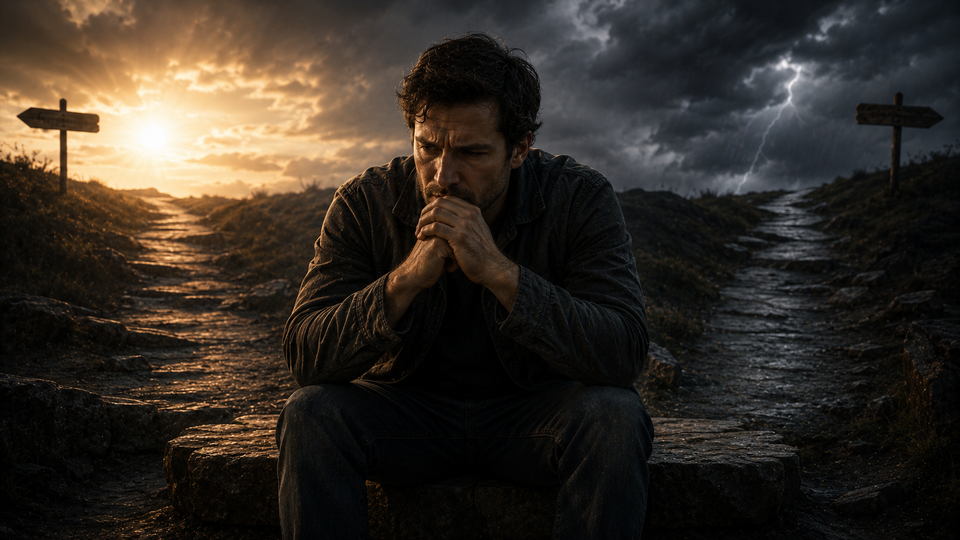
In the last video, I told you about the last several months of intense anxiety and depression I've been walking through, and I used that experience to dig into the Existential Problem of Evil: how could God exist if this is happening to me? We saw that this question really reduces to the Evidential Problem of Evil, and that Skeptical Theism gives us an adequate answer to it: God, as an infinite intellect, has reasons for allowing evil that we don't currently know, possibly reasons we can't even conceive of yet.
But here's the honest truth: even granting all of that intellectually, it might still not feel satisfying. I had depressive episodes that stretched on for days at a time. At my worst point, I thought seriously about suicide. I begged God, more than once, to make it stop. I asked Him to heal me in Jesus' name. I had every person willing to pray over me actually do it. And He never did what I was asking Him to do.
That leads to a different question than the one we tackled last time — not "does God exist," but something more personal: maybe God has a good reason for not answering my prayers the way I wanted. But if that's the case, why should I even bother turning to Him at all? If He's not going to help me when I actually need it, why believe in Him (or at least, why keep engaging with Him) in the first place?
What Is Practical Atheism?
This question might sound strange at first, because it's not asking "is there good evidence God doesn't exist." It's asking something more like, "should I choose to disbelieve, or at least disengage, simply because I don't like what God is doing?" I bring this up seriously because I actually lived this exact pattern for several years of my own life, and not as an abstract hypothetical.
In high school, I desperately wanted to have sex and do drugs. I took a philosophy class at an Episcopalian school, taught by a teacher who was himself an atheist, who convinced me that if I simply stopped believing God existed, I'd be free to do whatever I wanted without guilt. So I rejected God's existence not because the arguments moved me, but because I wanted the freedom. I became an atheist for reasons that had nothing to do with evidence.
I call this Practical Atheism: choosing to reject (or functionally live as though you reject) God's existence because you don't like something about Him or what He's doing, not because you've concluded, on the evidence, that He doesn't exist. And this same dynamic can show up specifically in the face of personal suffering: why would I want to serve a God who would let this happen to me? Why turn toward Him instead of away?
Reason 1: God Alone Can Fulfill Our Deepest Desire
Even though this question came up for me plenty during my anxiety and depression, it was never actually a live problem for me because I already knew, deep down, that God holds all the cards here. He built us in such a way that we can only find lasting happiness in Him.
i. We have an unlimited desire for happiness. ii. God is the only unlimited good. iii. So, only God can fulfill that desire.
I want to be genuinely and permanently happy, and I know that turning away from God doesn't get me any closer to that. It just cuts me off from the only thing that could actually satisfy the desire in the first place. (If this argument sounds familiar, it's the same logic behind the Megaphone Argument a few episodes back. We're just applying it personally now, in the moment of decision, rather than abstractly.)
Reason 2: Joy, Not Just Happiness
Here's an important qualification, though: none of this guarantees you'll feel happy during the period of suffering itself. Happiness, as I'm using the term here, depends on external circumstances, and external circumstances are, by definition, largely beyond our control. In my case, the external circumstance was a neurochemical imbalance making me feel terrible, day after day, regardless of what I believed or how I prayed.
So happiness can't be the real goal in the middle of suffering. Joy has to be the goal instead, and joy is different in kind, not just degree. Joy is a state of inner contentment that isn't hostage to your external conditions. We achieve joy only when we come to see that our situation has some real purpose or meaning behind it, even if we can't fully specify what that purpose is.
The psychiatrist Viktor Frankl (1905–1997), who survived multiple Nazi concentration camps and later wrote about it in Man's Search for Meaning (1946), put this about as well as it's ever been put:
"Life is never made unbearable by circumstances, but only by lack of meaning and purpose."
"In some ways suffering ceases to be suffering at the moment it finds a meaning, such as the meaning of a sacrifice."
But here's the catch: a thing only has a purpose if someone with a purpose in mind put it there. Imagine you trip over a rock on a trail. "Who put this here?!" Someone answers, "Jerry did." Now "what was Jerry's purpose?" makes sense. But if the answer is "no one — it's just there," the question "what is its purpose" stops making sense entirely. Purpose requires an author.
This gives us an argument from joy:
i. We can experience joy through suffering only if there's some purpose behind it. ii. There is only purpose to a thing if it's part of the plan of whoever put it there. iii. So, we can experience joy through suffering only if it's part of God's plan.
I found my own suffering became genuinely more endurable once I actually accepted that God had a purpose in it. At first, I believed intellectually that He did, but I resisted that belief emotionally, because I was still furious about the whole situation and that resistance just made everything feel worse. It was only once I actually got on board with God's plan, rather than fighting it, that things started to shift, and there were moments that felt almost joyful, precisely because I knew God was using the suffering for something, even without knowing exactly what.
This points to something important: drop the idea that you're somehow owed happiness. If you hold onto that assumption, you'll keep circling back to thoughts like "I don't deserve this," "this isn't really my life," "I refuse to accept this" and clinging tightly to your sense of what you're "owed" only intensifies the suffering. The better path is to lean into the pain and genuinely accept it. To be clear, accepting isn't the same as giving up hope or going numb. It means accepting your circumstances as part of God's good (if currently unclear) purposes, while still actively doing everything in your power to move toward healing: seeking real help, being honest with God and with people you trust, changing whatever needs changing, and so on.
Reason 3: Hope With Real Footing
Once you know your suffering is genuinely purposeful, you gain access to a kind of hope that's different from mere wishful thinking. There are two very different things we call "hope":
- Wishful thinking: "I really hope the Saints win this weekend." This has no rational guarantee behind it at all. It's just a wish, and it would be irrational to actually expect it to come true just because you hope for it.
- Hope with solid footing: "My hope is in their defense." This is a hope grounded in something real, some actual reason for confidence.
If we turn away from God and His purposes, our suffering becomes genuinely meaningless, and our only available hope collapses into the first kind: "I really hope this gets better," with no rational basis for expecting that it will. But if we turn toward God, our hope gets to stand on the second, sturdier kind of footing: hope in the actual plan He has for us, being worked out through the suffering. In my own case, during the worst of the anxiety, I knew (even if I could only guess at the specifics) that God was building me into a stronger, better man through it. Eventually I was able to put my hope in that outcome actually coming to pass, rather than staying stuck hoping only that my immediate circumstances would improve.
Reason 4: God Sustains Us Beyond Our Own Limits
We are, by nature, limited creatures, and there's no theoretical ceiling on how much suffering could come our way. Everyone has some breaking point, and grinding through purely on your own strength eventually meets its match. God, though, has unlimited strength, and promises to sustain us through any trial. Psalm 34:17: "The righteous cry out, and the Lord hears, and delivers them out of all their troubles." I can say firsthand this has proven true for me, which is strange to say, because it absolutely didn't feel true mid-episode; it felt exactly like abandonment. That's also the experience of the psalmists, and even of Jesus on the cross, quoting Psalm 22: "My God, my God, why have you forsaken me?" But looking back, God sustained me through the worst of it, even when it felt like the opposite in real time. So: one more reason to turn to God is that He alone can carry you through when your own strength runs out.
The Part I Have to Say, Even If It's Unwelcome
This next part might be unwelcome for some of you watching, but I'd be doing you a disservice — deceiving you, really — if I left it out. If you're trying to lean on God for His strength, for hope, for joy, and for ultimate happiness, you need to know how He's actually chosen to relate to us: through Jesus Christ, as revealed in Scripture. 1 Timothy 2:5 puts it plainly: "For there is one God and one Mediator between God and men, the Man Christ Jesus." And John 14:6 records Jesus saying, "I am the way, the truth, and the life. No one comes to the Father except through Me."
So if you want the strength, the hope, and the sustaining relationship with God we've been talking about this whole episode, the path runs through Him and that means making Him Lord of your life, not just a resource you call on in a crisis. If you reject Jesus, on this view, you're rejecting God and, with Him, the purposes, happiness, and strength we've spent this whole episode discussing. I know that might not be the answer everyone watching wants to hear, but I'd rather tell you the whole picture honestly than leave out the part that matters most.
Closing Thoughts
That wraps up the existential and practical sides of the Problem of Evil. Honestly, when I first started making these videos, I felt a little embarrassed putting out a whole series on suffering, because I felt like something of a fraud. I hadn't really been through serious suffering myself. Now, having lived through this stretch, I feel like I've actually earned the right to talk about it.
I know that you, watching this, either have already gone through real suffering or you will at some point. We all do, eventually. When it happens, I hope this series, and this episode especially, gives you something solid to stand on.