
The Manichaean Defense: Do We Need Evil to Have Good?
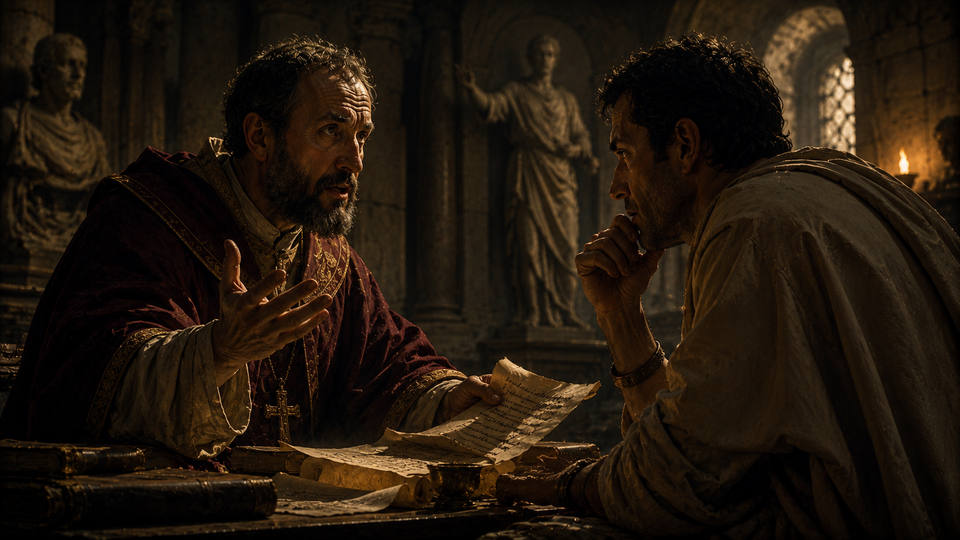
Growing up surfing in Southern California, I used to hear people complain about the lack of seasons. No real winter, no real change — just endless mild, sunny days. And every time, I'd ask them: do you actually want it to suck for three months a year? Because when I lived in Philly, I finally got real winters. And you know what happened? I appreciated summer so much more. There's an old argument buried in that complaint, and it turns out to be one of the oldest responses to the Problem of Evil in human history.
Could it be that we need winter to know what summer even is? And could it be, in the same way, that we need evil in order to have good — or at least to understand what good is in the first place? Let's consider it.
Quick Review
Back in Episode 2, I laid out the Logical Problem of Evil like this:
- If God exists, He could prevent evil (because He's all-powerful and all-knowing).
- If God exists, He would prevent evil (because He's all-good).
- So if God exists, evil doesn't exist.
- Evil exists.
- So God doesn't exist.
Since then we've been testing premise (2) and (3) with different possible reasons God might allow evil. Today's candidate is an old one: maybe good and evil are just two sides of the same coin, and you can't have one without the other.
Meet the Manichaeans
When I used to teach this material in the classroom, I'd ask students to come up with their own responses to the Problem of Evil before I gave them the textbook answers. Almost every single time, somebody would say some version of: "Well, you need evil to have good. They're linked." It's such a natural thought that people arrive at it independently, without ever having heard of the actual historical movement that gave this idea its name.
That movement is Manichaeism, founded by a Persian prophet named Mani, who lived in the 3rd century AD (roughly 216–274 AD) in the Sasanian Empire, in what is now Iran and Iraq. Mani drew on Zoroastrianism (the dominant Persian religion of the time, which already featured a cosmic struggle between the god of light, Ahura Mazda, and the spirit of darkness, Angra Mainyu), along with strands of Christianity and Buddhism, into a sweeping new religion that spread remarkably far for its era — west into the Roman Empire, east all the way to China.
At the heart of Mani's system was a radical dualism: the universe is the battleground of two co-eternal, opposed principles — Light (good) and Darkness (evil). They aren't one thing and its absence; they're two independent, competing substances locked in permanent cosmic combat. A fun historical footnote: the young Augustine of Hippo (354–430 AD), before becoming one of Christianity's most important theologians, was actually a Manichaean for about nine years before rejecting it — and it was partly his wrestling with this dualism that produced one of his most important contributions to philosophy, which we'll get to shortly.
For this video, I'm not interested in the whole Manichaean religious system — the ascetic practices, the elaborate cosmology. I'm just borrowing one piece: the idea that there's a necessary ontological link between good and evil, such that good can't exist without evil existing too. Call this the Manichaean Defense.
The Argument
Stated simply:
- Evil is necessarily tied to goodness, such that in order for good to exist, evil must also exist.
- It is good for there to be goodness.
- So, possibly, God allows evil so that there can be goodness.
It's the philosophical cousin of "you can't have light without dark."
Objection 1: False Ex Hypothesi
Remember the setup of the Logical Problem of Evil: we're granting, for the sake of argument, that God exists — all-good, all-knowing, all-powerful — and God then creates a world that contains evil.
But notice: on this very hypothesis, God exists before the world does, and God is all-good. That means we already have a case of goodness existing with zero evil in the picture — just God, alone, prior to creation. If theism is true, good and evil are demonstrably not "two sides of the same coin," because infinite good sat there for eternity with no evil to pair with it. Philosophers call this an argument being "false ex hypothesi" — false given the very hypothesis under consideration. The Manichaean Defense assumes the two must always travel together, but classical theism itself is a counterexample before creation even starts.
Objection 2: The Marshmallow World
Here's a second angle. Picture God creating a world that consists of nothing but a floating field of marshmallows. No sentient beings, no suffering, no moral agents — just a genuinely good, pleasant thing existing, with no evil anywhere in it. That's a coherent, describable possible world. It's good, and it has no evil in it. If that's even possible, the "necessary link" the Manichaean Defense needs simply isn't necessary.
You might object: "But that world has no free creatures, so it's a cheap example — the interesting claim is that a world with free creatures and moral goodness requires evil." That's a fair pivot, and it's really importing the Free Will Defense from Episode 8. But notice that's a different argument. The point of this objection to the Manichaean Defense specifically is narrower: it shows evil isn't required for good of any kind whatsoever to exist. The Manichaean claim was a metaphysical, universal claim about goodness itself — and one marshmallow-world counterexample sinks a universal claim.
Objection 3: Is the Link Even Real?
Now for the deepest objection. Is there actually a necessary metaphysical connection between good and evil, the way there supposedly is between light and dark?
Except — is there even one between light and dark? Think about it: darkness is just the absence of light. You could, in principle, imagine a small universe packed edge-to-edge with photons, with no shadow or absence anywhere in it — pure light, no dark. Darkness isn't a rival substance competing with light; it's a privation, a lack.
This suggests a very different picture of evil than the Manichaean one — a view historically associated with Augustine (who, remember, spent years as a Manichaean before rejecting it): the Privation View, sometimes called the Augustinian View of Evil. On this view, evil isn't positive "stuff" locked in combat with goodness — it's a lack, a failure of a thing to be the way it ought to be. A tumor isn't an evil substance; it's healthy cells failing to function properly. Blindness is the absence of sight where sight should be. We could even say the amount of evil something has equals the degree to which it fails to be what it should be. If this is correct, good doesn't require evil to exist, because evil isn't really a "thing" that needs a counterpart — it's just goodness, missing.
Compare the two pictures:
- Manichaean View: Good and Evil are both real, positive, cosmic entities, necessarily linked, locked in struggle.
- Privation View: Only good, positive being truly exists. Things are supposed to be a certain way, and evil is simply their falling short of that.
I find the Privation View considerably more plausible. But even setting that preference aside, there's a burden-of-proof problem for the Manichaean: why should we think this necessary ontological link exists in the first place? There's no obvious argument for it — it's simply asserted. Without independent support, the Manichaean Defense doesn't get off the ground.
So I think the Manichaean Defense, as originally stated, fails.
But Wait — There's a Better Version
Here's where it gets interesting. Even though the metaphysical claim fails, there might be a genuinely successful epistemological cousin of it.
Go back to that world of pure, undiluted light with no shadow anywhere. Even if such a world is metaphysically possible, ask yourself: would the people living in it actually know what light was? It's hard to imagine, because in our experience, light always comes bundled with contrast and shadow. In that all-light world, people might have no concept of light at all — or at best, it would be something they'd take completely for granted, like trying to explain to someone, "This invisible stuff around you — pretend it's actually there, we just can't see it."
Or consider an intelligent fish that has spent its whole life underwater and never breached the surface. Could it develop a concept of "wet"? What would wetness even mean to a creature with no experience of dryness? This is basically the predicament metaphysicians face when they try to talk about being itself — existence as such. Everything we can point to already exists, so how do we even form a contrastive concept of nonexistence to compare it to?
So: would we know there was such a thing as goodness if we'd never experienced its absence? Possibly not. At the very least, it would be extremely difficult to think about clearly.
Propositional vs. Experiential Knowledge
This gets at a distinction between two kinds of knowing. Propositional knowledge is knowing that a statement is true — I know the proposition "warm weather is awesome" is true. Experiential knowledge is having actually lived through both the presence and the absence of the thing, such that the contrast leaves you with a genuine sense of awe or appreciation. I can affirm the proposition about warm weather intellectually, but only experiential knowledge lets me really confirm it, feel it, appreciate it in my bones. Experiential knowledge, plausibly, includes propositional knowledge as a subset — but not the other way around.
That gives us a new argument:
- Propositional knowledge can, at best, yield a theoretical understanding of the good.
- Experiential knowledge yields appreciation and enjoyment of the good.
- So, experiential knowledge is (all else being equal) better than propositional knowledge.
- So, possibly, God allows evil so that we can genuinely appreciate and enjoy the good — something we couldn't do without it.
Call this the Epistemological Manichaean Defense. It doesn't claim good metaphysically requires evil. It claims that our full, felt appreciation of the good requires the contrast evil provides.
Two Objections to the Epistemological Version
Objection: Doesn't this make sin good? If experiencing evil gives us this valuable appreciation, does that mean committing evil is actually good for us? Not quite. We can gain experiential knowledge of evil without ourselves committing it — by suffering it, witnessing it, or living through its consequences. Even if the resulting knowledge is valuable, the deed itself can remain fully bad. A man who studies the Holocaust and gains a profound, gut-level appreciation for the evil of genocide hasn't thereby made genocide good.
Objection: I'd rather just trust God about goodness than get direct experience of evil. A fair preference, but we've never actually been in a position to compare, so we can't be sure that's what we'd prefer if we truly understood the trade-off. And even if it is our honest preference, that doesn't settle whether it's genuinely good for us — I have plenty of preferences that are bad for me. If experiential knowledge of the good really is valuable, God might allow some evil for its sake even against our stated wishes, the way a good parent sometimes overrides a child's preferences for the child's own benefit.
My Take
I think the strict Manichaean Defense — the metaphysical claim that good and evil are necessarily linked — is a clear failure. Theism itself, prior to creation, is a counterexample to it, and the Privation View gives us a much more plausible account of what evil actually is.
But the Epistemological Manichaean Defense? I think there's real substance there. I don't think it's the whole answer to the Problem of Evil, and I definitely don't think it accounts for every evil that exists in this world. Some suffering seems to go well beyond anything needed to help us appreciate goodness. But for at least some evils, I think this genuinely holds up. Moving away from sunny Southern California and living through real Philadelphia winters didn't just teach me a fact about summer — it gave me an experiential appreciation for it I'd never had before.
This is only one possible piece of the puzzle. Stay tuned, because we've got several more reasons to consider.