
Waste of Resources
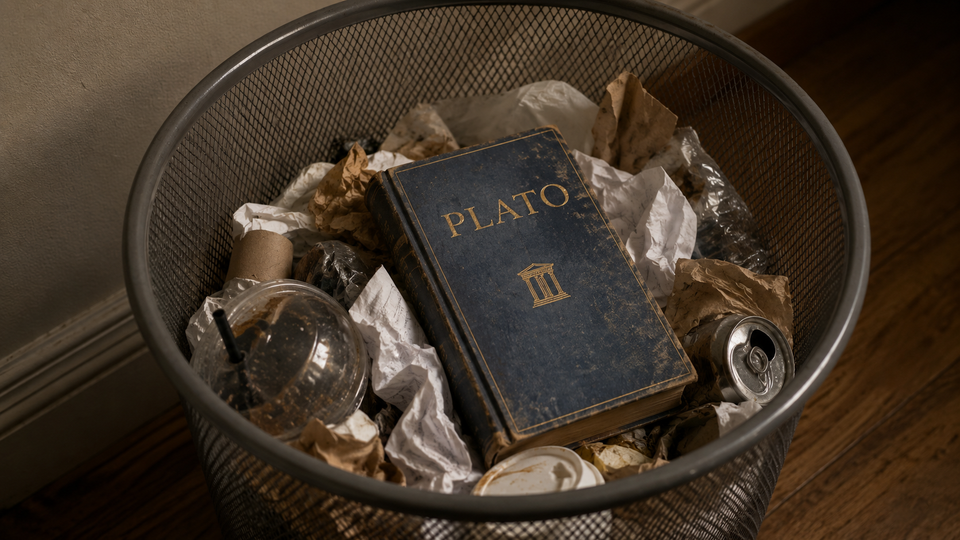
Colleges set aside real money so that philosophers can sit in their armchairs and think about stuff. That money could be feeding hungry kids, funding cancer research, or building wells in villages without clean water. Shouldn’t it?
It’s a fair question. Before defending the discipline I’ve given my life to, I want to take the objection seriously — not the cartoon version, but the strongest form of it.
The Steelman
The most rigorous version of this argument doesn’t come from people who hate the humanities. It comes from philosophers themselves — specifically, the effective altruism movement. Peter Singer’s drowning child thought experiment runs like this: if you walked past a child drowning in a shallow pond, you’d ruin your shoes to save her. The cost is real but obviously worth it. Now consider that thousands of children die every day — of malaria, starvation, dirty water — and a donation roughly the cost of those shoes could prevent it. Distance and statistics don’t change the moral math. If you wouldn’t walk past the pond, why are you walking past the global version?
Will MacAskill develops this further in Doing Good Better and What We Owe the Future. Sharpened: every hour and every dollar has an opportunity cost measured in lives. A philosophy department’s budget could fund anti-malarial bed nets. A philosophy professor’s salary could pay several public health workers. If you accept this framework, philosophy isn’t just unhelpful — it’s actively complicit in preventable suffering.
That is the strongest form of the objection. Let me try to answer it.
The Hidden Premise
Notice what the objection has to assume before it can even get started. Calling something “wasteful” requires a standard of what counts as flourishing. Wasteful relative to what? Saving lives is the proposed answer — but why is saving lives the metric? Why not maximizing pleasure? Why not glorifying God? Why not passing on your genes? Why not creating beautiful things that will outlast you?
Each of those is a real position. People have lived and died defending them. To say “we should spend resources curing disease rather than thinking about virtue” is already to have taken sides in a deeply contested debate about what human life is for.
David Hume put this sharply almost three centuries ago: you cannot derive an ought from an is. No collection of facts about the world — how many children die, how cheap a bed net is, how many quality-adjusted life years are gained per dollar — can on its own generate the conclusion that we ought to do anything about it. You need a prior commitment about what matters and why. That commitment is not a scientific finding. It is a philosophical one.
So the person who confidently announces that philosophy is a waste is already doing philosophy. They’ve just stopped paying attention to themselves doing it. They’ve smuggled in a whole theory of the good — usually some version of welfare consequentialism — and acted as if it were obvious. It isn’t obvious. Defending it is the kind of thing philosophers do.
What Philosophers Actually Built
Take a moment and look around. Then ask which parts of the world you live in were built by philosophers sitting in armchairs.
John Locke’s Second Treatise shaped the Declaration of Independence almost line by line. Madison and Jefferson were reading philosophy when they wrote the documents that founded the country.
Adam Smith is famous for The Wealth of Nations. He held a chair in moral philosophy and wrote The Theory of Moral Sentiments first. Modern economics emerged from his philosophical work on what humans owe each other.
The device you’re reading this on runs on logic gates. Those gates exist because Gottlob Frege, Bertrand Russell, and Ludwig Wittgenstein spent careers reworking the foundations of logic. Their work fed directly into Alan Turing’s, and Turing’s into the computer. Frege didn’t think he was inventing the smartphone. He was sitting in an armchair, thinking about stuff.
Modern medicine, which is exactly what the objection wants more of, runs on bioethics. Whether to remove a feeding tube, when consent is meaningful, how to allocate ventilators during a pandemic — these decisions are made every day in hospitals using frameworks developed by philosophers. Without that work, there is no IRB, no informed consent, no medical ethics committee at all.
Hannah Arendt thought carefully about totalitarianism after the war and gave us much of the vocabulary we still use to recognize it when it appears. Martin Luther King Jr. studied personalism in seminary; his “Letter from Birmingham Jail” cites Aquinas explicitly. Every human rights framework on the planet rests on philosophical foundations laid by Stoics, Christians, Kantians, and others arguing about the dignity of persons.
You can call that armchair work if you want. The chairs have done a lot.
The Surfboard Question
Here is where the thought experiment from the video comes back. Imagine a young woman with the intellectual gifts to cure a major disease. She enrolls in college, takes Phil 200, falls in love with philosophy, and decides to spend her life thinking and teaching instead of in a lab. Has she done something wrong? Has her professor done something wrong by inspiring her?
The honest answer depends on what human life is for. And that is the question she is now spending her life on.
I like to think of it this way. Suppose someone hands you a surfboard with fins on the bottom. You can use it as a coffee table. You can use it as kindling. You can puzzle for years over why anyone would put fins on a perfectly good coffee table. Or you can ask the person who made it what it is actually for — and a lot of confusion clears up at once.
Religion answers this through authority: the maker tells you what the board is for, and if you trust him, you trust the answer. Philosophy works the other direction — figuring out, by careful thought, what the thing seems built to do. Both matter. Both are how human beings have asked the question that lets us tell use from waste in the first place.
Resources are only wasted relative to a goal. The goal of a human life is precisely the question philosophy was invented to ask.
“But Life Without Humanities Is Miserable”
There is a softer defense available, and it is worth naming. Plays, movies, music, novels — almost no one calls these wasteful, and they’re often less obviously useful than philosophy. Feral children grow up with food and shelter and we wouldn’t wish their lives on anyone. Humans seem to need more than calories.
Two things to notice. First, the EA-style objection cuts against movies and music too. If you are going to be consistent, every dollar spent on a Marvel film is a dollar that could have gone to mosquito nets. The fact that almost no one is willing to be consistent here suggests the original objection isn’t actually about resource allocation. It is about whether philosophy specifically earns its keep — which is a question of taste, not ethics.
Second, you are reading this on YouTube (or wherever else you found it). You are not currently working a second shift to fund cholera treatment in South Sudan. I am not either. The fact that we both feel some pull toward thinking carefully about meaning, even when we could be doing something more efficiently altruistic, is itself data. Maybe the pull is telling us something true about what we are for.