
What Socialism Actually Is: A Philosophical Examination
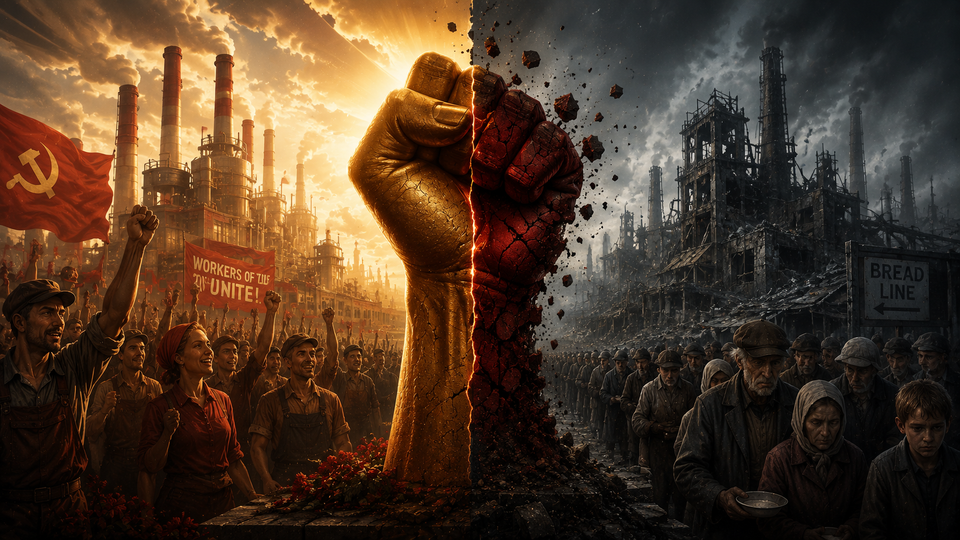
Imagine you work in a factory. You show up every day, operate the machinery, and produce chairs. At the end of the month, the chairs sell for $100,000. Your paycheck? $3,000. The owner of the factory, who hasn't touched a lathe in years, pockets the difference. Is that arrangement just?
A socialist says no. A capitalist says yes. And the disagreement between them turns out to rest not on economics but on some of the deepest questions in philosophy: questions about property, freedom, justice, and what human beings are for. In this post, I want to walk through the philosophy of socialism carefully, present the strongest arguments on both sides, and explain why I think the weight of reason falls decisively against it. I also want to clear up three confusions that plague almost every public conversation on this topic: the difference between socialism and a welfare state, the relationship between socialism and communism, and whether the Nordic countries are actually socialist.
What Socialism Is (And What It Is Not)
The first thing to get right is the definition, because getting it wrong poisons everything that follows. Socialism, as a philosophical and economic position, is a claim about ownership. It holds that the means of production (the factories, the land, the machinery, the raw materials used to produce goods and services) should be owned collectively, by the workers, the community, or the state, rather than by private individuals.
That is the core idea. Everything else follows from it. And notice what it does not include. Socialism, in its strict philosophical definition, is not about taxes. It is not about government programs. It is not about healthcare or education or food stamps. Those are features of a welfare state, which is a completely different thing. Socialism is specifically about who owns the means of production. Calling a welfare state "socialist" is like calling a vegetarian a vegan because they both eat salads. The categories overlap at the margins, but they are not the same thing, and conflating them makes serious conversation impossible.
Socialists draw a further distinction that often gets lost in popular debate: the difference between private property and personal property. When a socialist says she wants to abolish "private property," she does not mean your house, your car, or your toothbrush. Those are personal property, things you use and enjoy directly. What she means is productive property: the factory, the farm, the oil well, the rental apartment building. Things that generate wealth through other people's labor. The distinction goes all the way back to Marx himself, who wrote in the Communist Manifesto (1848) that "the distinguishing feature of communism is not the abolition of property generally, but the abolition of bourgeois property." This distinction is philosophically significant because it rests on a specific moral claim: that there is something different, morally speaking, about owning a thing you personally use versus owning a thing that other people use to generate wealth that you then collect. Whether that moral claim holds up is another matter.
The Philosophical Engine: Marx
Socialism did not appear out of nowhere. It arose as a reaction to the Industrial Revolution, and its earliest thinkers, Henri de Saint-Simon (1760-1825), Charles Fourier (1772-1837), and Robert Owen (1771-1858), envisioned cooperative communities where labor would be organized by passion and talent rather than by market forces. Marx and Engels later dismissed these thinkers as "utopian socialists," too idealistic and too disconnected from a rigorous analysis of how capitalism actually works. Marx set out to provide that analysis himself, and what he produced remains the philosophical engine of virtually every serious version of socialism since.
Marx's starting point is the labor theory of value, which he inherited from the classical economists Adam Smith (The Wealth of Nations, 1776) and David Ricardo (On the Principles of Political Economy and Taxation, 1817). The idea is that the exchange value of a commodity is determined by the quantity of socially necessary labor time required to produce it. A chair is worth more than a stick because it takes more labor to make. Marx takes this theory and asks a pointed question: if labor is the source of value, and the worker is the one performing the labor, then why does the factory owner get to keep most of the value?
His answer is the theory of surplus value, laid out systematically in Das Kapital (Volume I, 1867). A worker spends eight hours at the factory. In the first four hours, she produces enough value to cover her own wages (what Marx calls "necessary labor time"). But she works four more. The value she produces in those extra hours goes to the owner. That surplus, on Marx's view, is not a reward for risk or entrepreneurship. It is unpaid labor. It is exploitation, built into the basic structure of the capitalist relationship.
It is worth noting that the labor theory of value was challenged almost immediately after Marx by the marginalist revolution in economics. Eugen von Böhm-Bawerk, in his Karl Marx and the Close of His System (1896), argued that Marx's theory could not explain why goods requiring equal labor time often command wildly different prices, and that value is actually determined by marginal utility, the subjective usefulness of the next unit of a good to the consumer, not by the labor embedded in it. William Stanley Jevons (The Theory of Political Economy, 1871), Carl Menger (Principles of Economics, 1871), and Léon Walras (Elements of Pure Economics, 1874) all independently arrived at versions of marginalist theory around the same time. Today, the labor theory of value is rejected by the vast majority of professional economists, though it retains adherents among Marxist philosophers and some heterodox economists. The exploitation argument, which is the moral heart of socialism, rests on a theory of value that most economists regard as fundamentally mistaken.
Marx's second major contribution is the concept of alienation, developed most fully in his Economic and Philosophic Manuscripts of 1844 (published posthumously in 1932). Under capitalism, Marx argued, the worker is alienated in four ways: from the product of her labor (she makes it but someone else owns it), from the process of labor (she does not control how she works), from her species-being or Gattungswesen (a concept borrowed from Ludwig Feuerbach, referring to the distinctly human capacity for free, creative, conscious production), and from other human beings (capitalism structures relationships as competitive rather than cooperative). This fourfold alienation is one of Marx's most enduring ideas, and it connects to a philosophical tradition reaching back to Aristotle's concept of eudaimonia (human flourishing) and forward to the existentialist and communitarian critiques of modernity.
The final piece of Marx's philosophical engine is historical materialism: the theory that the fundamental driver of historical change is not ideas, not culture, not great individuals, but the material conditions of production. Every society has a base (the economic structure) and a superstructure (the political institutions, legal systems, religions, and ideologies that sit on top of it). Marx's controversial claim is that the base determines the superstructure. Your society's laws, politics, and moral philosophy are, in the final analysis, shaped by the economic interests of the class that controls production. Karl Popper mounted one of the most influential critiques of this theory in The Poverty of Historicism (1957), arguing that historical materialism is not genuinely scientific because it generates unfalsifiable predictions and treats historical "laws" as analogous to the laws of physics, when in fact history does not repeat in law-like ways.
The Strongest Arguments for Socialism
The case for socialism rests on four arguments that deserve to be stated at their full strength.
The first is the exploitation argument, which we have already seen. If labor is the source of value, and the capitalist systematically appropriates the value that the worker creates, then the basic structure of capitalism is unjust. The force of this argument lies in its simplicity, but it depends entirely on the labor theory of value. If value is determined by marginal utility rather than embedded labor, the exploitation argument loses its foundation. The factory owner contributes capital, organization, and risk-bearing, all of which arguably create value that the worker's labor alone cannot explain.
The second is the equality argument. Under capitalism, wealth tends to concentrate. The rich get richer, partly through returns on capital and partly through political influence. Thomas Piketty, in Capital in the Twenty-First Century (2013), provided extensive empirical evidence that when the rate of return on capital exceeds the rate of economic growth (his famous inequality r > g), wealth concentration tends to increase over time, potentially without limit. The socialist argues that genuine political equality is impossible without substantial economic equality, and that economic equality is impossible so long as the means of production are privately owned. This is a genuinely powerful argument, and even those who reject socialism should take the underlying concern seriously.
The third is the alienation argument. Even if capitalism were perfectly efficient and distributed wealth more equally, it would still be objectionable because of what it does to human beings as human beings. It turns creative, purposeful, social creatures into interchangeable units of labor, valued only for their productive output, stripped of meaningful connection to their work and to each other. This argument connects to Aristotle, to Hegel's master-slave dialectic in the Phenomenology of Spirit (1807), and to the broader philosophical tradition that holds human life is about the development and exercise of distinctly human capacities: creativity, reason, community, and purpose.
The fourth is the democracy argument. Why should workplaces be dictatorships? In a democratic country, you get a vote. The government cannot tell you what to think or how to spend your time. But walk through the factory doors and one person (the owner) makes every significant decision about your working life. The socialist asks: if dictatorship is wrong in politics, why is it acceptable in economics? This argument does not require you to accept the labor theory of value or historical materialism. All it requires is a commitment to democratic self-governance and the observation that the decisions affecting most people's daily lives most directly are made at work, not in a legislature. G.A. Cohen, in Why Not Socialism? (2009), pressed a version of this argument by asking why the cooperative norms we take for granted on a camping trip (sharing, contributing according to ability, taking according to need) should be abandoned the moment we scale up to an economy. His challenge is deceptively simple: if socialism is the natural way to organize a camping trip, what exactly changes when we add more people?
The Case Against Socialism
The case for socialism rests on a powerful diagnosis: capitalism generates inequality, alienation, and exploitation. I think the diagnosis has real merit. Where socialism fails, and fails catastrophically, is in the prescription. The cure is worse than the disease. Here is why.
The most devastating objection is the economic calculation problem, articulated by the Austrian economist Ludwig von Mises in his 1920 paper "Economic Calculation in the Socialist Commonwealth." Mises's argument is elegant. Rational economic planning requires comparing the costs and benefits of alternative uses of resources. Comparing costs and benefits requires prices for the means of production. Genuine prices arise only from market exchange between private owners. Under socialism, the means of production are collectively owned and not exchanged on a market. Therefore, under socialism, there are no genuine prices for capital goods, and rational economic planning becomes impossible.
The point is not that socialist planners are stupid or corrupt. They might be brilliant and well-intentioned. The point is that they are blind. Without market prices, they have no way to know the relative value of different resources, no way to determine whether using steel to make cars is more valuable than using it to make bridges, no way to calculate whether a given production process is efficient or wasteful.
The socialist economist Oskar Lange attempted a response to Mises in "On the Economic Theory of Socialism" (1936-37), proposing a model of "market socialism" in which a Central Planning Board would set prices by trial and error, raising prices when shortages appeared and lowering them when surpluses accumulated, mimicking the price-adjustment mechanism of a real market. Mises and Hayek both argued that this response missed the point. The trial-and-error process Lange described would be too slow, too information-poor, and too disconnected from the tacit, dispersed knowledge of actual market participants to achieve anything like the coordination that real markets produce. The debate remains one of the most important exchanges in the history of economic thought, but the weight of both theoretical argument and historical evidence has fallen heavily on the Mises-Hayek side.
Friedrich Hayek extended the argument in "The Use of Knowledge in Society" (1945) by pointing out that the problem is not just about calculation but about knowledge. The knowledge needed to allocate resources efficiently is dispersed across millions of individuals, and much of it is tacit: the local baker's knowledge of her customers' preferences, the foreman's knowledge of which machine is starting to wear out, the fisherman's knowledge of where the fish are running this week. This knowledge is local, particular, constantly changing, and often inarticulate. No central planner can possess it. The price system aggregates this dispersed knowledge into a single signal (the price) that any individual can act on without needing to understand the full picture. Central planning cannot replicate this because the relevant knowledge does not exist in a centralizable form.
The third objection concerns incentives. If everyone shares in the output equally regardless of individual effort, what incentive does any individual worker have to work hard, innovate, or take risks? The socialist will reply that people are motivated by more than personal gain: by pride, community, purpose, solidarity. And that is true. But it is one thing to say that some people sometimes work hard for reasons other than personal gain. It is another thing to build an entire economic system on the assumption that most people most of the time will do so. Robert Nozick, in Anarchy, State, and Utopia(1974), offered a different kind of challenge to socialist redistribution through his famous Wilt Chamberlain argument. Even if you start with a perfectly equal distribution of resources, free exchanges between consenting adults will naturally produce inequality. If a million people each voluntarily pay twenty-five cents to watch Wilt Chamberlain play basketball, Chamberlain ends up with $250,000 and everyone else has a quarter less. Is that unjust? Nozick argued that any patterned distribution (including socialist equality) can only be maintained by continuous interference with people's free choices, which is itself a deep violation of liberty.
The fourth objection is philosophical rather than economic, and it cuts deep. Private property is not just an economic institution. It is a foundation of individual liberty. If the state or the collective owns all productive property, then the state controls the means by which individuals earn a living. And a government that controls your livelihood controls you. You cannot dissent from a government that can fire you. You cannot organize opposition to a regime that owns the printing press, the broadcast station, and the factory where you work. John Locke, in the Second Treatise of Government (1689), argued that property rights are natural rights, grounded in the act of mixing one's labor with natural resources. On Locke's view, the right to property is not a social convention that the state may revoke at will; it is a pre-political right that the state exists to protect. Hayek made the complementary argument in The Road to Serfdom (1944) that economic planning inevitably leads to political tyranny, because the concentration of economic power gives the state leverage to control every other aspect of life.
Finally, the historical track record demands explanation. Every attempt to implement full socialism at scale has produced some combination of economic stagnation, political repression, and humanitarian catastrophe. The Soviet Union, Maoist China, Cambodia under the Khmer Rouge, Cuba, Venezuela, North Korea. The details differ, but the pattern is remarkably consistent. Socialists typically respond that these were not "real socialism," or that they were corrupted by authoritarian leaders. But if every attempt to implement your theory produces the same disastrous results, at some point you have to consider the possibility that the theory itself is flawed, that there is something about socialism that tends toward these outcomes. The calculation problem, the knowledge problem, the incentive problem, and the freedom problem all predict exactly the outcomes we observe. The track record is not an unlucky coincidence. It is the theory working itself out in practice.
Socialism, Communism, and the Democratic Question
For Marx, socialism and communism were two phases of the same historical process. Socialism was the lower phase: workers seize the means of production, the state persists under working-class control (the "dictatorship of the proletariat"), and resources are distributed according to contribution. Communism was the higher phase: the state "withers away," classes dissolve entirely, and resources are distributed according to need. Lenin took this framework and made it operational in The State and Revolution (1917), arguing that a revolutionary vanguard party was needed to guide society through the transition. In practice, no communist state ever reached the higher phase. The state never withered away. The dictatorship of the proletariat became just dictatorship.
"Democratic socialism" is the idea that collective ownership should be achieved through elections, legislation, and gradual reform rather than revolution. The intellectual roots trace back to Eduard Bernstein (1850-1932), who broke with orthodox Marxism in Evolutionary Socialism (1899), arguing that Marx's predictions were wrong and that socialists should work within democratic institutions. The crucial question is whether "democratic" changes the substance or only the strategy. If the goal is still to transfer ownership of the means of production from private individuals to the collective, then all the objections discussed above apply with full force. An economy without private ownership of capital goods has the same structural problems whether it was established by a revolution or by a parliamentary vote.
And this is where the most common confusion in American politics arises. When Bernie Sanders points to Denmark and says "that's what I want," he is pointing to a social democracy, not a socialist state. A social democrat does not want to abolish private ownership of the means of production. She wants to keep capitalism but regulate it heavily, tax it progressively, and use the revenue to fund public goods. Denmark has private corporations, a stock exchange, billionaires, and extensive private ownership of productive resources. It also has high taxes and generous public services. That is social democracy. It is not socialism.
In 2015, Danish Prime Minister Lars Løkke Rasmussen addressed this confusion directly in a speech at Harvard's Kennedy School of Government: "I know that some people in the US associate the Nordic model with some sort of socialism. Therefore I would like to make one thing clear. Denmark is far from a socialist planned economy. Denmark is a market economy." The Nordic countries are capitalist welfare states. They are evidence that capitalism with a generous welfare state can work under certain conditions. They are not evidence that socialism works.
Where This Leaves Us
Socialism is a serious philosophical position with a powerful diagnosis of real problems. Capitalism does generate inequality. It does produce alienation. It does create situations in which workers have very little power relative to the people who employ them. If socialists were only making a diagnosis, the position would deserve a great deal of sympathy.
But socialism is not just a diagnosis. It is a prescription. And the prescription, collective ownership of the means of production, creates problems far worse than the ones it solves. Without private ownership, you lose the price system, and without the price system, rational economic planning becomes impossible. The knowledge needed to coordinate a complex economy is dispersed and tacit in ways no central authority can aggregate. Individual incentives to innovate and work hard are gutted when rewards are collectivized. And the concentration of all productive property in the hands of the state eliminates the material foundation of individual independence, opening the door to authoritarianism.
Does this mean capitalism is perfect? Of course not. Capitalism has real problems, and serious people should think seriously about how to address them: through regulation, through a genuine safety net, through labor protections, through antitrust enforcement, through the kinds of institutions that prevent the concentration of wealth from becoming the concentration of power. John Rawls, in A Theory of Justice (1971), offered what remains perhaps the most sophisticated attempt to reconcile market economies with distributive justice through his difference principle: inequalities are permissible only if they benefit the least advantaged members of society. That is not socialism. It is a principled framework for constraining capitalism's worst tendencies while preserving its irreplaceable virtues.