
Zeno's Achilles and the Tortoise: Why Motion Is Impossible (and Why You Should Care)
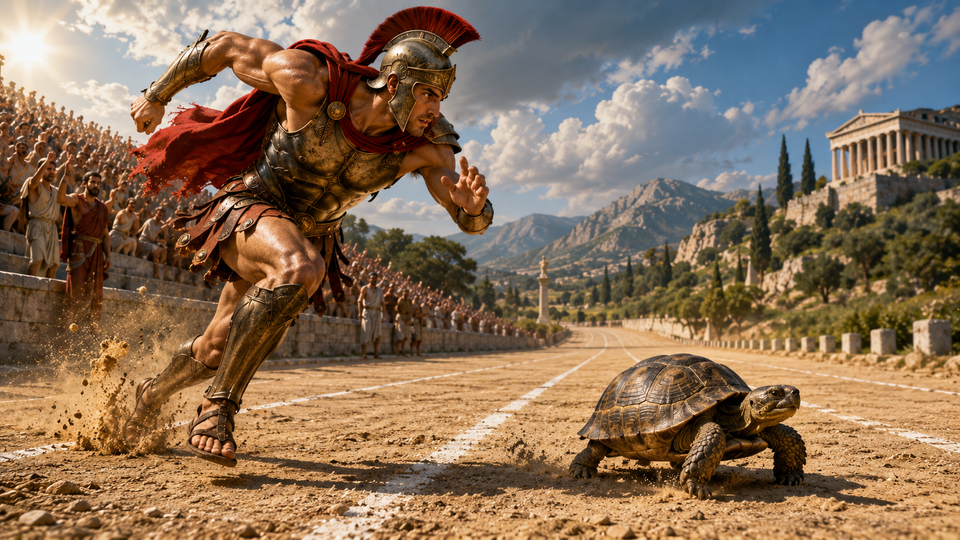
You can beat anyone in a race. You just have to know the secret. Unfortunately, the secret involves proving that your opponent can never cross the finish line. Even more unfortunately, the same proof applies to you. Welcome to Zeno's paradox of Achilles and the Tortoise.
The Paradox
Achilles, the fastest runner in Greek mythology, races a tortoise. Being a good sport, he gives the tortoise a head start. Now Zeno asks: can Achilles catch the tortoise?
Before Achilles can overtake the tortoise, he must first reach the point where the tortoise started. But by the time he gets there, the tortoise has moved ahead. Now Achilles must reach the tortoise's new position. But by the time he gets there, the tortoise has moved again, a smaller distance, but still forward. And so on, ad infinitum.
Achilles must complete infinitely many tasks (reaching each successive position of the tortoise) before he can catch up. But how can anyone complete infinitely many tasks? Therefore, Zeno concludes, Achilles never catches the tortoise. Motion is impossible.
Zeno of Elea
Zeno of Elea (c. 490-430 BC) was a student of Parmenides, who had argued that reality is fundamentally unchanging and that all change and motion are illusions. Zeno's paradoxes were designed to defend this view by showing that the common-sense belief in motion leads to absurdity.
The Achilles is one of about forty paradoxes that Zeno reportedly devised, though only a handful survive in detail. Aristotle, who discusses them in the Physics, considered them serious enough to warrant careful refutation.
The Problem of Infinite Divisibility
The force of the paradox comes from infinite divisibility. Between any two points, there are infinitely many intermediate points. If Achilles must pass through each one, he must complete infinitely many steps. And the intuition is that infinitely many steps cannot be completed in finite time.
This is not unique to Greek thought. Hindu and Buddhist philosophers reached remarkably similar conclusions. In Vedantic philosophy, the world of change and motion is maya, illusion. True reality (Brahman) is unchanging and indivisible. The Buddhist philosopher Nagarjuna argued that motion is conceptually incoherent: an object cannot move where it already is (because it is already there) and cannot move where it is not (because it is not there). These parallel discoveries suggest that the paradox touches something deep in the structure of thought itself.
Mathematical Response: Convergent Series
The standard modern response relies on the mathematics of convergent series. Yes, Achilles must cross infinitely many intervals. But those intervals get smaller and smaller, and their sum converges to a finite value.
If the tortoise has a 10-meter head start and Achilles is ten times faster, the intervals Achilles must cross are: 10, 1, 0.1, 0.01, 0.001, ... meters. The sum of this infinite geometric series is 10/(1 - 1/10) = 100/9 meters, approximately 11.11 meters. Achilles catches the tortoise at a definite, finite point, in a finite amount of time.
The mathematics is beyond dispute. But some philosophers argue that it does not fully resolve the paradox. The mathematical solution shows that the sum is finite, but it does not explain how infinitely many tasks are completed. It treats the infinity as a mathematical abstraction (a limit) rather than as a concrete series of physical events.
The Philosophical Residue
The question that lingers is this: is physical space actually infinitely divisible, or does the infinite divisibility exist only in our mathematical models? If space is continuous (infinitely divisible), then Achilles really does pass through infinitely many points, and we need an account of how that is possible. If space is discrete (made of indivisible units, as some physicists speculate with the Planck length), then the paradox dissolves because the number of steps is finite.
We do not currently know which answer is correct. The paradox of Achilles and the Tortoise, devised nearly 2,500 years ago, remains a live question at the intersection of mathematics, physics, and philosophy.
Suggested Reading
Aristotle, "Physics" Book VI. The earliest detailed discussion of Zeno's paradoxes.
Wesley Salmon, ed., "Zeno's Paradoxes" (Hackett). A classic collection of essays on the paradoxes.
A.W. Moore, "The Infinite" (Routledge). A philosophical history of infinity from the Greeks to the present.
Jonathan Barnes, "The Presocratic Philosophers" (Routledge). Rigorous treatment of Zeno and his context.