
Zeno's Paradox of Motion
I ran the anchor leg of the 4x400 at the CIF Finals my senior year of high school. We were in seventh and I was tired of pacing. I figured: forget strategy, I'm getting a medal — and I bust out faster than I'd ever run. On the home stretch I actually caught the guy ahead of me, and that's when a kid from Brethren Christian blew past from behind and smoked me. Best split of my life. Still got beat.
About 2,500 years ago a Greek philosopher named Zeno of Elea wrote down an argument that, if I'd known about it at the time, would have made me feel slightly better. According to Zeno, I should not have been able to be caught from behind. Nobody should. The thing that just happened to me — and to every runner who's ever lost a race in the final stretch — is actually impossible.
Here's how the argument goes.
The Race You Cannot Lose
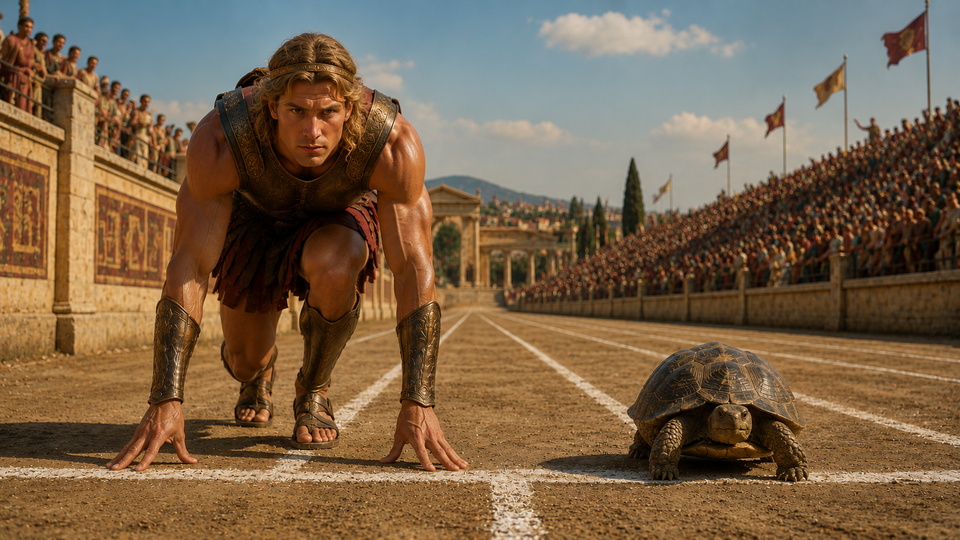
Suppose Achilles, the fastest of the Greeks, agrees to race a tortoise, and gives the tortoise a head start. Common sense says he'll catch up easily. Zeno says: think again.
By the time Achilles reaches the spot where the tortoise started, the tortoise has crept forward a little. So Achilles isn't caught up yet — he has to cover that new distance. But by the time he reaches that next spot, the tortoise has crept forward again. A little less, but still some. And again. And again. Achilles is always closing the gap, but there is always a smaller gap left to close. He never quite catches up.
This is not a parlor trick. It's a serious argument, and it leads to a serious conclusion. Either Achilles can't catch the tortoise — which is obviously false, because runners catch other runners all the time — or something is deeply wrong with how we're thinking about motion.
Zeno bites the bullet. He says: motion is the thing that's wrong. What you think you see when you watch a race is an illusion. There isn't really any moving from point A to point B, because to do that you'd have to complete infinitely many sub-trips, which is impossible.
"But Calculus Solved This"
People often respond that mathematics handles this fine. The infinite series 1/2 + 1/4 + 1/8 + … converges to 1. Sum up the infinitely many sub-trips and you get a finite total. Achilles catches the tortoise at a calculable moment. Problem solved.
Except a lot of philosophers don't think the calculus answer really solves the problem so much as describes it more precisely. It tells us that the sum is finite. It doesn't quite tell us how a runner manages to perform infinitely many actions, one after the other, in a finite stretch of time. The math gives us the arithmetic. The metaphysics is still on the table.
Aristotle's Better Move
Aristotle, writing about a century after Zeno, offered what I think is still the most interesting reply. He distinguished between two kinds of infinity:
- Actual infinity — a completed totality of infinitely many things, all existing at once.
- Potential infinity — the capacity to keep dividing or extending without end.
The line from here to there can be potentially divided into infinitely many segments. You could keep marking smaller and smaller intervals forever. But that doesn't mean the line actually consists of infinitely many already-divided segments waiting to be crossed. Achilles doesn't have to perform infinitely many completed sub-actions; he just has to traverse a continuous stretch of ground, which we could in principle measure with finer and finer rulers.
Zeno's argument quietly assumes the potential divisions are actual ones — that to traverse the line, Achilles must check off each division as a separate task. If that assumption is wrong, the paradox dissolves.
That move is over 2,300 years old, and philosophers are still arguing about whether it really works.
A Stranger Echo
The video also touches on something I find fascinating: certain traditions in Hinduism — particularly the Way of Knowledge — and certain schools of Buddhism reach a conclusion that's surprisingly close to Zeno's. The world of change we seem to experience is maya, illusion. True reality is something unchanging beneath the appearances. Two completely different cultures, working from completely different starting points, ended up with the same suspicion: that motion and change might not be what they seem.
Whether you find that convergence comforting or alarming probably depends on your priors.
Watch the Full Video
In the video I lay out the paradox in detail, walk through Zeno's actual reasoning, look at why "your senses are lying to you" is a less crazy position than it first sounds, and ask which concept in the argument we might want to question. (Spoiler: I don't think the answer is "just trust calculus.")