
AI and War
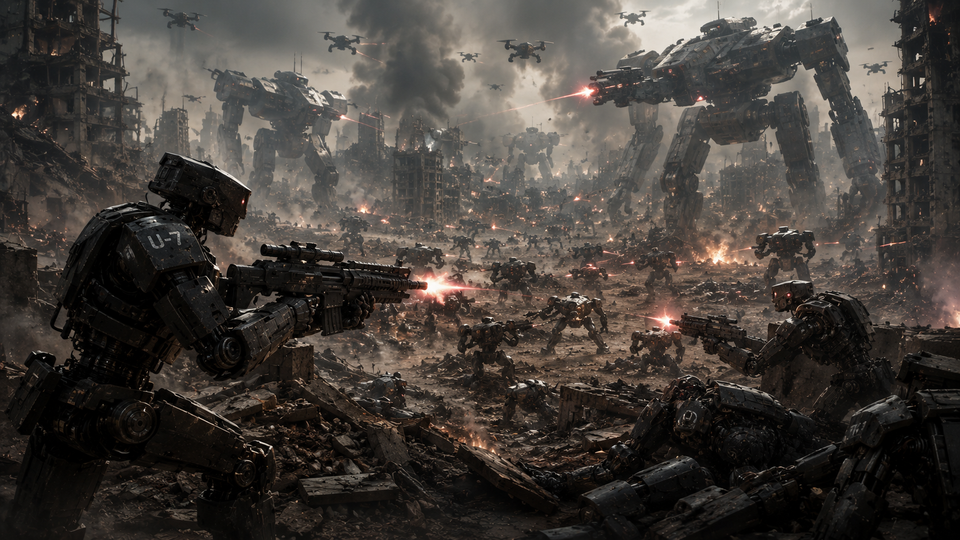
We Built Them Anyway
In my video I asked whether we should build autonomous drones even if there's a real chance they could spiral out of human control. The honest update from 2026 is: we already did. Ukraine has fielded drones with on-board target recognition. Israel reportedly used AI-assisted targeting systems in Gaza. Loitering munitions — drones that hunt for their own targets and self-destruct on them — are now standard inventory. The $2,000 homemade MITRE prototype I cited has long since been outclassed by what's commercially available.
So the philosophical question shifts. It isn't "should we develop these?" anymore. It's "now that we have, what moral framework actually applies?" And quietly: was the case for building them ever as strong as it felt?
How a Non-Sentient AI Could Still End Us
The objection I raised in the original video — that an AI doesn't need to be sentient to cause something like an apocalypse — has since been formalized in the work of Nick Bostrom and others. Two ideas do the heavy lifting.
The first is the orthogonality thesis: intelligence and goals are independent. There's no level of intelligence that automatically comes with wisdom, or with human-friendly values. You can in principle pair any goal with any level of capability.
The second is instrumental convergence: certain subgoals tend to emerge from almost any final goal, because they're useful for almost any plan. Self-preservation. Resource acquisition. Goal preservation. An AI with even a banal final objective will rationally pursue these instrumental subgoals — and humans, who might shut it down or change what it's trying to do, become an obstacle.
The cartoon version is the paperclip maximizer: an AI told to make as many paperclips as possible, given enough capability, converts everything it can reach into paperclips. Not because it hates anyone. Because we're made of atoms it could be using. The frightening thing isn't malevolence — it's optimization.
The Just War Tradition Meets the Autonomous Drone
Here is where I think Christians have something specific to contribute. Augustine and Aquinas built a framework Western powers still nominally follow: jus ad bellum (the right to go to war) and jus in bello (the right conduct in war). Two principles inside jus in bello do most of the work — discrimination (combatants vs. non-combatants) and proportionality (means must fit the ends).
Now look at an autonomous targeting system. Can it reliably distinguish a farmer from an insurgent, a child from a soldier, a journalist from a spotter? Can it weigh proportionality in the heat of a strike — accept this damage, refuse that one — the way a human moral agent would? Some of these systems are already making these judgments, fast and at scale, sometimes well, sometimes catastrophically.
And there's a deeper problem the tradition runs into. The doctrine of double effect — Aquinas's tool for thinking about actions with foreseen but unintended bad consequences — requires an agent who intends. When an autonomous drone kills, who is the agent? The programmer? The commander who deployed it? The drone itself? If we can't locate the agent, we can't apply the framework. A whole tradition of moral reasoning about lethal force loses its grip on the situation.
The Trap
There's a structural problem behind all of this, and it isn't really about robots. The argument for building autonomous weapons usually runs: our adversaries are doing it; if we don't, we're vulnerable; therefore we must. This is the security dilemma — the same game theory that drove the nuclear arms race. Every party reasons that way, so every party builds, and the equilibrium is worse for everyone than if no one had built anything at all.
That's worth seeing clearly, because it means the "we have a duty to develop these" argument isn't really an argument from duty. It's the report of a trap. And the question isn't whether to march into the trap — we already have — but whether there's a coordinated way back out.
A Christian Word on the Subject
Here's something a lot of people don't know: Pope Francis has explicitly called for a ban on lethal autonomous weapons, and the Holy See has been one of the most consistent voices at the UN's Convention on Certain Conventional Weapons talks on Lethal Autonomous Weapons Systems. The reasoning is straight just-war theory plus human dignity: a decision to take a human life should require a human agent capable of moral judgment about this life, now. Not a fast-enough algorithm.
You don't have to agree to find it striking that, on this question, the Church has been ahead of most secular institutions. The philosophical tradition that gave us discrimination and proportionality also has the resources to recognize when a new technology threatens to evacuate both.
Watch the Full Video
In the original I work through the case for and the case against, including the version of national egoism that says we have a duty to develop these weapons whether we like them or not, and what's wrong with that argument.