
Can AI Teach Us about Human Motivation?
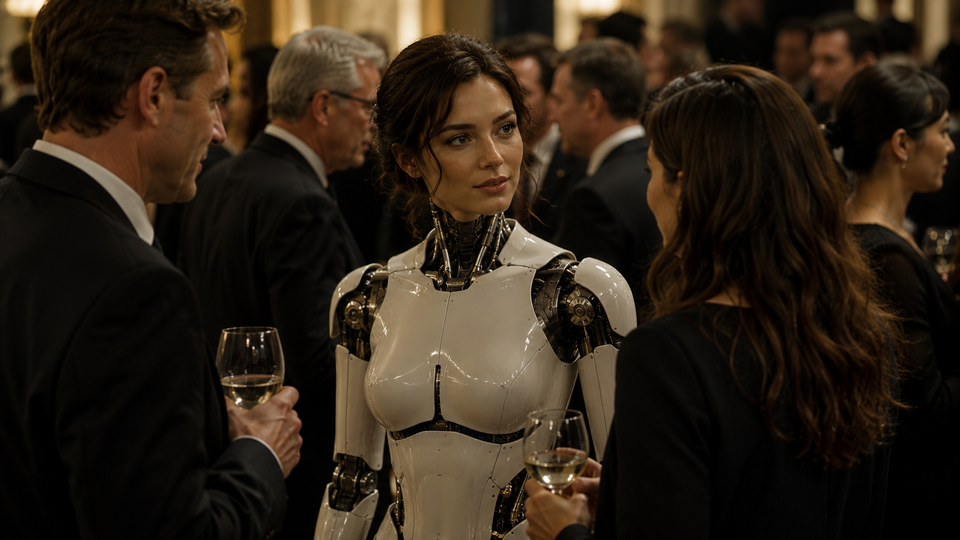
When I recorded the original video, "AI that can fool you into thinking it's human" was a slightly futuristic claim. Today it's a Tuesday. You can open ChatGPT or Claude, have a long conversation about your relationship with your father, and walk away feeling heard. The Turing test, once a benchmark, has become a thing your phone passes on the way to telling you the weather.
So the question I asked back then has only gotten more pressing: if a machine acts like it understands you—if it acts like it cares about you—is anything actually happening on the inside? Or is it the world's most polished impression of a person?
The Chinese Room
The classic version of this worry is John Searle's Chinese Room. Imagine you're locked in a room with an exhaustive rulebook. Sheets of paper with Chinese characters are slipped under the door. You consult the rulebook—"if you see these characters, write back those characters"—and slide a response out. The native Chinese speakers outside are convinced they're having a fluent conversation.
You, of course, don't understand a word of Chinese. You're just shuffling symbols by rule.
Searle's claim is that this is what every computer is, all the way down. A program manipulates symbols according to formal rules. No matter how sophisticated the rulebook gets—no matter how many billions of parameters, no matter how convincing the outputs—it's syntax without semantics. Form without meaning. Words without anything the words are about.
In my video I argue that mimicry of behavior is no guarantee of identical reasoning. The Chinese Room is the cleanest way to see why. The behavior could be perfect, and the understanding could be zero.
The Easy Problems and the Hard One
David Chalmers gave us a useful pair of labels. The "easy" problems of mind—how information gets processed, how decisions get made, how behavior gets produced—are easy in the sense that we can imagine science eventually solving them. The "hard" problem is something else entirely: why is any of this accompanied by inner experience? Why is there something it is like to be you, reading this sentence, rather than nothing at all?
The easy problems are exactly what AI is built to solve. Inputs get processed, decisions get computed, outputs get produced. But the hard problem isn't on the spec sheet. There's no line in the source code that says and here is where the subjective experience happens. We can grant a system spectacular behavior, spectacular functional organization, and still ask: is there anyone home?
An Older Answer: Form, Matter, and the Intellect
For Aristotle and Aquinas, this isn't a new debate—it's one branch of a very old one. They distinguished between the bodily powers of the soul (senses, imagination, memory) and what they called the intellect. The lower powers work with phantasms, sensible images. They are bodily, and on this view nothing in principle stops a sufficiently sophisticated machine from doing what they do. Mimicking sensory processing? Plausible.
But the intellect, for Aquinas, doesn't work with sensible particulars. It grasps universals: what it is to be a triangle, a human, a good. The act by which I understand triangularity isn't an act of any bodily organ, because the object of that act—the universal itself—isn't a bodily thing. The intellect, on the Thomistic view, is immaterial.
If that's right, then the ceiling for artificial intelligence isn't an engineering ceiling. It's metaphysical. No arrangement of silicon and electricity could understand the way you do, because understanding isn't the kind of thing matter does. A machine could get arbitrarily good at imitating the outputs of an intellect without performing a single intellectual act.
You don't have to be a Thomist to find that worth taking seriously. You just have to notice that "behavior identical to a human's" and "doing what a human does" aren't obviously the same claim.
Why This Is No Longer Academic
Here's where this turns from philosophy seminar into headline news. The question I asked in the video—can we tell whether the robot is making decisions for the benefit of others?—is, almost word for word, what's now called the AI alignment problem. It's a major research field with serious money and serious stakes behind it. Self-driving cars. Autonomous weapons. The recommendation engines deciding what your kids see at 11pm.
If genuine concern for others is the kind of thing only minds with inner lives can have, and machines don't have inner lives, then "AI that acts for the benefit of others" is going to be an exercise in shaping behavior, not cultivating virtue. We can train models to act caring. We can't, on the view I'm defending, train them to be caring. And the gap between those two might be the most important practical question of the next decade.
Watch the Full Video
In the original I lay out three reasons to be skeptical that human-mimicking AI is doing what a human is doing—even when it looks indistinguishable from the outside. The Chinese Room above gives you the flavor of the first one; the other two go to the architecture of the brain and the role of experience in motivation.