
Euthyphro Dilemma, Part 2: Does God Just Pick What's Right and Wrong?
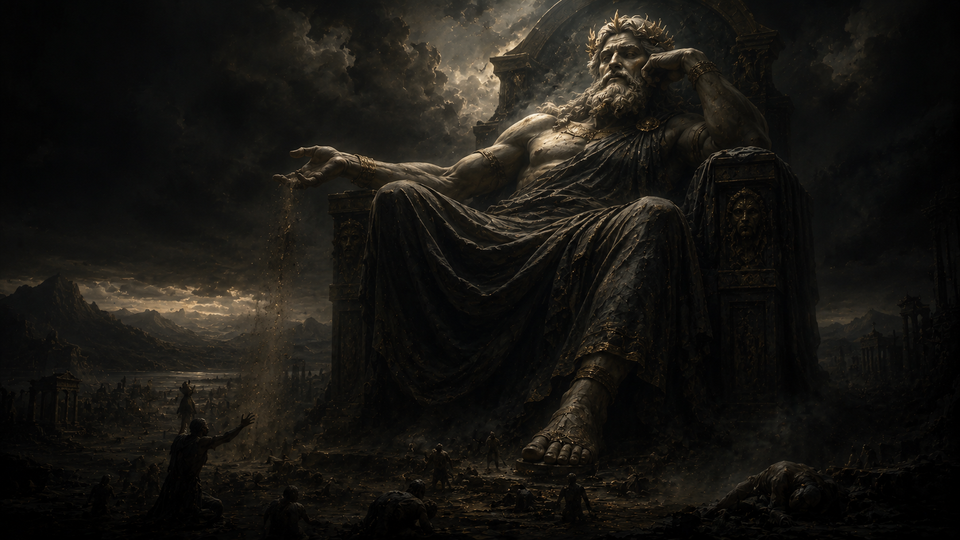
Picture God on the first morning of creation, before there are any creatures around to love or hurt each other, sitting down to write the moral rulebook for the universe. Does He open a book that already exists somewhere, a cosmic instruction manual He simply reads off and enforces? Or does He pick up a blank pad and, with nothing to guide His pen but His own will, write "kindness: good, cruelty: evil" the way you might write "spades are trump" at the start of a card game? That image, God as author rather than reader of morality, is where we're headed in this second installment of our journey through the Euthyphro dilemma. Grab a coffee, settle in, and let's wade back into water that's been troubling philosophers for about twenty-four hundred years.
A Quick Paddle Back to Where We Started
If you caught the first video in this series, you already know the shape of the problem. Plato wrote a short dialogue somewhere around 399 BC, right around the time of Socrates's trial, in which Socrates runs into a religious expert named Euthyphro outside the courthouse. Euthyphro is there to prosecute his own father for manslaughter, supremely confident that he knows exactly what piety demands. Socrates, being Socrates, asks him the simplest possible question: what is piety? And in trying to answer, Euthyphro stumbles into one of the most famous forks in the history of thought: is the pious loved by the gods because it is pious, or is it pious because it is loved by the gods?
Strip away the ancient Greek pantheon and swap in the God of classical theism, and you get the modern version of the question: is something good because God commands it, or does God command it because it's already good? We called these two options "horns," because like a bull, this dilemma seems to gore you no matter which way you turn.
In the first video, we took Horn 1 for a walk: the idea that God commands things because they are already, independently, good or evil. Torturing infants is wrong, and God, being perfectly wise, recognizes that wrongness and forbids it. This has real appeal. It makes sense of why God's commands feel authoritative rather than arbitrary. But we saw it comes with a serious cost. If goodness and evil are fixed truths that exist prior to and independent of God's will, then in some sense God is not the ultimate source of morality. He's more like a very reliable moral instrument, a perfect thermometer reading a temperature He didn't set. That threatens God's sovereignty and puts pressure on classical ideas about omnipotence, since now there's something God can't do, namely make cruelty good, because the moral facts are already locked in. We also asked the harder question lurking underneath: if morality doesn't depend on God, what does it depend on? Where do these free-floating moral truths live, and what makes them true? That's a strange kind of Platonism to have to sign up for, moral facts just sort of hanging out in reality the way numbers might, needing no one to make them true, God included.
So Horn 1 has a leak. Naturally, philosophers who wanted to preserve God's status as the absolute sovereign of everything, including morality, swam over to the other horn. That's where we're spending our time today.
Horn 2: Divine Command Theory
The second horn says: God decides. Full stop. Saving a life is good, and torturing a baby is evil, not because these facts were sitting around waiting for God's endorsement, but because God's will makes them so. Prior to God's command, there was no moral fact of the matter at all. Goodness and evil are, in a very real sense, invented by divine fiat. For those of you who love a tidy label, this is called Divine Command Theory, or DCT if you want to sound like you've read the journal articles.
This isn't a fringe position dreamed up to win an internet debate. It has serious pedigree. The clearest and most historically influential champions of this view are the medieval voluntarists, especially Duns Scotus, the Scottish Franciscan working around 1300 AD, and even more famously William of Ockham, the English Franciscan friar writing in the first half of the fourteenth century AD, roughly the 1320s through the 1340s. Ockham, whom you may know from "Ockham's razor," the principle that we shouldn't multiply explanatory entities beyond necessity, held a startlingly strong version of this view. He argued that God's will is genuinely unconstrained by any prior standard of goodness, and that God could, in principle, have commanded us to hate Him, and hatred of God would then have been obligatory and good. That's about as pure a version of Horn 2 as you'll find in the history of philosophy. This whole family of views gets called voluntarism, from the Latin voluntas, meaning will, because it grounds morality in will rather than in reason or in fixed rational natures. Its opposite number, intellectualism, is the view that God's reason perceives moral truths that are, in some sense, independent of or at least logically prior to His will, which is closer to Horn 1. Thomas Aquinas leaned intellectualist; Scotus and Ockham pushed hard toward voluntarism. This wasn't an idle scholastic squabble. It shaped debates about whether morality is fundamentally about rational order or about obedience to a sovereign will, a question that echoes all the way down into modern moral philosophy and even into political theory, as we'll see later.
So Horn 2 has serious philosophical company. It preserves God's absolute sovereignty beautifully. Nothing constrains Him, not even morality, because morality is downstream of His will rather than upstream of it. But, as you might guess, this move creates its own headaches, and there are three big ones worth dwelling on.
Objection One: Doesn't This Make Morality Arbitrary?
Here's the worry in its starkest form. If nothing about torturing babies made it evil prior to God's command, then God's choice to forbid it looks a lot like a coin flip. He could just as easily have gone the other way. He could have surveyed the options, on Horn 2 there's no prior fact pulling Him one direction, and simply decreed that torturing infants is virtuous and saving lives is contemptible. On Horn 1, remember, God's choices tracked something real; He commanded against torture because torture was already wrong. But on Horn 2, there's no "already" to track. It's morality by dice roll.
And that feels monstrous to us. Try to actually picture the counterfactual universe where God commanded the opposite, where cruelty is dubbed good and compassion is dubbed evil. Our gut reaction is immediate and visceral: how horrifying, what dumb moral luck we dodged by living in this universe instead of that one.
But here's a wrinkle worth sitting with, and it's the kind of thing that rewards slow thinking rather than a snap verdict. If Divine Command Theory is true, then in that other possible universe, the inhabitants would not experience their moral order as horrifying at all. Their sense of moral revulsion, their built-in emotional and rational architecture for detecting wrongness, would be calibrated to their moral order, the one where cruelty is good. They would find our universe, the one where we protect the vulnerable, utterly perverse. They'd recoil at incubators and vaccines and lullabies the way we recoil at torture chambers.
Which raises an uncomfortable but genuinely interesting question: can we actually judge a different possible morality using intuitions that were built for our own? Our sense that "torture is obviously wrong" might not be some view from nowhere, a neutral vantage point outside all possible moral systems from which we can rank them. It might just be the operating system we happen to be running, installed in us because it matches the actual moral order God chose for this world. That doesn't make the objection disappear, but it does mean the objection is doing something sneakier than it looks. It's smuggling in our moral intuitions, which are themselves a product of this moral order, and using them to judge the very question of whether God's choice was arbitrary. It's a bit like a fish trying to evaluate whether water was a good choice for fish to need, using judgment faculties that only work because it lives in water. I'm not saying that settles the arbitrariness worry entirely, but I think it should at least make us less smug about how obviously absurd the "reversed" universe would be.
Objection Two: A Decision With No Reason Behind It
The second objection is subtler and, I think, more interesting philosophically. It goes like this. Surely it's good, maybe even a component of what perfection requires, to act rationally rather than randomly. And God, on classical theism, is maximally perfect, which should include being maximally rational. But to act rationally, in the fullest sense, is to act for a good reason. On Horn 1, God had a reason to forbid torture: it was already wrong, and a perfectly wise being naturally aligns His will with the moral facts. But on Horn 2, there is no prior fact about torture's wrongness for God to be responding to. So when God commands against torture, He isn't doing so for any reason at all. It's a preference with no rationale behind it, which sounds like exactly the kind of thing a perfectly rational being shouldn't be capable of doing.
I have to admit, I'm not fully convinced this objection lands as hard as it first appears, and the reason I think that traces back to a wonderful old puzzle called Buridan's Ass. The paradox is traditionally hung on the name of Jean Buridan, a French philosopher working in the fourteenth century AD, though interestingly the core idea shows up even earlier, in a passage of Aristotle's De Caelo, where he imagines a man equally hungry and thirsty, positioned exactly between food and drink, and wonders whether he must simply stay put, frozen by symmetry. The donkey version is the one that stuck in popular memory: imagine a donkey standing exactly, perfectly equidistant between two identical bales of hay, with absolutely nothing distinguishing them in taste, freshness, or accessibility. If every action requires a sufficient reason favoring it over the alternatives, and there is no reason favoring the left bale over the right bale, does the donkey simply starve to death, paralyzed by a tie she has no rational way to break?
Most of us think that's the wrong conclusion to draw. The sensible response is that the donkey just picks one. She doesn't need a reason to prefer left over right specifically; she only needs a reason to eat something rather than starve, and that reason is satisfied by either bale. The choice between the two options can be arbitrary in the narrow sense, unmotivated by any distinguishing feature, without the overall action being irrational. It would be far more foolish, far more of a rationality failure, for the donkey to stand there and die simply because she couldn't locate a reason to prefer one identical bale over the other.
I think something similar might be going on with God and morality on Horn 2. Maybe God did, so to speak, flip a coin between "make cruelty good" and "make compassion good," in the sense that nothing external forced the outcome one way. But it doesn't follow that this was irrational of Him. It would arguably be far more strange, far more of a failure, for God to refuse to create any moral order at all simply because there was no antecedent fact tipping the scales. Creating a moral order, some moral order, seems like the rational move; which particular order gets created might be the part that's arbitrary, the way it's arbitrary which bale of hay the donkey picks, without the picking itself being irrational. So I'm not sure the a-rationality objection does the damage it initially seems to do.
It's worth flagging, too, that this whole objection sits close to a much more general puzzle in philosophy: David Hume's is-ought problem, laid out in his A Treatise of Human Nature, published in 1739 and 1740 AD. Hume pointed out that you can never validly derive a statement about what ought to be the case purely from statements about what is the case; there's a logical gap between description and prescription that no amount of additional facts seems to close. Divine Command Theorists are essentially trying to bridge that exact gap using God's will as the mechanism: God wills X, therefore X is obligatory. Whether God's will is a special enough kind of fact to leap the is-ought chasm, when no ordinary fact seems able to, is really a live descendant of Hume's challenge, and it's going to matter a great deal for the objection we turn to next.
Objection Three: Where Does the Obligation Come From?
This is, in my view, the sharpest of the three objections, and it's the one that actually points us somewhere productive. On Horn 1, remember, there's an independent moral standard: certain things are just good or bad, full stop, and God's commands track that standard. That gives us a tidy answer to why we're obligated to follow God's commands: because His commands line up with what was already, objectively, good.
But Horn 2 has thrown that independent standard overboard. All God does is issue a command. And a command, all by itself, doesn't obviously come pre-loaded with obligation. If your neighbor shouts across the fence that you must mow your lawn every Tuesday, you don't suddenly owe him lawn-mowing obedience just because he said so with enough conviction. So why would God's command be different? You might say, "because God commands us to obey His commands." But notice what's happened: that's now a second command, and we need to ask why we're obligated to follow that one too. Pull on this thread and you get an infinite regress, or you get a vicious circle, obligation trying to bootstrap itself into existence using nothing but more of itself.
There are two moves worth walking through here, and the second one is where things get genuinely exciting.
The first response is a kind of tu quoque, a "you too" move. Notice that Horn 1 has to answer a strikingly similar question. Why does the moral standard, whatever independent fact makes torture wrong, carry obligation with it? We invent all sorts of standards constantly. Chess has a standard for legal moves. Traffic law has a standard for which side of the road to drive on. Board games invent rules on the spot. None of those standards seem to carry inherent, binding obligation the way morality does. So even on Horn 1, we need to explain why the moral standard, specifically, is the kind of standard that obligates us, when other standards clearly don't. And the only answer anyone seems to be able to give is something like, "because that's just what it is to be a moral standard, as opposed to a chess standard." But if intellectualists are allowed to say that, then Divine Command theorists can say the analogous thing: God's commands aren't ordinary commands like "mow your lawn"; they are moral commands, a special category, and moral commands carry obligation as part of what makes them moral commands rather than mere requests. That may sound like question-begging, but it's no more question-begging, the argument goes, than the parallel move on Horn 1. Both sides eventually hit bedrock and have to say "that's just the kind of thing this is."
The second response is more ambitious, and it's where Divine Command Theory starts to look less like a stubborn dead end and more like a doorway. This move says: don't treat God's commanding as a separate act, floating free, disconnected from everything else God does. Remember that God, on classical theism, doesn't just rearrange pre-existing stuff. He creates everything that exists other than Himself, out of nothing. And that includes not just particular things, this rock, that tree, this human being, but the very natures of things, what it is to be a rock, a tree, a human being. God doesn't just make individual humans; He is the author of what humanness is, of what it means to flourish as the kind of creature a human being is.
If that's right, then obligation isn't bolted onto creation as an afterthought, a command issued to already-finished beings from the outside. It's woven into the fabric of what those beings are from the very moment of their creation. Human beings are, by their created nature, the kind of beings for whom flourishing involves compassion, community, honesty, and the protection of the vulnerable, especially the most vulnerable among us, like infants. So when we ask, why are we obligated to save lives and not torture them, the answer isn't merely "because God said so" in some detached legislative sense. It's "because that is what it is to be the kind of being we are, and God is the one who made us that kind of being." The obligation isn't an external command bolted onto a neutral creature. It's built into the creature's very being, the way it's built into the nature of a knife to cut, or the nature of an eye to see. A knife that's dull isn't just breaking an external rule; it's failing to be a good instance of the kind of thing it is.
This is genuinely reminiscent of a much older philosophical program: natural law theory, most fully developed by Thomas Aquinas in the thirteenth century AD in his massive Summa Theologiae, written between roughly 1265 and 1274 AD. Aquinas argued that moral obligation flows from the rational nature God gave to human beings; to act well is to act in accordance with what our nature, as rational creatures oriented toward certain genuine goods, actually calls for. What's fascinating is that this Horn 2 move ends up borrowing something that sounds a lot like Aquinas's natural law framework, while still insisting, contra classical natural law theory in its purest form, that God is the ultimate author of those natures rather than a being who discovers them ready-made. It's an attempt to have Horn 2's full-throttle divine sovereignty and Horn 1's non-arbitrary, nature-grounded obligation at the same time.
This whole cluster of moves, by the way, isn't just theology. Notice how the exact same puzzle shows up in secular political philosophy, which tells you this obligation problem is bigger than the Euthyphro dilemma itself. Thomas Hobbes, writing Leviathan in 1651 AD, grounded political obligation in a social contract; we consent, at least implicitly, to be governed, and that consent is supposed to generate real obligation. But critics have always pushed back: why does mere agreement generate binding obligation, especially for people born long after the supposed contract was struck, who never actually signed anything? The divine right of kings faced a mirror-image question: why would being descended from the right bloodline generate a right to rule and an obligation to obey? And modern majoritarian democracy faces its own version: why does fifty-one percent of a vote generate a binding obligation on the other forty-nine percent, especially in the nightmare scenario where a bare majority votes to harm a minority? In every case, we're asking the same structural question we asked about God's commands: what turns a mere fact, a contract, a bloodline, a vote tally, a command, into a genuine "ought"? Nobody has a fully settled answer, which should make us less quick to dismiss Divine Command Theory just because it has this same puzzle. It's in very good, very persistent philosophical company.
It's also worth knowing that this isn't just an ancient argument gathering dust in medieval libraries. It's alive and well in contemporary philosophy of religion. Robert Adams, in his landmark 1973 paper "A Modified Divine Command Theory of Ethical Wrongness" and later in his 1999 book Finite and Infinite Goods, developed a sophisticated modified Divine Command Theory that tries to answer exactly the objections we've covered today, arguing that God's commands, issued by a being who is essentially loving, are what constitute moral wrongness, while trying to avoid the arbitrariness worry by grounding those commands in God's unchanging, loving character rather than pure unconstrained will. Alvin Plantinga, William Lane Craig, and Richard Swinburne, three of the most prominent living philosophers of religion, have all wrestled with versions of this dilemma in their work on the metaethical foundations of theism, often converging on some version of the "natures of things" solution we just sketched, sometimes called a theistic natural law view or a hybrid of Horn 1 and Horn 2. So when we talk about "God's commands being written into the nature of created things," we're not inventing a clever escape hatch out of thin air; we're standing on the shoulders of a conversation that runs from Plato through Ockham through Aquinas through Hobbes all the way to philosophy departments today.
Where This Leaves Us
So where does that leave Horn 2? It preserves God's sovereignty magnificently, nothing external constrains His will, but it seems to buy that sovereignty at the price of arbitrariness, and it strains to explain where genuine moral obligation comes from if not from some prior standard. We've seen that the arbitrariness objection might be less devastating than it first appears, once we notice that our revulsion at alternative moralities may itself be a product of the very moral order we're using to judge them. We've seen that the a-rationality objection runs into trouble from Buridan's donkey, since an arbitrary choice between options isn't the same thing as an irrational one. And we've seen that the obligation objection, the toughest of the three, pushes us toward an intriguing idea: that obligation isn't bolted onto creatures from outside, but woven into the very natures God gives them when He creates them in the first place.
That idea, that what's obligatory for a thing is written into what kind of thing it is, is really just a clue, a thread left dangling for us to pick up. It doesn't yet tell us how to reconcile the full sovereignty of Horn 2 with the non-arbitrary structure of Horn 1. But it's a promising enough thread that it's going to be the whole subject of our third and final video in this series, where we'll ask whether there's a way to escape the dilemma altogether rather than just gripping one horn a little more comfortably than the other.