
Euthyphro Dilemma 1: Are Moral Truths Independent of God?
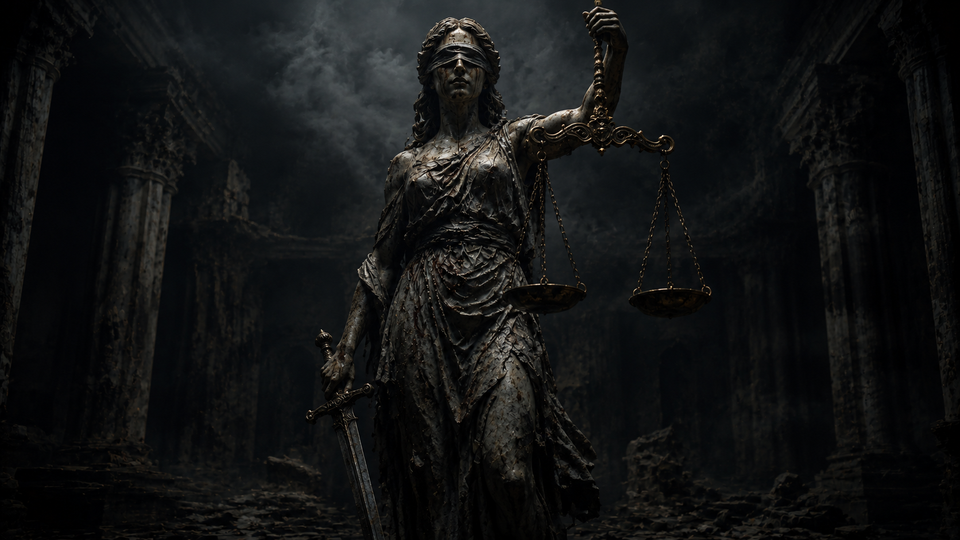
If God exists, how exactly did God decide what's right and wrong? Was it just a matter of picking willy-nilly, the way you might pick a paint color for your kitchen? Or was God somehow forced to pick one particular way, with no real say in the matter at all? It sounds like a strange question to ask about an all-powerful being. But it's one of the oldest and most durable puzzles in the philosophy of religion, and once you see it, you can't unsee it.
A Question Asked Outside a Courthouse
The puzzle comes to us from Plato, in a short dialogue called the Euthyphro, written around 399 BC. The setting is almost comically specific. Socrates is standing outside the court in Athens, waiting to face the charges that will eventually lead to his execution — corrupting the youth, impiety toward the gods. While he waits, he runs into a man named Euthyphro, who is there for his own extraordinary reason: he is prosecuting his own father for murder. His father had left a servant bound and neglected in a ditch, where the man died of exposure, and Euthyphro is convinced that pursuing the charge is the pious thing to do, even against his own family.
Socrates, ever the gadfly, is fascinated. Here is a man so confident he knows what piety requires that he's willing to drag his own father into court over it. So Socrates asks him, quite sincerely, to explain what piety actually is. Not examples of pious acts, but the essence of piety itself — the one form or feature that makes all pious things pious.
Euthyphro, after a few false starts, offers this: the pious is what is loved by the gods. And this is where Socrates springs the trap that has echoed through twenty-four centuries of philosophy. At 10a of the dialogue, he asks: "Is the pious loved by the gods because it is pious, or is it pious because it is loved by the gods?"
Notice how tidy and how devastating that question is. It isn't asking whether the gods love pious things — everyone agrees they do. It's asking about the order of explanation. Does piety cause the gods' love, or does the gods' love cause piety? Those sound like they might amount to the same thing, but they don't, and the difference between them turns out to carry enormous weight.
Plato, of course, was writing in a world of many gods — Zeus, Apollo, Athena, and the rest, gods who famously disagreed with each other, who had favorites, who squabbled like an unusually powerful extended family. Part of the bite of Socrates' question in its original context was that the gods themselves might disagree about what's pious, which makes "loved by the gods" a shaky foundation indeed. But philosophers over the centuries have found it easy, and illuminating, to translate the question into monotheistic terms. Swap "the gods" for "God," and swap "pious" for "good" or "morally right," and you get the modern version of the puzzle, sometimes just called the Euthyphro Dilemma: does God command things because they are good, or are they good because God commands them?
Setting Up the Two Horns
Before we go further, it helps to fix our target with two examples that (almost) nobody disputes. Saving an innocent person's life, when you're in a position to do it, is good. Torturing babies for fun is evil. I choose these examples on purpose because they're about as close to moral bedrock as we get. If your ethical theory can't accommodate the wrongness of torturing infants for entertainment, your theory is in trouble, not the infants.
Now apply the dilemma. Take Horn 1: God commands what is already good, and forbids what is already evil, because He recognizes these moral truths as antecedently true. Saving lives is good — full stop, as a fact about the world, or about morality — and God, being maximally wise and observant, sees this truth and communicates it to us. Torturing babies is evil, also as a standing fact, and God sees that too and forbids it. On this view, God functions something like a perfect moral reporter. He doesn't invent the moral order; He reads it, understands it perfectly, and passes it along to us, His creatures, who are not nearly so reliable at reading it ourselves.
This sounds humble, even reasonable. It avoids a whole set of theological headaches around God commanding whatever He likes. But — and this is the heart of today's video and this post — Horn 1 turns out to open up a set of problems every bit as serious as the ones it avoids. Let's take them one at a time.
Objection One: What Happened to Sovereignty?
Classical theism, across the Jewish, Christian, and Islamic traditions, has generally wanted to say that God is sovereign in the fullest sense — not merely the most powerful being among many, but the ultimate source and ground of absolutely everything else that exists. Nothing stands over God, nothing constrains God from the outside, nothing tells God what to do.
But look at what Horn 1 commits us to. If moral truths are already fixed, already true, independently of God, prior to and apart from Him, then God is in the position of a student consulting an answer key He didn't write. He looks at the moral facts, confirms they're true, and communicates them to us — but He doesn't get to vote on their content. There they sit, immovable, and God, however great He might otherwise be, has to conform to them just like the rest of us. That's a strange kind of sovereignty. It's sovereignty over creation, perhaps, but not sovereignty over the moral order itself, because the moral order was there to greet Him. Whatever else you want to say about a being who has to answer to something else, "radically sovereign" doesn't sit naturally on his résumé.
Objection Two: What Happened to Omnipotence?
A close cousin to the sovereignty worry concerns God's power. Omnipotence, on any reasonably strong understanding of the term, means God can do absolutely anything that isn't a straightforward logical contradiction. He can create galaxies, part seas, become incarnate, raise the dead. But on Horn 1, there's something rather ordinary that He apparently cannot do: He cannot make it the case that torturing babies for fun is good. That fact is already settled, eternally and independently, and no amount of divine power can reach in and rewrite it.
Now, a theologian might respond that this isn't really a limitation any more than God's inability to make a square circle is a limitation — some things are just necessarily false, and moral truths might be that kind of necessary truth. That's a fair reply, and we'll return to something like it in a moment. But notice what it costs: it means there is a whole domain of necessary truths — the moral ones — that God's omnipotence has nothing to do with. He didn't establish them, He can't alter them, and His power, whatever its scope, has to stop at their border. For a being whose defining feature is supposed to be limitless power, that's an oddly shaped boundary to discover.
Objection Three: What Happened to Freedom?
Here's a third angle, and it has a nice, almost common-sense structure to it. We generally think that having more options, more freedom of the will, is better than having fewer — within reason, of course. A person who can choose between honesty and dishonesty and freely chooses honesty seems, in some sense, more praiseworthy or at least more free than a robot hardwired only to tell the truth. Now, God, as classically conceived, is meant to be maximally perfect in every respect, including freedom. Whatever freedom a being could possibly have, God has all of it, without limit.
But on Horn 1, God isn't actually free to determine what counts as right or wrong. The moral facts are already sitting there, fixed, and God's only freedom is the freedom to recognize them accurately and communicate them to us — a bit like being "free" to report the results of an election that's already been counted. His will simply has no say in the content of morality. So the very picture that was supposed to protect God's goodness (He can't just arbitrarily decide torture is fine) ends up looking like it hems in His freedom, restricting the range of things His will is actually doing any work on. It's a strange kind of perfection that comes with an entire category of facts about which your will is simply irrelevant.
Objection Four: Where Do These Truths Even Come From?
Now we come to the objection I think is the sharpest of the four, the one that keeps philosophers up at night rather than just mildly unsettled: if moral truths exist independently of God, what on earth are they, and where do they live?
Some philosophers bite this bullet directly and say that certain truths — including moral truths, but also things like mathematical and logical truths — simply obtain, full stop, prior to and independently of absolutely anything else, God included. They're just true, necessarily and eternally, the way "2 + 2 = 4" seems true no matter what.
Here's where I want to push back with a thought experiment, because I think it exposes just how strange this position is. Picture the entire physical universe gone. Not just rearranged — gone. No space, no time, no matter, no energy, no laws of physics scribbled on some cosmic whiteboard. Now, for the sake of argument, picture God also gone from this picture. What's left?
Nothing. And I mean that in the fullest sense of the word — not an empty black field stretching in all directions, because even an empty field is something, a container with dimensions, a canvas waiting for paint. I mean the absence of anything whatsoever, including containers and canvases. Now ask yourself: in that absolute nothing, is it true that torturing babies for fun is wrong?
It's very hard to see how it could be. Truth needs a truth-bearer and it needs a subject matter to be true about. "Torturing babies is wrong" is a claim about actions, agents, suffering, value — but if there's nothing at all, there's no action, no agent, no suffering, no value, and, it seems, no truth either. Nothing is neither true nor false; it's just nothing. If that's right, then it becomes very hard to explain how a moral truth could be sitting around, all on its own, in a scenario with no God and no universe to be the truth-maker for it. Truths, plausibly, need something backing them up, grounding them, making them true rather than false — and "nothing" is a spectacularly poor foundation for anything, moral truths very much included.
This is, in fact, one of the oldest and best arguments for why classical theists have wanted to resist Horn 1 in the first place, and it connects to a concept that goes by the Latin name aseity — from a se, "from itself." Aseity is the idea, central to classical theism from Augustine through Aquinas and beyond, that God alone exists entirely from and through Himself, dependent on nothing whatsoever outside Himself for His existence or His nature. Everything else that exists — you, me, galaxies, unicorns if there were any — depends on something else for its existence. God, on this picture, is the one exception, the "unmoved mover," in Aristotle's phrase later baptized into Christian theology, or the ipsum esse subsistens — subsistent being itself — of Aquinas's Summa Theologiae (written 1265–1274). If moral truths exist as brute, freestanding facts with no dependence on God at all, that's a direct challenge to aseity: suddenly there's a whole category of eternal, necessary truths that don't owe their existence to God in any way. God would no longer be the sole self-sufficient reality. He'd have company.
The Trouble with Floating Moral Forms
Some philosophers, trying to make sense of these free-floating necessary truths, reach for something like Plato's own theory of Forms. Plato — the very author of the Euthyphro — held, in dialogues like the Republic and Phaedo, that abstract realities like Beauty, Justice, and the Good exist as perfect, eternal, non-physical entities, existing in a realm entirely separate from the physical world we inhabit, which merely contains flawed copies or "participations" in those Forms. It's a strikingly beautiful metaphysics, and you can see its appeal for someone trying to rescue Horn 1: maybe moral truths are like Platonic Forms — an abstract entity called Goodness, existing eternally, independently of God, and it's by relating to this Form that actions become good or evil.
But once you actually try to picture this, the strangeness piles up fast, and I think it piles up in the same three ways we've already seen.
First, there's a category problem. These are supposed to be moral laws — prescriptions, oughts, imperatives — but we're being asked to think of them as freestanding entities, objects that simply exist out there like unusually important furniture. Picture, if you can, a little ghostly placard floating in the void, with "Thou Shalt Not Torture Babies" inscribed on it in some kind of metaphysical calligraphy, existing all on its own, needing no mind to think it, no God to underwrite it, no universe to apply to. That's a bizarre picture once you actually try to hold it in your head rather than gesture at it abstractly.
Second, there's a causal problem, and this is the one that trips up even sophisticated versions of the view. How does an abstract entity — something outside space and time, with no causal powers, by definition inert — actually make an act right or wrong? Numbers don't do anything; the number seven doesn't cause your calculator to display "7." So how does a free-floating moral Form reach down and confer rightness on an act of kindness, or wrongness on an act of cruelty? Contemporary philosophers of religion — Robert Adams is a good example, particularly in his 1999 book Finite and Infinite Goods, and William Lane Craig in his many discussions and debates on the Euthyphro Dilemma — have pressed exactly this point: abstract objects are notoriously bad candidates for explaining why anything happens or why anything has the properties it has. The mechanism is wildly mysterious, arguably more mysterious than the theological picture it was meant to replace.
Third — and this is where it comes back around to the sovereignty and control worries from before — if these moral Forms genuinely exist independently, then God is now sharing His eternal existence with a whole population of abstract entities He didn't create and doesn't control. It's not just that there are truths God has no say over; now there are apparently beings, entities with some kind of reality, that exist wholly outside God's creative and governing power. For a tradition that has always wanted to say "in the beginning, God" — full stop, nothing else, nothing alongside — that's a significant concession to make.
A Word on Leibniz, and Why This Isn't Just Academic Hair-Splitting
It's worth pausing to note that this dilemma isn't some fringe puzzle invented to trip up seminary students. It sits at the center of how philosophers have thought about the relationship between God and value for centuries. Gottfried Wilhelm Leibniz, writing in the Theodicy (1710), argued that God surveyed all possible worlds — every combinatorial arrangement of creatures, laws, and histories — and, being perfectly good and perfectly wise, selected the best one for actual creation. But notice: this only makes sense if "best" is a standard God is tracking, a standard He measures possibilities against, which pulls Leibniz's picture uncomfortably close to Horn 1. If goodness is a standard sitting there for God to survey and select by, we're right back in the same bind — sovereignty, omnipotence, freedom, and grounding, all under pressure again.
Contemporary philosophers of religion have spent enormous energy trying to find a way through this. Alvin Plantinga, particularly in his work on modal realism and abstract objects, has wrestled with where necessary truths of all kinds — mathematical, logical, and moral — ultimately reside, and whether they can be reconciled with classical theism's demand that God be the source of absolutely everything else that exists. Robert Adams's divine command theory, meanwhile, tries to thread the needle from the other direction, tying moral obligation to God's commands while still trying to preserve the idea that God's commands aren't arbitrary, because they flow from His unchanging, essentially loving character. That move, interestingly, is really a step toward Horn 2 — but that's a conversation for next time.
Where This Leaves Us
So here's where Horn 1 leaves us. If we say God commands the good because it's already good, independently of Him, we seem to compromise His sovereignty, His omnipotence, and His freedom, and we're left with a genuinely puzzling question about where these moral truths could possibly come from in the first place, since nothing at all — no universe, no God — seems like an awfully thin foundation for eternal truths to stand on. And if we try to rescue the picture by populating reality with free-floating moral Forms, we trade one mystery for three: a category mistake, an unexplained causal mechanism, and a whole population of entities outside God's control.
That's the trouble with Horn 1. And this is exactly why it's called a dilemma and not just a hard question: it comes with two horns, and so far, we've only examined one of them. If Horn 1 looks this uncomfortable, you might expect Horn 2 — the idea that things are good simply because God commands them — to be the safer harbor. Whether that's true, and what fresh problems wait for us over there, is where we're headed next.
This puzzle has been on the table for roughly twenty-four hundred years, since a barefoot Athenian philosopher cornered a pious young man outside a courthouse and asked him a question he couldn't quite answer. It says something about the durability of good philosophy that we're still standing in that same spot, turning the same question over in our hands, still not quite finished with it.