
Hilbert's Hotel: There's Always Room for One More
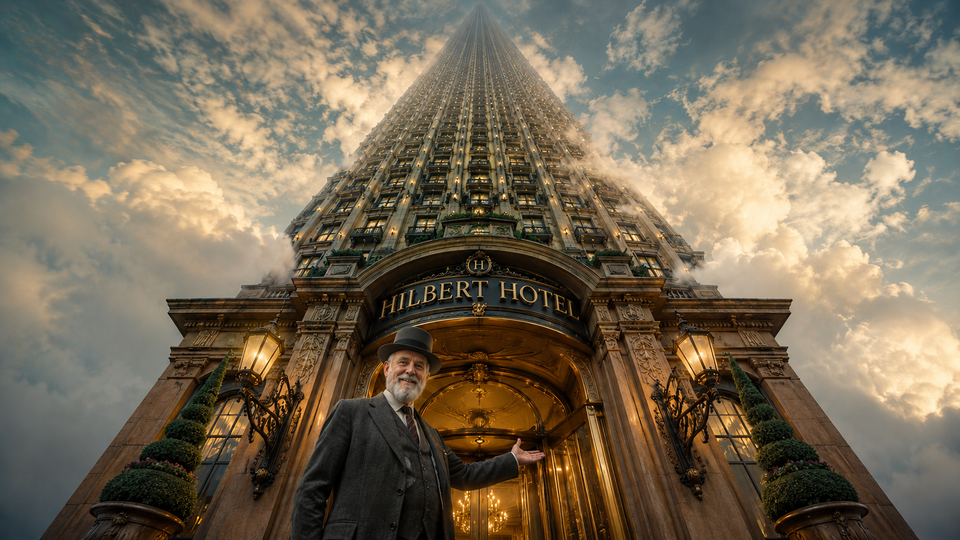
You run a hotel with infinitely many rooms, numbered 1, 2, 3, and so on. Every single one is full. A tired traveler walks in and asks for a room.
A normal hotel manager apologizes. You don't. You make an announcement: Everyone please move from your current room n to room n+1. Guest 1 moves to room 2, guest 2 to room 3, guest 3 to room 4. Every guest still has a room. And room 1 is now empty for the new arrival.
What if a coach pulls up with infinitely many new guests? Easy. You ask each existing guest to move from room n to room 2n — so guest 1 to 2, guest 2 to 4, guest 3 to 6. Now all the odd-numbered rooms are empty, and there are infinitely many of those. The new infinity fits.
This thought experiment is the German mathematician David Hilbert's, from a lecture he gave in the 1920s, and it's the punchline of the puzzle I've been building toward across this whole series on infinity.
What the Hotel Is Really Showing
Here is the deeper question: are there more natural numbers (1, 2, 3, …) than even numbers (2, 4, 6, …)?
On one hand, obviously yes. The natural numbers contain all the even numbers plus all the odd numbers. The evens are a strict subset.
On the other hand, obviously no. We can match them up one-to-one with no leftovers: 1 ↔ 2, 2 ↔ 4, 3 ↔ 6, and so on forever. Every natural number gets matched with exactly one even number. Nothing left over on either side.
Both arguments are correct. The set of evens is strictly smaller than the set of naturals and exactly the same size. Welcome to infinity by addition.
In the earlier post on infinity by division, we saw a finite line that somehow contained infinitely many parts. Hilbert's Hotel runs the same kind of trick in the other direction: an infinite collection that has the same size as one of its proper subsets. Once you allow actual infinities into your ontology, the ordinary rules of "how many" stop working.
Galileo Saw It First
Hilbert wasn't the first to notice this. In 1638, Galileo Galilei pointed out the same kind of puzzle in his Two New Sciences: the natural numbers can be paired one-to-one with their squares (1↔1, 2↔4, 3↔9, 4↔16…), even though most natural numbers obviously aren't squares. He concluded — with what I think is admirable honesty — that the relations "greater than," "equal to," and "less than" simply do not apply to infinite collections.
About 250 years later, Georg Cantor took Galileo's puzzle and built a whole branch of mathematics on top of it. He defined two infinities to be "the same size" exactly when they can be paired one-to-one. By that measure, the naturals, the evens, the odds, the squares, and even the rational numbers are all the same size — what he called aleph-null. And then, in a move that broke a lot of mathematicians' brains at the time, Cantor proved that the real numbers (the continuum) are a strictly larger infinity than that.
So there really are multiple sizes of infinity. The hotel is a parable, but it's a parable about a mathematically real situation.
The Move That Got Theological
Here is where this gets interesting for philosophy of religion. The contemporary Christian philosopher William Lane Craig has argued, in defense of what's called the Kalam cosmological argument, that Hilbert's Hotel shows actual infinities cannot exist in the physical world. The hotel's behavior is absurd. The infinite-molecules-fitting-in-an-already-full-universe version is absurd. So whatever the math allows, reality doesn't tolerate completed infinite collections of real things.
If that's right, then the past cannot be an actual infinity of moments. The universe must have had a beginning. And a universe that began to exist requires a cause. From a math paradox about a hotel, you get an argument for a Creator.
That's a strong move, and it's worth knowing about. But it's also contested within the Christian philosophical tradition. Thomas Aquinas, for example, held that we cannot demonstrate philosophically that the universe had a temporal beginning. He believed by faith that it did, but he thought an eternally-existing universe was at least logically possible. For Aquinas, the cosmological arguments don't rely on a first moment in time; they rely on a sustaining First Cause that holds creation in being at every moment, beginning or no beginning.
So Hilbert's Hotel isn't a knockdown argument for anyone's preferred metaphysics. But it is one of the rare places where math, philosophy, and theology genuinely meet — which is part of why it has fascinated thinkers for a century.
Watch the Full Video
In the video I walk through the hotel scenario step by step, ask why this trick even works, and show why "infinity by addition" runs into the same kind of trouble we ran into with "infinity by division" earlier in the series.