
Two Kinds of Infinity
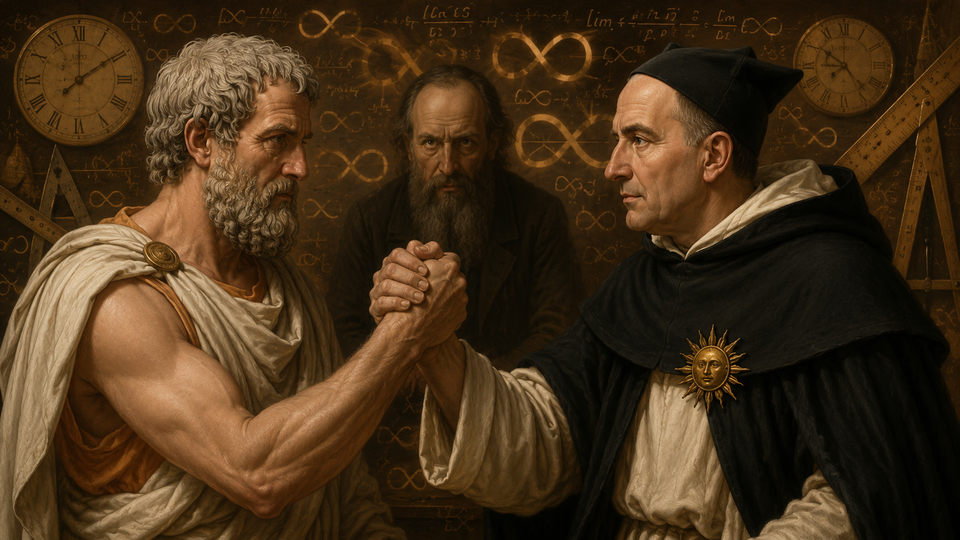
If you've been reading the earlier posts in this series, you've watched me reach for the same tool in every single one. Achilles can catch the tortoise, the divisibility puzzle dissolves, supertasks are exposed as the misuses they are, and Hilbert's Hotel is a story about math rather than about reality — all because of a distinction Aristotle made more than 2,300 years ago between two kinds of infinity. I keep using it because it keeps working. This is the video where I finally stop using it and start explaining it.
Here is the puzzle Aristotle was trying to solve.
Two Puzzles, One Pattern
The puzzles we've worked through in this series all share a shape. Take two examples we've already seen.
The paradox of infinite division: a finite line seems to contain infinitely many parts. If each part has any length, the line should be infinite, which it isn't. If each part has zero length, the line should be a single point, which it also isn't. Either way, the line we walk across every day looks impossible.
The paradox of the evens: there are infinitely many even numbers and infinitely many natural numbers, so we can match them one-to-one and they must be the same size. But the evens are a strict subset of the naturals, so there must be fewer of them. The same set is somehow both smaller than and equal to a set it sits inside of.
Both puzzles dissolve once you notice that we're using the word "infinite" to mean two different things at once.
The Distinction
Potential infinity: a process that can always be taken one more step. You can always divide a line one more time. You can always add one more to a natural number. You can always pair off one more even with one more natural. The process never completes. That's the whole point.
Actual infinity: a completed, never-ending collection sitting there as a finished totality. All the parts of the line, all the natural numbers, all the pairings, considered as a single thing already done.
Aristotle's claim is that the first kind of infinity exists in nature and the second doesn't. There is no completed-but-endless collection of parts of a line; there is only the line, which we can keep dividing as long as we like. There is no completed-but-endless collection of natural numbers; there is only the process of counting, which we can keep doing as long as we like.
Notice what this dissolves. The paradox of the evens only bites if you treat "all the natural numbers" and "all the even numbers" as two completed totalities you can now compare. If they're processes, never-completed, the question of whether they're "the same size" doesn't even arise — there's no finished thing to count. The same goes for the parts of the line. The infinitely many divisions are something we could perform without limit, not something already sitting inside the line waiting to be counted.
A Strange Kind of Potential
There is a worry, and Aristotle notices it himself. Usually "potential" means able to become actual. An acorn is a potential oak. A block of marble is a potential statue. But if no actual infinity ever exists, then this is a potential that cannot become an actual. What kind of potential is that?
Aristotle bites the bullet. This kind of potentiality, he says, is genuinely unusual. It does not point toward a possible completion. Its essence is not being completable. The infinite is what is never finished — and to demand a finished version of it is to demand exactly what its definition forbids.
Aquinas Picks It Up
The medievals took Aristotle's distinction and refined it. Thomas Aquinas, working in that tradition, distinguished between categorematic and syncategorematic infinity. A categorematic infinity is one taken as a completed whole — here is an infinite thing. A syncategorematic infinity is a process or capacity with no built-in limit — for any quantity, there is a greater one. For Aquinas, only God is infinite in the strong sense, and even then in a way that transcends the mathematical question entirely (infinite perfection, not infinite quantity). Created things can only be infinite in the weaker sense: never-ending in some respect, but never all at once.
This isn't pedantry. It's the move that lets Aquinas hold that God is infinite without committing himself to the absurdities of Hilbert's Hotel scaled up to divine proportions.
And Then Cantor Showed Up
The Aristotelian-Thomistic consensus held for over two thousand years. Then, in the late 1800s, Georg Cantor built a rigorous mathematics of completed infinite sets. His work didn't dissolve into paradox when he treated infinities as finished totalities; it produced theorems. Mathematicians use his framework today without apology.
So is Aristotle wrong? Maybe — or maybe Cantor's actual infinities live in a different kind of space than the one Aristotle was talking about. Cantor himself was a religious thinker who distinguished between the transfinite (which math can handle) and the Absolute Infinite (which belongs to God alone, beyond mathematical comprehension). On that picture, Aristotle and Cantor might disagree less than it first looks.
This is one of the live questions in philosophy of mathematics. There isn't a settled answer.
One Loose End
The video closes on a question that has bothered Aristotle's own readers for centuries. Aristotle thought the past was infinite — that the universe had no beginning. But "the past" is a strange object: it's done, it's complete, it's not still being added to. Doesn't that make it an actual infinity, the very thing his whole framework forbids?
How he tries to handle that — and whether he succeeds — is the next puzzle in the series.
Watch the Full Video
In the video I walk through both paradoxes, draw the distinction more carefully, address the "but how can potential never become actual?" objection, and tee up the question of whether Aristotle's framework can survive its own creator's belief in an eternal past.