
Hilbert's Hotel: Where Infinity Checks In and Logic Checks Out
Are there more even numbers or odd numbers? The question sounds like it belongs in a third-grade classroom. But it leads, with surprising speed, to one of the strangest and most beautiful ideas in the history of human thought: the mathematics of infinity.
The Setup
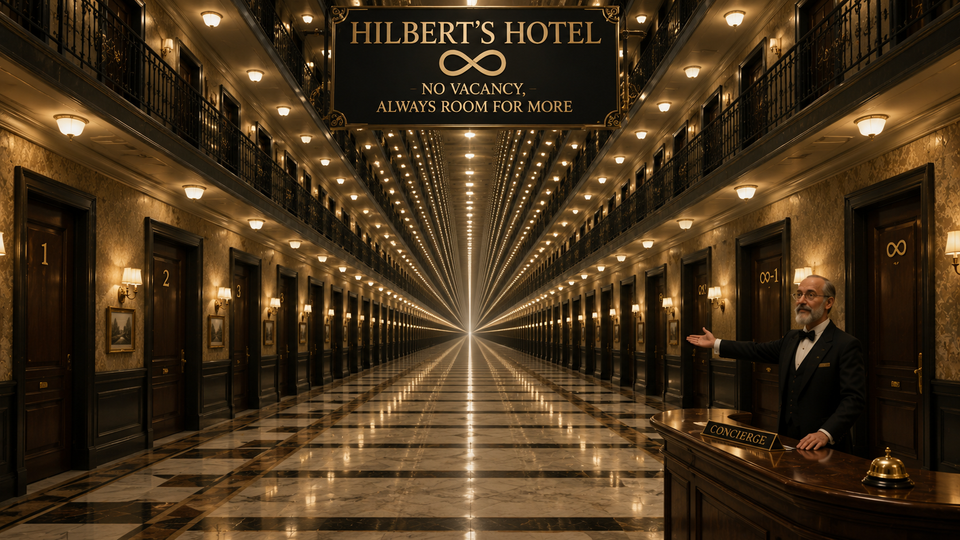
Imagine a hotel with infinitely many rooms, numbered 1, 2, 3, 4, and so on, forever. Every room is occupied. A new guest arrives. The front desk says: no vacancy.
But the manager has a solution. Ask every current guest to move one room up. The guest in room 1 moves to room 2. The guest in room 2 moves to room 3. And so on. Every guest gets a new room (their old number plus one), and room 1 is now empty for the newcomer.
No one is kicked out. Everyone has a room. And yet a fully occupied hotel just accommodated a new guest.
This thought experiment was devised by the German mathematician David Hilbert (1862-1943) to illustrate how infinity behaves differently from any finite quantity. With a finite hotel, full means full. With an infinite hotel, full does not mean there is no room.
Infinitely Many New Guests
It gets stranger. Suppose not one new guest arrives, but infinitely many. An infinite bus pulls up, carrying passengers numbered 1, 2, 3, and so on. Can the hotel accommodate all of them without evicting anyone?
Yes. Ask every current guest to move to the room with double their current number. The guest in room 1 goes to room 2. The guest in room 2 goes to room 4. The guest in room 3 goes to room 6. Now all the odd-numbered rooms (1, 3, 5, 7, ...) are empty, and there are infinitely many of them, one for each new guest.
This is where the original question gets its answer. Are there as many even numbers as odd numbers? Yes. In fact, there are as many even numbers as there are natural numbers altogether. The function that sends n to 2n establishes a one-to-one correspondence between the natural numbers (1, 2, 3, ...) and the even numbers (2, 4, 6, ...). Every natural number gets paired with exactly one even number, and every even number gets paired with exactly one natural number. Nothing is left over.
One-to-One Correspondence
This idea, called a bijection or one-to-one correspondence, is the key to the mathematics of infinity. Two sets are the same size if and only if their elements can be paired up with nothing left over on either side.
For finite sets, this matches our intuition perfectly. A class of 30 students with 30 desks has the same number of students and desks, and we can see this by pairing each student with a desk.
For infinite sets, the results are bizarre. The natural numbers (1, 2, 3, ...) can be put into one-to-one correspondence with the even numbers, the odd numbers, the perfect squares, the prime numbers, and even the rational numbers (all fractions). All of these sets are the same size of infinity: countably infinite, or aleph-null in Georg Cantor's notation.
This violates the ancient principle that the whole is greater than the part. The even numbers are a part (a proper subset) of the natural numbers, and yet they are the same size. Infinity does not play by the rules of the finite.
Why It Matters
Hilbert's Hotel is not just a clever puzzle. It reveals something fundamental about the nature of infinity: an infinite set can be put into one-to-one correspondence with a proper subset of itself. This is sometimes taken as the definition of an infinite set (the Dedekind definition).
It also opens the door to the question we will explore later in this series: are all infinities the same size? (Spoiler: they are not. Cantor showed that the real numbers are a strictly larger infinity than the natural numbers. But that is another story.)
Suggested Reading
David Hilbert, "On the Infinite" (1925). Hilbert's original lecture on the subject, available in many anthologies of mathematical philosophy.
Rudy Rucker, "Infinity and the Mind" (Princeton University Press). A lively and accessible tour through the mathematics and philosophy of infinity.
Amir Aczel, "The Mystery of the Aleph" (Washington Square Press). A narrative history of Cantor's work on infinite sets.