
Aristotle's Solution: Potential vs. Actual Infinity
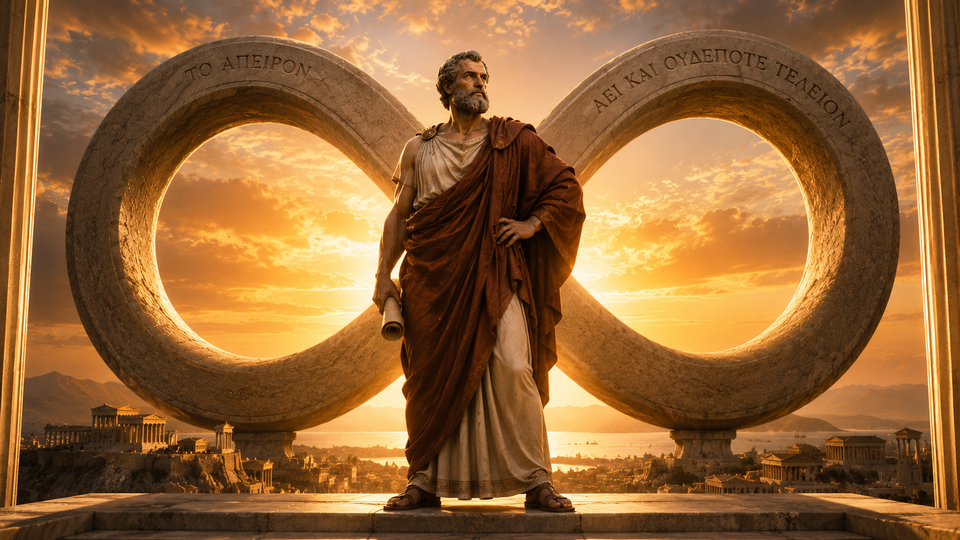
Does Aristotle solve the paradoxes of infinity? For over two thousand years, his answer was the dominant view in Western philosophy: infinity exists, but only as a potential, never as a completed whole. This distinction between potential and actual infinity is one of the most influential ideas in the history of thought.
The Problem
The previous episodes have shown that infinity generates paradoxes. You can divide a line segment forever, but this produces infinitely many pieces, and it is unclear how they relate to the original segment. You can count forever, but you never reach a final number. Infinity seems to be both unavoidable (we can always add one more, divide one more time) and impossible (we can never complete the process).
Aristotle's Distinction
Aristotle (384-322 BC) proposed a solution in the Physics (Book III, Chapters 4-8). He distinguished between two kinds of infinity:
Potential infinity: a process that can be continued indefinitely but is never completed. You can always count one more number, divide one more time, add one more step. The process has no natural end. But at any given moment, you have only completed finitely many steps.
Actual infinity: a completed infinite totality, existing all at once. All the natural numbers, gathered together as a single collection. All the points in a line, present simultaneously. An infinite set, considered as a finished object.
Aristotle accepted potential infinity and rejected actual infinity. There is no largest number, because you can always add one. But there is no completed collection of all numbers, because you can never finish gathering them. Infinity is a process, not a thing.
How It Solves the Paradoxes
This distinction dissolves many of the paradoxes. Zeno's Achilles does not need to complete infinitely many tasks, because the infinite divisibility of the racecourse is merely potential. In reality, Achilles runs a finite distance in a finite time. The infinite division exists only in the sense that we could (in principle) continue to subdivide the distance, not in the sense that infinitely many subdivisions actually exist and must be traversed.
Similarly, the line segment is not actually composed of infinitely many points. It is a continuous whole that can be divided but has not been divided. The points are potentialities of division, not actual constituents of the line.
The Dominance of Aristotelianism
Aristotle's solution dominated Western thought for over two millennia. Medieval philosophers (notably Thomas Aquinas) adopted it enthusiastically. The idea that actual infinity is impossible became a standard philosophical and theological commitment. God, being infinite, was an exception, but the created world was held to be only potentially infinite.
This had consequences for theology and cosmology. If actual infinity is impossible, then the universe cannot be infinitely old (because an actually infinite number of past moments would have had to elapse). Many medieval philosophers, following Aristotle's logic, argued that the world must have had a beginning.
The Challenge from Cantor
In the late 19th century, Georg Cantor shattered the Aristotelian consensus. He developed set theory and showed that actual infinities are not only consistent but mathematically indispensable. The set of natural numbers is a well-defined, completed infinite totality. So is the set of real numbers. And these two infinities are different sizes.
Cantor's work provoked fierce opposition. Leopold Kronecker called him a "corrupter of youth." Henri Poincare called set theory a "disease." But the mathematics proved robust, and by the mid-20th century, actual infinity was a standard part of the mathematical toolkit.
Whether Cantor refuted Aristotle is debatable. Some philosophers argue that Cantor showed actual infinity is mathematically consistent but did not show it is physically real. The question of whether physical space and time are actually infinite (containing actually infinitely many points or moments) remains open.
Suggested Reading
Aristotle, "Physics" Book III, Chapters 4-8. The original statement of the distinction.
A.W. Moore, "The Infinite" (Routledge). The best single-volume history, covering Aristotle through Cantor and beyond.
Michael Hallett, "Cantorian Set Theory and Limitation of Size" (Oxford University Press). A detailed study of Cantor's work and its philosophical implications.
William Lane Craig and James Sinclair, "The Kalam Cosmological Argument" in "The Blackwell Companion to Natural Theology." A modern defense of the impossibility of actual infinity applied to the past.