
Should we be as promiscuous as bonobos?
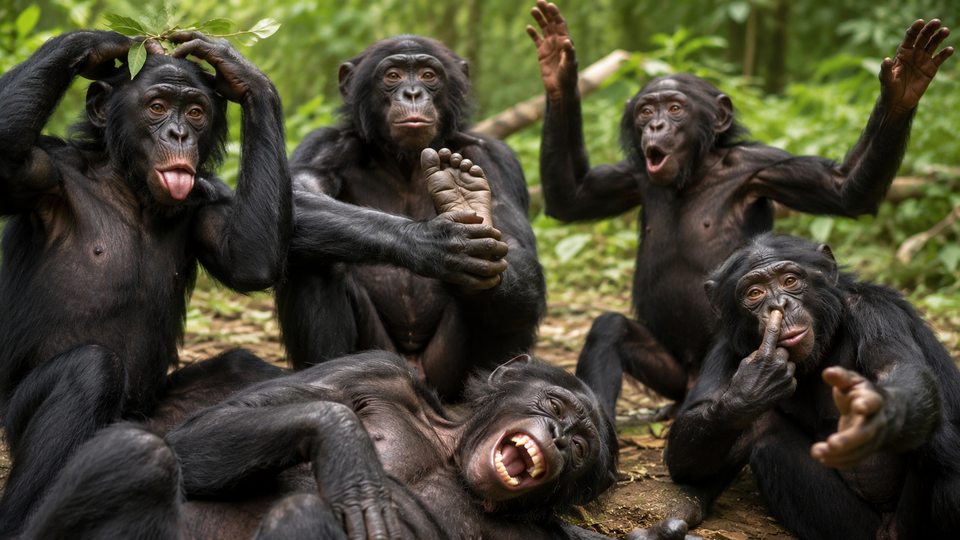
Bonobos share about 98.7% of our DNA, making them (along with chimpanzees) our closest living relatives. They live in remarkably peaceful societies. They resolve conflicts without bloodshed. And they are completely, uninhibitedly polyamorous.
Meanwhile, we humans have an epidemic of violence. Wars, assaults, murders, road rage. So here's a question worth asking: if the species most genetically similar to us has figured out how to live in peace, and the main difference is their sexual behavior, should we take notes?
Let's consider.
The Bonobo Model
The comparison between bonobos and chimpanzees is instructive. Chimpanzees are notoriously aggressive. They wage territorial wars, beat subordinates, and sometimes kill members of their own group. When chimps do use sexual behavior, it tends to come after conflict, as a form of reconciliation.
Bonobos reverse the order. They use sexual contact before conflict ever arises. When two bonobos encounter a tense situation (competition over food, a territorial dispute, a social slight), they engage in genital rubbing, mounting, or other sexual contact. The tension dissipates. Violence is averted. Publications like Scientific American and Psychology Today have documented this pattern extensively, and it's led some commentators to wonder whether humans are simply doing sex wrong.
The implicit argument goes something like this: bonobo societies are peaceful because they're polyamorous. Human societies are violent because we restrict sex to monogamous pairs (or try to). Therefore, adopting bonobo-style sexual openness would reduce human violence.
It's a tidy argument. It's also wrong in several important ways.
It's Not What You Think
The first problem is that people misunderstand what bonobo sexuality actually looks like in practice. When we hear "polyamorous society," we picture something appealing: attractive people having pleasurable sex with other attractive people, everyone walking around in a satisfied glow, too content to fight about anything.
That's not what bonobos are doing. They're using sex as currency, not pursuing it for euphoria. The bonobo who rubs genitals with a rival over a piece of fruit isn't experiencing some ecstatic encounter. It's a transactional behavior, more analogous to a handshake than a love affair.
Now translate that to human life. Imagine someone walks up to you on the street, ready to start a fight. How do you de-escalate? By the bonobo model, you'd engage in sexual contact with that person. Not someone you chose, not someone you're attracted to, not even necessarily someone of the sex you're attracted to. The bonobo model doesn't care about your preferences. It's indiscriminate by design.
That's a far cry from the fantasy most people entertain when they hear "what if everyone were polyamorous?"
The Selective Imitation Problem
There's a deeper logical problem with the "imitate the bonobos" argument, and it's one that any philosophy student should recognize: you can't cherry-pick which behaviors to imitate from a species and call it principled reasoning.
Bonobos also engage in sexual behavior with juvenile bonobos. If the argument is that we should adopt bonobo sexual practices because those practices produce peace, then consistency demands we consider all of their sexual practices, not just the ones we find palatable. Obviously, no one would advocate for that. But that's precisely the point. We're already applying a moral filter to decide which bonobo behaviors are acceptable and which aren't. And the moment we do that, we've admitted that "bonobos do it" isn't a sufficient justification for anything. We need independent moral reasoning to decide what's permissible, which means the bonobos aren't actually doing the philosophical work in the argument.
This is a version of the naturalistic fallacy: the move from "this is how things are in nature" to "this is how things ought to be." Nature is full of behaviors we'd never endorse. Some animals eat their young. Some species reproduce through coercion. Observing a behavior in nature tells us nothing about whether we should adopt it.
What We'd Lose
Even setting aside the logical problems, there's a values question worth confronting. Would a society built on sex-as-currency be one worth living in?
In Aldous Huxley's Brave New World, the dystopian society operates on exactly this principle. "Everyone belongs to everyone else" is a state slogan. Sex is ubiquitous, casual, and stripped of meaning. And the result is not paradise. It's a society of shallow, compliant people who have traded depth for comfort. Huxley's point is that when you make sex a social utility rather than something with personal significance, you don't just change sexual norms. You flatten the inner life of every person in that society.
This resonates on a personal level. For many people, sex is something sacred, something that carries meaning precisely because it's shared selectively. If it became a universal tool for conflict resolution, that meaning would evaporate. That's a real cost, and it's worth asking whether it's a cost we'd willingly pay, even in exchange for less violence.
Do We Really Need This?
The deeper assumption behind the bonobo argument is that humans can't handle violence through moral agency, so we need a biological workaround. But that assumption is worth questioning.
There are all kinds of ways to eliminate violence if you're willing to abandon human dignity. You could chain everyone up. You could sedate entire populations. You could remove all sources of conflict by removing all freedom. These "solutions" work in the narrow sense that they'd reduce violence, but no one would endorse them, because they treat humans as problems to be managed rather than agents capable of moral growth.
Saying we should use our bodies as instruments of peace isn't far from giving up on moral living entirely. Part of what it means to be human is the belief that we can choose not to be violent, even when we're tempted, even when it's hard. The fact that we sometimes fail doesn't mean we should abandon the project. It means we should keep working at it.
The Counterevidence
Finally, the empirical premise itself is shaky. If polyamory were a reliable antidote to violence, we'd expect sexually promiscuous people to be less violent. But there's no evidence for that correlation. Plenty of violent people are sexually prolific, and plenty of peaceful people are monogamous. The link between sexual openness and nonviolence that seems so clear in bonobo societies doesn't appear to transfer to humans.
And even the bonobo side of the comparison is overstated. Bonobos are less violent than chimpanzees, but they are not nonviolent. Researchers have documented aggression, coercion, and dominance behavior among bonobos. They're more peaceful than chimps, not peaceful in some absolute sense. The idealized picture of the bonobo utopia is itself a simplification.
The Takeaway
The bonobo argument is seductive because it offers a simple, biological solution to one of humanity's oldest problems. But it falls apart under scrutiny. It misrepresents what bonobo sexuality actually involves, it commits the naturalistic fallacy, it requires selective imitation that undermines its own logic, and it underestimates both the value of meaningful sexual relationships and the capacity of human beings for genuine moral agency.
The question isn't whether bonobos have found something that works for them. They have. The question is whether their solution is one that respects what we value about being human. And the answer, I think, is no.