
"Brave New World" by Aldous Huxley
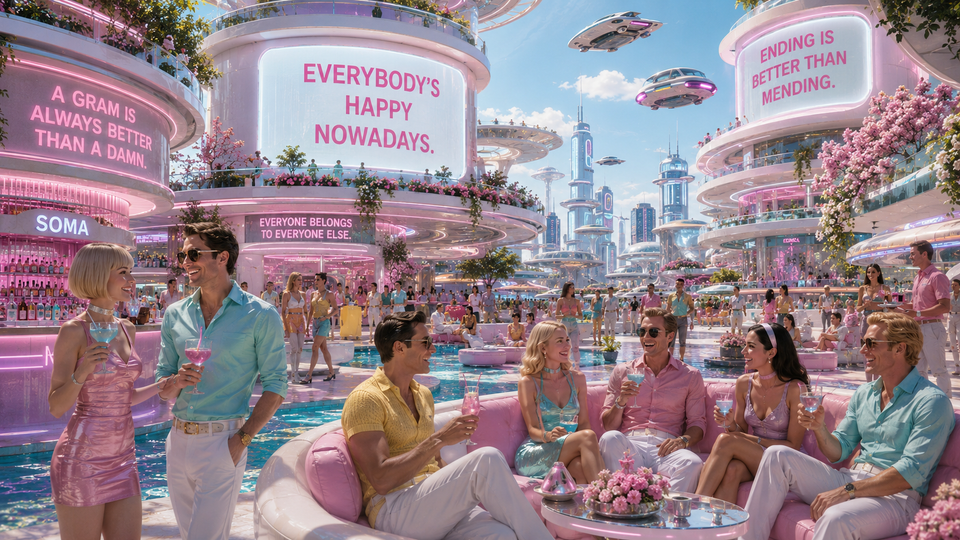
Aldous Huxley published Brave New World in 1932, and it remains the dystopia we are most likely to actually live in.
There are two great 20th-century dystopias, and most readers know them as a pair. George Orwell's 1984 fears a boot on the face — totalitarian violence, surveillance, fear. Huxley fears something subtler. He fears that we will be lulled into giving up our freedom voluntarily, in exchange for comfort, pleasure, and the absence of struggle. Neil Postman made the contrast famous in his 1985 book Amusing Ourselves to Death: Orwell feared those who would ban books; Huxley feared there would be no reason to ban a book, because no one would want to read one.
Look around. Which prophecy looks more accurate now?
This is the book where Huxley laid out his vision in full. It is messier and less elegantly plotted than its reputation suggests, the political implications are sometimes overcooked, and there are dated assumptions about race and eugenics that a modern reader will need to chew through. But the core argument is one of the most important pieces of moral philosophy disguised as fiction the 20th century produced. Let me show you why.
The Book in Thirty Seconds
The setting is the World State, sometime in the 26th century. Reproduction has been removed from families and moved into hatcheries. Children are decanted in batches, conditioned chemically and psychologically to fit predetermined social castes — Alphas at the top, Epsilons at the bottom — and trained from before birth to want exactly what they are supposed to want. Family relationships are illegal. Sexual partnerships are casual, frequent, and discouraged from ever becoming serious. Old age has been eliminated; everyone is youthful until they die at sixty. A drug called soma erases anxiety and grief without measurable side effects. Religion has been replaced by a state cult that has Henry Ford in the place of Christ.
The system is genuinely stable. Almost everyone is genuinely happy. The World State's motto is "Community, Identity, Stability," and by their own measure they have achieved all three.
The novel follows three characters who do not quite fit. Bernard Marx is a high-caste citizen who suspects something is wrong because he is physically odd for his caste and has felt the sting of social exclusion. Helmholtz Watson is a successful propagandist who senses he was meant for something more than writing jingles. John the Savage is a young man raised on a reservation outside the system who has read Shakespeare and believes in things the World State has engineered away.
The book is the story of what happens when these three confront the system at full strength, and the system answers them.
Huxley's Real Argument
The central argument is not that the World State is bad because it is cruel. The book is honest enough to admit that the system is, by ordinary measures, kind. It feeds people, removes their pain, ensures their belonging, and gives them pleasures of every imaginable kind on demand. The argument is that even if all of this is true, the system is still wrong.
Mustapha Mond, the Resident World Controller for Western Europe, gets the book's best speeches. He is not a stupid villain. He has read the books his society has banned, including Shakespeare and the Bible, and he can articulate exactly what they offer. He explains that the World State has consciously chosen comfort over depth, pleasure over meaning, stability over greatness. The trade-offs were intentional. Truth and beauty were sacrificed for happiness, and the system thinks this was the right trade.
The argument of the book is that the trade was wrong, and the way Huxley demonstrates it is more interesting than the argument itself.
The Sacrifices the System Does Not Notice
Huxley plants the answer in the texture of the world he builds, not in any single speech. Walk through what has been eliminated.
The system requires that family be dissolved. The word "mother" is obscene; the idea of parents raising a child is treated as a kind of dirty joke. Why? Because attachment to particular people produces the kind of loyalty that resists collective conditioning. You cannot fully belong to everyone if you also belong to someone.
The system requires that solitude be uncomfortable. Citizens are conditioned to be uneasy when alone. Why? Because solitude is where genuine thought happens, and genuine thought is the precondition for resisting the system. Huxley puts it bluntly through the Controller: it is natural to believe in God when you are alone. The system cannot allow anyone to be alone for long.
The system requires that waiting be unnecessary. Soma erases the gap between desire and satisfaction. Why? Because waiting produces longing, and longing is the engine of human depth. Having to wait is what teaches a person to want things at all.
The system requires that science be tightly controlled. Why? Because science is a process of free inquiry that produces uncomfortable truths. The World State permits applied technology but suppresses theoretical research. They have built their utopia on what science has already given them and they cannot afford for it to give them anything else.
The system requires that nobility and heroism become impossible. Mustapha Mond admits this openly. You cannot be a hero if nothing costs you anything. You cannot be noble if there is no struggle. The system has eliminated all the conditions that make moral excellence possible because moral excellence is destabilizing.
The list goes on. What is missing from the World State is exactly what makes a human life deep — particular love, solitude, longing, free inquiry, struggle, the possibility of greatness. Huxley's argument is that the system has not bought happiness. It has bought a flatter, thinner kind of contentment by amputating everything that gave the original article its weight.
The Soma Question
This is essentially the question Robert Nozick made famous in 1974 with his experience machine thought experiment, and I have written about it before in my post on Understanding Others. Nozick asked: if you could plug into a machine that gave you any subjective experience you wanted — perfect simulated happiness, simulated love, simulated meaning — would you do it? Most people, when they sit with the question, say no.
Soma is the experience machine in pill form. The fact that almost everyone in the World State takes it without hesitation is the most damning detail in the book. The citizens are not making the choice the rest of us make when we say we would refuse the machine. They have been engineered into not seeing that there is a choice.
The deep question Huxley is asking, then, is not "is happiness good?" but "what counts as happiness?" He is insisting on a distinction that runs all the way back to Aristotle: the distinction between pleasure and eudaimonia. Pleasure is a sensation. Eudaimonia is the flourishing of a creature actually doing what it was made to do. The World State has perfected the production of pleasure. It has destroyed every condition under which eudaimonia would be possible. That is the trade Huxley refuses.
There is a wonderful line in the book where the Controller observes that soma combines the advantages of Christianity and alcohol — meaning the religion gives the consolation without the demands and the bar gives the escape without the hangover. This is exactly what a real religion is not, and Huxley knows it. The criticism is built into the joke.
The Religious Thread
Huxley is unusually attentive to the religious dimension. The Controller in the book's climactic dialogue admits that without God, the system is degrading by the old standards — but explains that the World State has changed the standards. The response Huxley leaves open for the reader to make is the philosophical heart of the novel: if there is a God, then the old standards are still in force, whether the World State acknowledges them or not. The standards do not depend on whether the system permits them. They depend on whether there is a reality larger than the system to which everyone, including the system, answers.
Huxley does not, in this book, commit to the existence of that larger reality. He is too cautious for that, and his later religious explorations (he wrote The Perennial Philosophy in 1945) were more syncretic than Christian. But he sees the structure clearly. A society that has banished God has also banished any standard outside itself by which it could be judged, and the result is a community that cannot recognize its own degradation because it has no leverage from which to recognize anything.
The Freedom Debate
The book stages a debate about freedom that is worth pulling out, because it is one of the few places where the conflict between the three protagonists becomes explicit.
Bernard Marx wants to be free from conditioning. He wants to be himself, even when himself is unhappy. His desire is mostly aesthetic and personal; he has been excluded from the system's pleasures and would prefer to be the kind of person who can shape his own life. This is freedom from constraint.
Lenina Crowne wants to be free to have a good time. She accepts the conditioning and wants the system to keep providing her with what it has trained her to enjoy. This is freedom of indulgence.
What both miss, and what the book gestures toward through John the Savage, is a third option: freedom to be happy in some way other than what the system has assigned to you. Not freedom from constraint and not freedom to indulge, but freedom oriented toward a real good that you yourself have to discover, and to which you owe a real obligation. The first two kinds of freedom can coexist with the World State. The third kind cannot.
This is the freedom Christianity, Aristotle, and the deeper liberal tradition have all defended in various ways. It is the freedom that requires you to be a particular kind of creature — one that can recognize a good outside itself and reach for it. The World State has engineered exactly this capacity out of its citizens, and that is why the book reads as a horror story even though no one is suffering.
Cross-References to Other Posts
If you have been following the blog, several earlier threads come together here.
The Nozick experience-machine question I raised in my post on Understanding Others is the same question Huxley is asking about soma. The Christian view of human dignity I outlined in the Atlas Shrugged post is exactly what the World State has denied. The view of heroism and inner struggle I worked out from The Hobbit is what Huxley has Mustapha Mond explicitly eliminate from his society. And the question of what makes us human, which I worked through in the Do Androids Dream of Electric Sheep post, gets a different answer here: not empathy, but the capacity for the kind of attachments, longings, and struggles the World State has engineered away.
Huxley is essentially writing the dystopia that makes the points my other posts have been arguing about positively.
What to Read Alongside
If you enjoyed Brave New World:
- George Orwell, 1984 (1949). The other half of the 20th century's dystopian pair. Read both; they are arguing about different fears, and you need both diagnoses to see your own century clearly.
- Neil Postman, Amusing Ourselves to Death (1985). The book that brought the Huxley-versus-Orwell contrast into focus for a popular audience. Short, sharp, more relevant every year.
- C. S. Lewis, The Abolition of Man (1943). Lewis's philosophical companion piece. He saw exactly what Huxley saw and argued it without the fictional scaffolding.
- Aldous Huxley, Brave New World Revisited (1958). Huxley's own non-fiction follow-up, written twenty-six years later. He thought the world was moving toward his prophecy faster than he had expected.
The Bottom Line
Brave New World is the right book if you want to understand the form of unfreedom that our actual century is going to have to resist. It is the wrong book if you want polished prose or a satisfying tragic arc.
I think every serious reader should engage with it at least once. The book is a warning, and the warning is more applicable now than it was when Huxley issued it. The world has built more of the World State than anyone in 1932 expected.