
"Sophie's World" by Jostein Gaarder
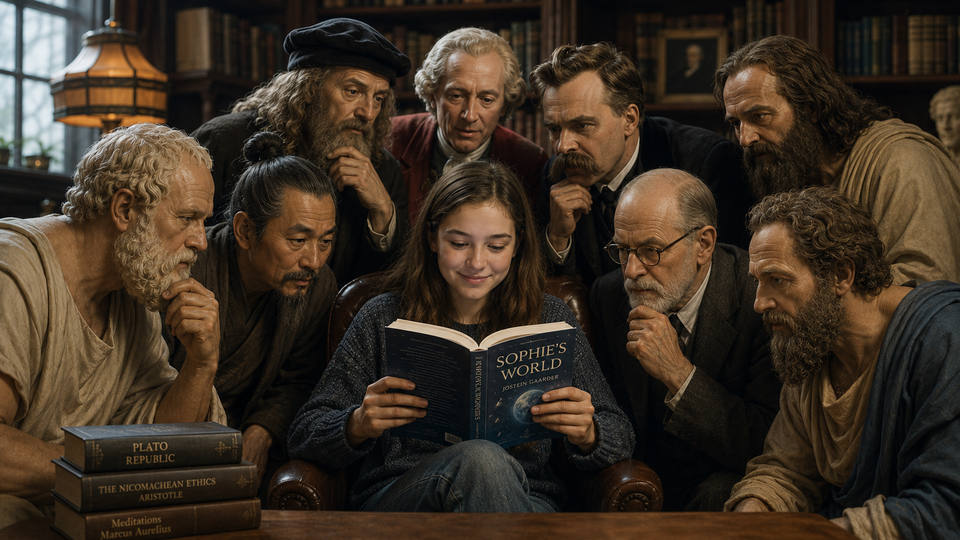
Should You Start with Sophie's World?
You decided you want to read more philosophy. Now you're standing in the bookstore — or the Amazon page, or the library catalog — and there are roughly six thousand books that claim to be the right introduction. Which one do you actually pick up?
This is the question I want to try to answer in this post, with a specific book in mind. Sophie's World, by the Norwegian writer Jostein Gaarder, has sold more than forty million copies since 1991 and has become the default first philosophy book for a generation of readers. Is it the right pick for you? Sometimes. Let me explain when.
The Book in Thirty Seconds
Sophie Amundsen is fourteen years old. She starts receiving anonymous letters that pose strange questions: Who are you? Where does the world come from? Each letter is followed by another that walks her through how a particular philosopher in history tried to answer the question. Along the way she also receives postcards addressed to a girl named Hilde, who has no obvious connection to her. About halfway through, the book pivots in a way I won't spoil, and the philosophical stakes of the story turn out to be much weirder than they first appeared.
Gaarder was a high school philosophy teacher in Norway before he wrote the book. Sophie's World grew out of his classroom, which is the most important thing to know about it. It explains both what the book is unusually good at and where it falls short.
The Pedagogy Question
There's an argument waiting near the front of the book that I want to address head-on, because it's the argument any serious reader will have with Gaarder's whole approach. It goes like this.
Philosophy is hard. Kant — no slouch at hard — said doing philosophy is work. If you want to read it, you should sit down with the primary sources, do the thinking, and not look for some sugar coating to make it palatable. Dressing the history of Western thought in a young-adult mystery novel is, on this view, slightly dishonest. It teaches you that philosophy comes with a plot.
I don't think this is right, and the reason lives on the other side of the same tradition. Socrates says philosophy begins in wonder. Aristotle says it too. Pope John Paul II makes the same point in Fides et Ratio. Wonder is the precondition. Without wonder, the work doesn't get started — you can sit in front of Kant's Critique of Pure Reason for a thousand hours and never actually start doing philosophy if you don't already feel the pull of the question.
Here is the thing about wonder: you can't summon it on command. You can't decide to feel it because it's the morally serious thing to do. Either the question grips you or it doesn't. And one of the legitimate jobs a teacher (or a book) can do is help you feel it. Stoking wonder is not a cheap trick. It's the precondition for the work Kant wants you to do.
This is the case for Sophie's World, and I think it's a real case. The novel form is a tool for getting a reader to the point where the philosophical work can actually begin.
What the Book Gets Right
A few things, and they are not small.
First, it gets people to finish it. There is an immense gap between books people start and books people complete, and almost every serious philosophy introduction lives on the wrong side of that gap. Sophie's World pulls readers through. That alone has done more for the popular reception of philosophy than fifty better-argued books that no one reads.
Second, it gives the reader a map. By the time you finish, you have a working mental picture of Western philosophy's main moves from the pre-Socratics through Sartre. The picture is rough and oversimplified — but it is a picture, and that means the next book you read has something to hang on.
Third, and this is the part that's almost never discussed: the meta-fictional twist in the middle of the book is itself the lesson. Without spoiling the mechanics, the story eventually forces the reader to ask whether Sophie really exists, and what it would even mean for her to exist. This is George Berkeley's idealism dramatized. The book is making you feel a metaphysical problem from the inside instead of explaining it from outside. That is, when it works, the highest thing a teaching novel can do.
What It Gets Wrong
A few things, and these are not small either.
It is not, strictly speaking, a great novel. Flannery O'Connor wrote brilliantly about why this kind of book is so hard to pull off — the harder a writer pushes a thesis, the more the fiction warps under the weight, until you can hear the author arguing through the characters' mouths. Sophie's World has this problem in places. The characters exist mostly to be taught at, and the prose is workmanlike rather than electric. Dostoevsky managed to write philosophy in fiction without this happening. Walker Percy did too. Iris Murdoch and Marilynne Robinson did. Gaarder doesn't quite.
It is also almost entirely Western. Confucius, Lao Tzu, the Buddha, the Islamic philosophical tradition, the Indian schools — all essentially absent. If you finish Sophie's World thinking you have a map of "philosophy," you actually have a map of one branch of it. Which is fine because the Western tradition covers so much, but it is definitely something of which to be aware.
And — for readers who care about this, which on this channel is many of you — Christianity in Sophie's World is mostly historical scaffolding rather than a live intellectual tradition. Augustine and Aquinas pass through quickly, treated more as figures of their period than as thinkers whose arguments still demand a response. That is not a fatal flaw. It is a thing to know going in.
What to Read Next
If Sophie's World worked for you and you want to know what's next, I would suggest picking a track:
- Stay narrative. Boethius’ Consolation of Philosophy next, then Walker Percy's Lost in the Cosmos for something modern and strange.
- Go to a primary source. Start with Plato's Apology. It is short, electric, and almost everyone who reads it cannot believe how alive it still feels twenty-four centuries later.
- Go problem-based. Sandel's Justice, or any good ethics anthology.
- Go Christian. Pieper's Leisure: The Basis of Culture, Lewis's Abolition of Man, Feser's Aquinas (the introductory one, not the big one).
That is enough material to keep you busy for a couple of years if you want it.
The Bottom Line
Sophie's World is the right first philosophy book if you have never read philosophy before, you want a guided tour rather than a problem to chew on, and you trust a novel to keep you moving. It is the wrong first book if you already know you want to dig into specific questions, if you cannot stand fiction that wears its lesson on its sleeve, or if you want a tradition broader than the Western canon from page one.
For most of the people who write me asking where to start, it is still my first recommendation. Just know what you are picking up.