
"The Brothers Karamazov" by Fyodor Dostoevsky
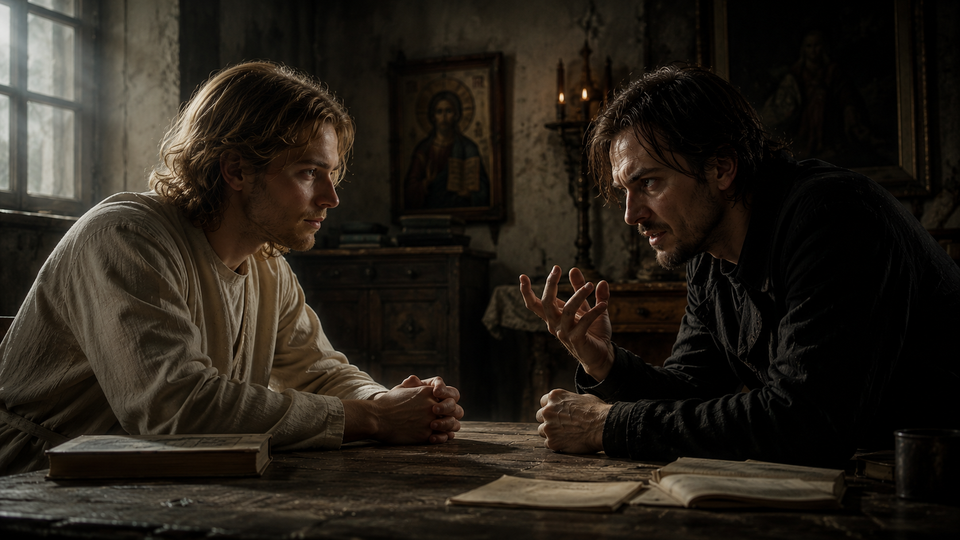
If There Is No God, Do You Get to Kill Your Father?
This is the question Fyodor Dostoevsky spent his last great novel asking. He published The Brothers Karamazov in 1880, the year before he died, and it remains the most important argument for and against religious belief that any novel has ever staged.
I love this book. I have taught with it, reread it, fought with it, and come back to it across two decades, and I am still discovering things in it. If you are looking for a single work of literature that does the philosophical work of an entire seminary curriculum, this is the one. It is also, in its quiet moments, one of the most humanly observant books in the Russian tradition — Dostoevsky was as good at writing people as he was at writing arguments, which is the rarest combination in serious literature.
This post is not a summary. The book is too long to summarize and too good to spoil. What I want to do is walk through the philosophical spine — what Ivan argues, what Alyosha answers, and why the conflict between them is still the most useful argument in print about whether the existence of God matters.
The Setup
The Karamazov family is a disaster. Fyodor Pavlovich, the father, is a shameless lecher — vain, dissolute, cruel without ambition, and entirely indifferent to the three sons he has neglected for most of their lives.
Each of the sons is a different answer to the question of how to be the child of such a father.
Dmitri, the oldest, is a boorish profligate with a hot temper, more like the father than he wants to admit, locked in jealous competition with Fyodor over a woman named Grushenka whom they both believe loves them. Dmitri hates his father, sometimes publicly and loudly.
Ivan, the middle son, is a brilliant intellectual and a quiet atheist. His rage at his father is colder and more articulate. Most of the philosophical work of the novel runs through Ivan's mind.
Alexei, called Alyosha, is the youngest. He is a novice monk under the elder Zosima, a strong Christian, and as close to a Christ figure as a non-allegorical novel allows. He is, in Dostoevsky's quietly remarkable phrasing, incapable of hate. Even of his father.
Fyodor is murdered partway through the book. Dmitri is the obvious suspect. He had motive, opportunity, and a thoroughly public record of saying he wanted his father dead. Whether he actually did it is the mystery the plot is organized around, but it is not the question the philosophy is organized around.
The book is great as a book. I want to talk about the philosophy, because there is a lot of it.
The Euclidean Mind
Early in the long conversation between Ivan and Alyosha that runs through the middle of the novel, Ivan makes an unusual epistemological move. He says he has a mind stuck in Euclidean space — the ordinary three-dimensional geometry of school textbooks — and he simply cannot conceive of non-Euclidean geometries. He acknowledges that mathematicians have shown such geometries are real and coherent. He acknowledges that there might be true things to say about them. He just cannot picture them.
Then he extends the move to God. If non-Euclidean space is already past the limits of what his mind can hold, God — by any serious definition — is much further past those limits. So Ivan declares himself epistemically incompetent on the question. He cannot understand God. He will not accept conclusions about a being he cannot understand.
It is a clever move and Dostoevsky knows it is clever. But the move quietly contains its own answer. Ivan acknowledges that we can say true things about non-Euclidean space — that parallel lines meet at infinity, for example — even when we cannot picture it. The fact that we cannot fully comprehend something is not a reason to refuse to know anything about it. This is exactly what serious natural theology has always claimed: that we can know real things about God by reason, even when full comprehension is unavailable. Ivan's modesty about his own mind, taken seriously, leaves the door open to the discipline he is trying to close.
Dostoevsky does not press the point. He just lets Ivan make the move and lets the reader notice that Ivan has not actually escaped the question. The rest of the novel is what Ivan does instead of escaping it.
The Rebellion
Ivan's next move is harder, and it is the most famous chapter in the book.
He brings Alyosha to a tavern and tells him a series of stories about the suffering of innocent children. The stories are real — Dostoevsky took them from newspaper accounts. A girl is locked in a freezing outhouse all night by her mother. A serf boy is torn apart by his master's hounds for accidentally hurting one of them. The stories accumulate, and they are not abstract. Ivan does not let Alyosha — or the reader — look away from any of them.
Then Ivan does something the standard problem of evil never does. He does not say: therefore God does not exist. He says: even if God exists, even if there is some grand harmony in the universe that ultimately reconciles all of this, I refuse to accept it. He says he is returning his ticket. He will not enter a heaven whose price was the tears of one tortured child. He does not deny the world's Maker; he rejects Him morally.
This is the move I want my readers to feel. Most modern versions of the problem of evil are a logical argument: God is supposed to be omnipotent and good, evil exists, therefore something has to give. Ivan is making a different kind of argument. He is granting, for the sake of the conversation, that God might exist. He is refusing the deal anyway. The universe is unjust. Justice would require that the good be rewarded and the evil punished. They are not. So the universe is unjust, and Ivan will not pretend otherwise to keep his place in it.
This is, I think, closer to what people actually do when they walk away from religious belief. They do not usually walk away because they have run an airtight syllogism. They walk away because something in the world has refused to fit their moral picture, and they refuse to fit themselves to the world.
Alyosha's answer is short and easy to miss. Christ shed innocent blood for all, he says, and therefore He can forgive all. The injustice of the world has been taken out on the most innocent person who ever lived. That is the only place the moral arithmetic can be made to balance — not in some hidden harmony at the end of time but on a hill outside Jerusalem on a Friday afternoon.
This is not, strictly, an answer to the standard problem of evil. It does not explain why suffering exists. But it is not trying to. It is answering the actual question Ivan asked — the question about whether the world's injustice can be answered at all — by pointing to where, in the Christian story, the injustice was answered. Whether Alyosha's answer satisfies you is a question I will leave to you. Whether it is the right answer is the question the whole novel is built around.
The Grand Inquisitor
Ivan does not accept Alyosha's answer. He responds with a poem he has been writing — the chapter known as "The Grand Inquisitor," which is one of the most influential pieces of writing in modern Western literature.
In the poem, Jesus returns during the Spanish Inquisition. The crowds recognize Him at once. He works miracles. He is arrested, on the orders of the Grand Inquisitor — a ninety-year-old cardinal of the Catholic Church — and held in a cell. The Inquisitor visits Him at night and delivers a long, careful, philosophically serious diatribe about why Jesus cannot be allowed to continue His work.
The diatribe is organized around the three temptations of Christ in the wilderness. Dostoevsky, through the Inquisitor, argues that Jesus made the wrong call on each of them.
The temptation of bread — turn these stones into bread to relieve your hunger. The Inquisitor says: you should have taken the bread. If you had given humanity bread, they would have followed you. Freedom and bread are incompatible because people, faced with hunger and given freedom, will always choose the food. Only an authority that controls the bread can also be trusted to choose what is best for them.
The temptation of the cliff — throw yourself down and the angels will catch you. The Inquisitor says: you should have done it. Humanity craves miracles. Without them, free will leaves people unable to feel certain that God is real. You imposed a faith without miracles and you condemned them to anxiety.
The temptation of worship — bow down to me and all the kingdoms of the world will be yours. The Inquisitor says: you should have bowed. A unified human authority could have done the work of conscience for people. They would never have to wonder if they were right; the authority would tell them. They would sin without guilt because they would be obeying. Their guilt could be lifted by the system that ran their lives.
This is, the Inquisitor explains, what the Church has done in the centuries since. The Church has corrected your mistake. We have taken away the freedom you gave them and we have given them bread, miracle, and authority. They are happier this way. We are doing what you should have done. And now you are back, and you are going to be in the way.
Then comes the move that makes the chapter unforgettable. Jesus, throughout the diatribe, has said nothing. At the end, He stands up, walks across the cell, and kisses the old man on his bloodless lips. The Inquisitor staggers. He opens the door and tells Jesus to leave. Jesus leaves. The kiss is His only response.
What the Inquisitor Was Really About
The Inquisitor is officially a Catholic cardinal, but Dostoevsky is not making an anti-Catholic argument. He is using the Catholic setting as a costume for a different target. The Grand Inquisitor's actual position — the rejection of freedom as too heavy for humanity to bear, the offer of bread and authority in its place, the willingness to lie to the masses for their own good — is Dostoevsky's portrait of the socialist atheism that was sweeping the European intelligentsia in his lifetime. He was writing the great novel of the late 19th century, watching exactly the ideologies that would produce the 20th century lining up to march.
The argument the Inquisitor makes is genuinely powerful. Freedom is heavy. Free will does bring anxiety. People do often prefer to be told what to do, what to want, who is good and who is bad, rather than figure those things out themselves. The 20th century made the Inquisitor's case in body counts of forty million per regime. Dostoevsky saw it coming.
And then Jesus kisses the old man, and walks out into the night.
I have spent a lot of time trying to understand the kiss. The best reading I have arrived at — and I think Dostoevsky meant it this way — is that Ivan, the author of the poem, has built a beautiful rational edifice for godless socialism, and there is one piece of the Christian story he cannot get out of his head: the love of enemies, the kiss for the persecutor, the silence in the face of the diatribe. The Inquisitor cannot argue with the kiss because the kiss is not an argument. It is what cannot be talked away. Ivan has constructed an unanswerable case against Jesus and then, in the poem he himself wrote, finds Jesus answering by an act of love that the case cannot absorb.
Alyosha, having listened to the whole poem in silence, then gets up and kisses Ivan. Dostoevsky is too good a writer to underline what this means. He just lets it land.
Free Will
The philosophical core of the Grand Inquisitor chapter is a question about freedom. Is free will a good thing?
The Inquisitor's argument is that free will is a curse. It produces anxiety, regret, guilt, the suffering of choosing badly. Most people would rather not have it. The state — religious or political — can take it from them and replace it with the relief of having one's choices made by an authority that knows better. Bread, miracle, mystery, and authority are what humans actually want. Freedom is what Christ thought we wanted, and He was wrong.
Dostoevsky's answer, embedded in everything else the novel does, is that free will is a good thing — but not in the way modern liberal cultures usually mean it. The freedom Christ offers in the New Testament is not the freedom to do whatever you feel like. That freedom, John's gospel says, is actually a kind of slavery — you become a slave to your desires, a slave to sin. The freedom Christ offers is freedom from that slavery. Free from sin, you are free to be who you were actually meant to be.
This is freedom as the unimpeded pursuit of your real good, not freedom as the absence of constraint on your impulses. It is closer to what Aristotle and Aquinas meant by freedom than what the modern liberal tradition means by it. It is also what makes responsibility possible. The truth sets you free, and the freedom that follows comes with the weight of actually being the person who chose.
Yes, this is harder than just being told what to do. The Inquisitor is right about that. And Dostoevsky, through the whole arc of the novel, argues that it is still better — that a soul that has chosen, suffered, sinned, and turned back is more real than a soul that has been managed into never having to choose. The whole tragedy of the Karamazovs is the tragedy of free people. The Inquisitor's regime would have spared them all of it. Dostoevsky thinks the sparing would have cost them their souls.
"If There Is No God, Everything Is Permitted"
The line from the novel that has shaped Western thought more than any other is Ivan's: "if there is no God, everything is permitted." It can be taken two ways, and the novel uses both.
The first reading is metaphysical. If there is no God, there is no ontological ground for moral truth. What makes it true that killing your father is wrong? Your father has no physical property — shape, color, mass — that makes harming him morally significant. There are no rules etched into the fabric of the universe that we have so far failed to find. The only thing that makes sense of moral law is a moral law-giver. If there is no moral law-giver, then there is, strictly speaking, no moral law. Nietzsche saw this clearly in the generation after Dostoevsky, and pressed it harder than anyone has before or since. I have a video on the Moral Argument for the Existence of God that develops this in detail.
The second reading is motivational. Even if you grant that there is some kind of moral law without God, why would you obey it? "Because you should" is not an answer; it assumes you already care about should-ness. If there is no God, no heaven, no hell, no final accounting, then the only reasons to be moral are reasons that depend on getting caught — social pressure, legal punishment, reputation. And those reasons disappear the moment you can be sure you will not get caught.
The novel works out both readings. Ivan articulates them, sometimes consciously and sometimes only in glimpses. Smerdyakov, a character whose role I will not reveal so as not to spoil the plot, takes the readings seriously and acts on them. The result is the catastrophe at the center of the book.
Dostoevsky's claim, embedded in the structure of the whole novel, is that the famous line is not just a clever observation. It is the truth that destroys the Karamazov family. Ivan thinks he is making a philosophical observation. Someone else takes it as a permission slip.
A Note for First Readers
The Brothers Karamazov is long, sometimes slow, and full of Russian names that change form according to grammatical case. Some practical notes for getting through it.
For a translation, the Pevear and Volokhonsky version (1990) is the modern standard and the one I recommend. The older Constance Garnett translation is in the public domain and serviceable, but Pevear and Volokhonsky catch more of Dostoevsky's actual rhythm. The Ignat Avsey translation (1994) is also excellent and slightly more readable for first-timers.
For a reading plan, Book 5 ("Pro and Contra") contains both Rebellion and the Grand Inquisitor. If you only ever read one book of the novel, that is the one. Book 6 contains Zosima's life and teachings, which are Dostoevsky's positive vision and the necessary counterweight to Ivan. The murder mystery occupies Books 8 through 12 if you want to read for plot. The final epilogue is short, hopeful, and one of the best last chapters in literature.