
"1984" by George Orwell
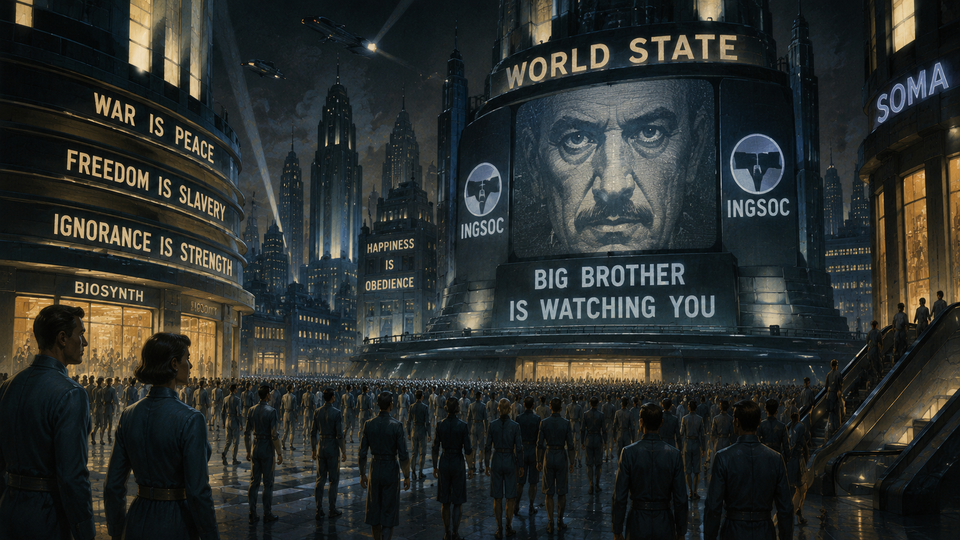
Does the Past Exist Only in Our Minds?
In George Orwell's 1984, the answer is yes — and that answer is the foundation of the deepest tyranny in modern literature.
The book was published in 1949, and it remains the most influential English-language novel about political power ever written. I cannot remember a year in the last decade when some commentator did not reach for it to describe what was happening in front of them, and I cannot remember a year when the comparison was not, in some important respect, apt. Orwell saw something about the way modern power works that the rest of us are still catching up to.
This post is the case for reading it now — and for reading it as the philosophical work it actually is.
The Author You Have Probably Been Underestimating
Orwell was born Eric Arthur Blair in 1903 to a minor British colonial official. He worked as a colonial police officer in Burma in his early twenties, hated it, came back to England, and spent the next decade as a struggling journalist and novelist with an unusual commitment to going where the suffering actually was. He lived among the homeless in London (Down and Out in Paris and London, 1933). He lived among unemployed coal miners in northern England (The Road to Wigan Pier, 1937). He was a socialist by conviction and a Britisher by formation, and he was sharper than almost anyone else in his generation about the gap between what the European left said and what it actually did.
What sharpened him decisively was Spain. He went to fight for the Republic against Franco in 1936 and ended up in a Trotskyist militia, the POUM, that Stalin's agents in Spain decided to destroy. The Communists turned on their fellow leftists, fabricated charges, ran show trials, and killed the POUM's leadership. Orwell was wounded by a sniper, fled the country with his life, and spent the rest of his career trying to tell a Western left that did not want to hear it what Stalin was actually doing. Homage to Catalonia (1938) was his first attempt. Animal Farm (1945) was his second. 1984 was his third and last.
He died of tuberculosis in 1950, less than a year after 1984 was published, at the age of forty-six. He spent the final weeks of his life in a hospital bed in Britain and worked on revisions to the manuscript until almost the end. The book is the work of a dying man who had seen the future and felt that nothing else was worth writing.
The World
Winston Smith lives in Airstrip One, a future Britain absorbed into Oceania, one of three superstates in a permanent rotation of strategic wars. The country is run by the Party. Life is harsh — there are rationing queues for everything, the buildings are crumbling, the synthetic gin tastes like nothing edible, and the electricity goes out unpredictably. Anyone who has lived in or studied the actual Soviet Union, Cuba, Venezuela, or East Germany under the Stasi will find the texture of daily life in Airstrip One uncomfortably familiar. Orwell did not invent it; he reported it.
Every waking moment is monitored. The telescreens in every room can hear everything and cannot be turned off. The crime is called thoughtcrime — any negative thought about the Party, any suggestion that the Party could be wrong, any imagination of a life that might be better. The Thought Police find you. They torture you until you repent. Then they shoot you.
The texture of the surveillance is not just technological. It is social. Children are encouraged to inform on parents, and several do. Friends are encouraged to inform on each other, and most do. Marriage requires Party approval, which is rarely given to people who actually want to marry each other. Sex is reframed as a procreative duty to the Party rather than an act of love between persons. The Party has worked methodically to sever every natural human relationship and replace it with loyalty to itself.
The slogan, posted everywhere: "BIG BROTHER IS WATCHING YOU."
Doublethink
The mental discipline required to live in such a society — to live without being arrested for the inevitable contradictions between what the Party says and what your own eyes can see — is called doublethink.
Orwell's account of it is one of the most precise things in the book. Doublethink is the ability to hold two contradictory beliefs at the same time and accept both of them. It is the ability to know that you are constructing a lie and at the same time to believe sincerely in the lie you are constructing. It is using logic against logic. It is repudiating morality while laying claim to it. It is believing that democracy is impossible and that the Party is the guardian of democracy. It is the ability to forget what needs to be forgotten, to bring it back when it is needed, and then to forget it again — and to apply this process to itself, so that the act of doublethink is itself forgotten.
The premise underlying all of it is the Party's claim that human beings are infinitely malleable. Squeeze them hard enough, in the right way, and they can be made to believe anything. Including, in the book's most famous example, that 2 + 2 = 5.
I think Orwell himself was unsure about how far this premise actually holds. The novel is partly a stress test of it. The book wants to know whether there is anything in a human soul that finally refuses to be reshaped, or whether the answer is no, the system can take you all the way down. The ending is the answer, and I will not give it away here, but it is worth noticing that Orwell asks the question with terrible honesty.
The Mutability of the Past
The deepest political technique in the novel — and the one this post is built around — is the Party's claim to control the past.
The Party teaches that whoever controls the present controls the past, and whoever controls the past controls the future. Winston works in the Ministry of Truth, which is where the past gets edited. Old newspapers, old speeches, old records get pulled, revised to match current Party doctrine, and reprinted. The originals go down the memory hole, an incinerator chute that destroys evidence permanently. If the Party said two years ago that the chocolate ration would never be reduced, and last week reduced it, then it becomes Winston's job to go back and revise the original announcement so it predicted the reduction. The change is then official. Anyone who remembers otherwise is mistaken.
The philosophical move underneath this is sharp. The Party reasons that the past exists in two places only — written records and human memories. The Party controls the records directly. The Party works on memories through doublethink, expecting citizens to revise their own recollections to match the Party's current account. Therefore the Party controls the past. The past becomes whatever the Party currently says it was.
The novel pushes the move to its logical extreme. O'Brien, the Party intellectual who interrogates Winston, argues that reality itself exists only in human minds — not in any individual mind, but in the collective mind of the Party. What the Party collectively believes is true. What the Party disbelieves is not. If the Party says 2 + 2 = 5, then 2 + 2 = 5, and any individual who insists otherwise is, by definition, mad. Sanity is statistical.
Two Philosophical Responses
There are two responses to the Party's claim about the past that the novel gestures at without developing, and I want to put them on the table.
The first is the B-theory of time. On the philosophical view sometimes called eternalism, all moments in time are equally real — the past, present, and future all exist, the way that all locations in space all exist. The past is not a fading set of memories about something that no longer is; it is an actually existing portion of reality that the present moment cannot reach but cannot erase. On this view, the Party is making a metaphysical mistake. They do not control the past at all. They control current beliefs about the past, which is a much smaller thing.
The second response is theological. Even if you grant that human knowledge of the past depends entirely on documents and memories, there is a knower who is not human and whose knowledge does not depend on either. God knows what actually happened, in itself, with no possibility of revision. The Party's revisions stop at the door of the divine mind, and what is true in the divine mind remains true regardless of what the documents say. This is one of the older Christian arguments against the moral nihilism of total power — there is always a witness who cannot be silenced.
Orwell, who was not religious in any orthodox sense, does not develop either response. But the novel is haunted by the question of whether anything outside the Party can be appealed to, and the failure to find such an appeal is one of the things that makes the book so dark.
The Kantian Misuse
The Party's underlying argument also leans, I think, on a misuse of a real philosophical tradition.
Immanuel Kant argued in the 18th century that we cannot know reality directly. What we know is reality as filtered through the structures of human consciousness — space, time, causation, the categories of the understanding. Reality "in itself" (the Ding an sich) is permanently inaccessible to us; we can only know it as it appears.
O'Brien quietly takes a version of this idea and weaponizes it. If reality is mind-dependent, and the Party controls the relevant minds, then the Party controls reality. There is no external court of appeal because, in some sense, there is no external court.
The move is a non sequitur, and it is worth pointing out exactly where it fails. Kant did not claim reality was only in individual minds; he claimed that we cannot access reality except through the structures of consciousness. The independent existence of other minds, and of an external world, was something Kant assumed throughout his work. O'Brien's argument quietly assumes that other people are real and reliable enough to share a collective illusion, while denying that anything else is real and reliable in the same way. Either the external world is uncertain in a way that makes other people uncertain too, or the external world is certain enough that the past should be too. You cannot have it both ways.
The novel does not catch O'Brien on this. The reader has to.
Newspeak
The other philosophical move in the book is linguistic. The Party is developing a language called Newspeak — a stripped-down version of English designed to make rebellious thought literally impossible.
The principles. Cut all synonyms. Cut all antonyms and replace them with prefixes (good and evil become good and ungood; bad becomes ungood, worse becomes plusungood, worst becomes doubleplusungood). Eradicate any vocabulary that allows the formulation of dangerous concepts. Words like freedom, justice, and democracy are removed from the language or stripped of their original meanings.
The underlying claim is that you cannot think of something for which you have no language. If the word for political freedom has been deleted from the vocabulary, then the concept can no longer be entertained, and rebellion becomes literally unthinkable.
This is roughly the Sapir-Whorf hypothesis from 20th-century linguistics — the idea that the structure of language shapes the structure of thought. Modern linguistics treats Sapir-Whorf as overstated in its strong form and probably true in its weak form. Orwell is, I think, mostly right here. You cannot think clearly about something for which you do not have concepts. Words are the primary vehicles of concepts. You can occasionally have a thought that you cannot quite name, but those thoughts are unstable and hard to develop. A regime that controls the language has a serious head start on controlling thought.
This is also, by the way, a live concern now in ways most readers do not notice. Every era has its preferred vocabulary for what is permitted to be said and what is not. The vocabulary changes, the practice continues. Orwell's diagnosis was specific to the totalitarian case, but the general phenomenon is everywhere, including in cultures that consider themselves free.
Orwell's Own Socialism
This is where I want to push back on Orwell a little, because the book deserves the honesty.
Orwell remained a socialist his entire life. He was clear that 1984 was not an attack on socialism as such but on the Stalinist perversion of it. He believed in democratic socialism — workers' ownership, government redistribution, broad equality — implemented through voting and protected by free speech and a free press. Animal Farm makes the same point: the pigs are not bad because they are socialist, they are bad because they have betrayed socialism by becoming the new ruling class.
I respect Orwell's position because I respect Orwell. But I have a hard time seeing the difference he wants me to see. Whether your property is taken from you by a small cadre of Party functionaries or by a voting majority of your fellow citizens, the property is gone. Whether your speech is restricted by the Thought Police or by the disapproval of a democratic majority, the speech is restricted. Whether your child is conscripted into the regime's ideology by Party schools or by curricula adopted through democratic processes, the child is being conscripted.
The thing 1984 demonstrates so vividly — the destruction of individual conscience by a politicized collective — is not a uniquely totalitarian risk. It is a risk anywhere collective decisions are allowed to override individual conscience, and that includes democratic societies. Orwell saw this in flashes. I think he did not quite want to face it.
This is not a reason to reject the novel. It is a reason to read it with one more layer of skepticism than even Orwell would have wanted. The diagnosis is sharper than his prescription.
Cross-References
If you have been following the blog, several previous posts converge here.
My post on Brave New World paired Huxley and Orwell as the two great 20th-century dystopias. They are arguing about different fears: Orwell about coercion, Huxley about seduction. Read both. You need both diagnoses to understand the actual century.
My post on The Republic worked out Plato's cycle of regimes — democracy decays into tyranny when its freedom dissolves into chaos. Orwell's Airstrip One is the late stage of that cycle, after the chaos has given way to the strong leader. Plato is the philosophical ancestor of Orwell's diagnosis.
My post on Is Philosophy Dangerous? tallied the body counts of 20th-century totalitarianism. Orwell wrote 1984 as the regimes that produced those body counts were consolidating. The book is his attempt to make the rest of us see what he had already seen.
What to Read Alongside
If you liked 1984:
- George Orwell, Animal Farm (1945). The shorter, sharper allegory. Read it first if you want a faster introduction to Orwell's diagnosis.
- Aleksandr Solzhenitsyn, The Gulag Archipelago (1973). The non-fiction version of what Orwell only imagined. Written by someone who survived it.
- Hannah Arendt, The Origins of Totalitarianism (1951). The most rigorous philosophical analysis of what Orwell was depicting. Written two years after 1984 was published.
- Aldous Huxley, Brave New World (1932). The other half of the pair. The two books together are more than the sum of their parts.
The Bottom Line
1984 is the right book if you want to understand the political technologies that the 20th century developed and the 21st century has not retired. It is also the right book if you want to test the limits of your own willingness to face an honest political diagnosis.
It is the wrong book if you want hope, or polished prose, or any author who shares your political assumptions without complicating them. Orwell will complicate them. He was not anyone's reliable ally. He was a man who had seen things and was trying to tell us before he ran out of time.
I think every serious reader should read it at least once. The book is not just a warning. It is a small, careful, brutally honest piece of philosophical observation about what political power tries to do when it gets the chance.
Your Turn
Two questions for the comments.
Which of Orwell's diagnoses do you actually see at work in your own country right now? Be honest. The diagnoses are uncomfortable across the political spectrum.
And the harder one. If you had Winston's choice — a small private rebellion that you cannot win but that you can perform — would you make it? Why or why not? What does your answer tell you about what you actually believe about truth?