
"The Hobbit" by J.R.R. Tolkien
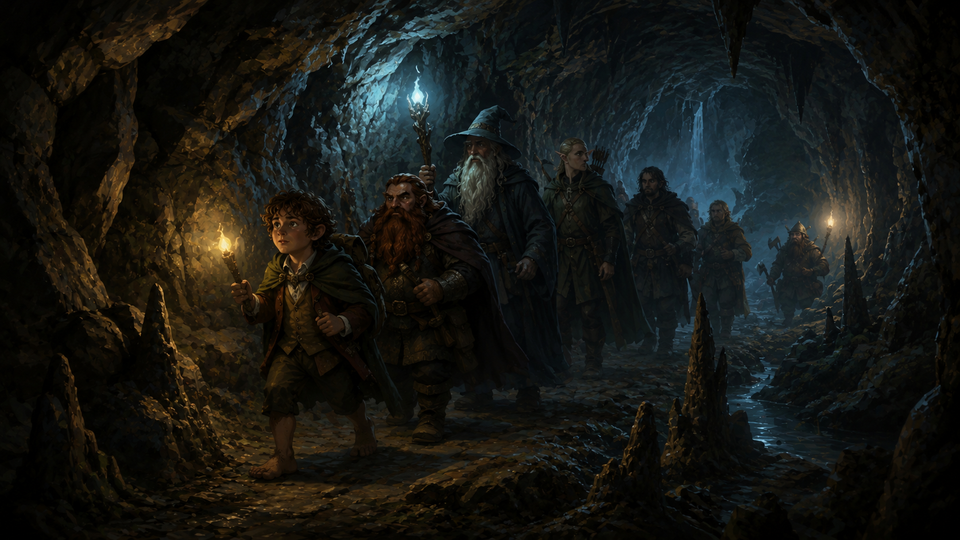
Is There Philosophy in The Hobbit?
Someone asked me recently whether The Hobbit counts as philosophy.
The question is fair. Tolkien's book has goblins and dragons and a riddle game in the dark. It is, by genre, an adventure novel. It does not sit anyone down and explain Kant. So is the philosophy actually there?
Philosophy is actually everywhere in The Hobbit — not in the sense that Tolkien wrote a tract dressed up as fiction, but in the sense that every serious story carries a moral world inside it, and Tolkien's moral world is unusually well-built. Tolkien himself hated allegory in his own work and said so explicitly. But hating allegory is not the same as having no philosophy. It is just a particular philosophy about how stories should work.
Let me show you what I mean.
Tolkien's Method (and the Argument with Lewis)
C. S. Lewis and J. R. R. Tolkien were friends for forty years. They disagreed about a lot of things, and one of the deepest disagreements was about what fiction is for.
Lewis used fiction to illustrate ideas. The Chronicles of Narnia are not subtle. Aslan is Christ. The Stone Table is the Cross. The Pilgrim's Regress is Lewis's own Pilgrim's Progress. The fiction is a vehicle, and the cargo is the doctrine.
Tolkien rejected this approach. He wrote in the foreword to The Lord of the Rings that he disliked allegory in all its forms and preferred history, "true or feigned." His view: a story should embody truth, not transmit it. The reader should walk through a world built on the right moral foundations and come out the other side with their imagination shaped, not their reasoning convinced. The truth seeps up through the cracks of the story rather than being pasted on top of it.
The other thing to know is that Tolkien was a serious Catholic. He famously described The Lord of the Rings as "a fundamentally religious and Catholic work, unconsciously so at first, but consciously in the revision." The Hobbit is less consciously religious, but the moral universe is the same one. Providence, grace, the dignity of small people, the value of mercy, the danger of pride — these are not Tolkien's ornaments. They are the structure he built the world on.
So the philosophy is there, but it has to be read out of the action, not preached over it. The book treats you like an adult by trusting you to do the moral noticing yourself.
Is the Quest Just?
The setup. A dragon named Smaug conquered the dwarven kingdom under the Lonely Mountain, killed most of its inhabitants, and is sitting on their treasure. Sixty years later, thirteen surviving dwarves under Thorin Oakenshield, with a wizard's blessing, set out to take it back. They recruit Bilbo Baggins, a respectable hobbit who has never had an adventure, to be their burglar.
Is it morally permissible to mount this expedition?
There is a long Christian tradition for thinking through exactly this kind of question. Augustine, Aquinas, Vitoria, Suárez, and Grotius developed what we now call just war theory, and the criteria are surprisingly applicable to a thirteen-dwarf revenge quest. Let me run the quest through them.
Just cause. The dwarves are recovering a homeland and inheritance that were stolen from them through unprovoked aggression. Yes.
Right intention. This is mixed. The dwarves do want their homeland back. They also want the treasure, and Thorin's family pride is in the equation. Just war theory says right intention does not require pure motives, but it does require that the just cause be the primary aim, not a cover for revenge or greed. Tolkien lets this question hang and forces the reader to watch the answer evolve in real time. By the end of the book, when Thorin refuses to share the recovered treasure with the people of Laketown, we have our answer: the intention was less pure than it looked.
Proper authority. Thorin is the rightful king under the mountain. Yes. (Bard later contests the proceeds of the quest, but not the right to undertake it.)
Last resort. Smaug is not negotiating. Yes.
Reasonable chance of success. This is the most interesting one. Fourteen against a dragon is not a reasonable chance — which is exactly why they recruit Bilbo, why Gandalf is involved, and why the whole quest depends on the small, hidden, unpredictable things rather than open battle. The traditional criterion gets reinterpreted: maybe a long-shot quest is permissible if it depends on the right kind of small-scale virtues.
Proportionality. Are the likely costs proportionate to the likely good? Before the quest, you would have said yes. After the quest, when you count Laketown's destruction, Thorin's death, and the Battle of Five Armies, the proportionality question becomes very hard. The book is honest about this. The quest was probably just at the start. By the end, the cost was higher than anyone calculated.
Just war theory does not give you a single verdict in every case. What it gives you is a structured way to ask the moral question. Tolkien builds a story where the question must be asked.
Is It Okay to Steal?
Bilbo steals five times over the course of the book. Each theft is a different moral case, and the differences are not accidental. Tolkien is teaching you to notice moral distinctions you might otherwise blur.
Aquinas worked through theft in detail in Summa Theologiae II-II Q66, and his framework is exactly what is needed here. His most striking move: in extreme necessity, taking what you need to survive is not theft at all, because the universal destination of goods — God's intention that the earth's resources sustain all human life — overrides private ownership in cases of dire need. Run Bilbo's five cases through this framework.
The troll purse. Bilbo's first theft. He picks the trolls' pockets under peer pressure from the dwarves and his own hunger. The trolls have stolen the food. Bilbo is hungry. This is closest to theft proper, except that the trolls are themselves robbers and murderers and their goods are largely stolen. Verdict: ambiguous, and Bilbo is appropriately embarrassed when he gets caught.
The ring. Found, not taken. Bilbo does fail to return it to Gollum, but the moral weight here is about deception (he conceals the ring) rather than theft as such. The book lets this look minor; the sequel will tell us it wasn't.
The elf food. Bilbo steals food from the elven king's kitchens while he and the dwarves are evading capture. Aquinas: necessity. Bilbo's life and his friends' lives are at stake. Not theft in the moral sense at all.
The dragon hoard. The dwarves take back what Smaug took from their ancestors. Is taking stolen things from a thief theft? The Western tradition has been clear about this for centuries. Restitution is not theft. The legal subtleties are real (Bard's claim on a share, the Laketown contribution) but the basic act of recovering stolen property is morally clean.
The Arkenstone. The deepest case, and it deserves its own section.
The Arkenstone
Near the end of the book, Bilbo takes the Arkenstone — the most precious gem in the dwarves' hoard, the one Thorin most wants — and secretly gives it to Bard and the elven king. They will use it as leverage to force Thorin to negotiate a peace.
Is this theft? Bilbo argues it isn't: he had been promised a fourteenth share of the treasure, and he was simply taking his share. The argument is technically true and morally a stretch. He knows perfectly well that the Arkenstone is not just any gem.
Is it betrayal? Yes. He hands his friend's most cherished possession to his friend's enemies.
Is it right? Yes. And this is the moment where the philosophy of the book reaches its highest pitch.
Aristotle distinguishes three kinds of friendship. There are friendships of utility (we use each other), friendships of pleasure (we enjoy each other), and friendships of virtue (we love each other's actual good). Only the third counts as full friendship. And the test of the third kind is exactly this: when the friend's own pursuit threatens the friend's own good, what does true friendship do?
The cheap answer is loyalty: support your friend no matter what. The deeper answer is harder. Thorin's obsession with the Arkenstone and his refusal to share the treasure are destroying him — they are dragon-sickness, a moral disease the book takes seriously as a spiritual condition. Bilbo's act removes the object of the sickness from his friend's grasp, and risks the friendship to do it.
There is a Christian intensification of this point. The New Testament teaches that the greatest love a person can show is to lay down their life for a friend. Bilbo lays down something harder than his life. He lays down the friendship itself, knowing he may be hated for it, because he loves Thorin more than he loves having Thorin's love.
The book confirms the verdict in two ways. Gandalf approves the act, which is Tolkien's authorial signal. And Thorin himself, dying, takes back his curses on Bilbo. His final speech acknowledges that there was more goodness in Bilbo than anyone, including Thorin himself, had recognized, and that the world would be a merrier place if more of us valued ordinary joys above accumulated treasure.
This is the moral peak of the book. It is not subtle Catholic theology, but the structure is unmistakable. Sacrificial love, undertaken for the friend's actual good, vindicated by the friend in the moment of his clearest seeing. The story embodies it without ever lecturing about it.
A Few More Pieces
The outline of my video covers more than this post can. Let me note the ones I haven't developed.
Courage as inner battle. When Bilbo stands alone in the tunnel knowing he must face Smaug, he conquers his urge to turn back. Tolkien tells us explicitly this is more courageous than anything that happens after. Aristotle in NE III.6–9 said exactly this: true courage is not the absence of fear but action in the face of fear. The action scenes count for less than the tunnel because the tunnel is where the inner battle is fought.
Heroism and rational egoism. The dwarves leave Bilbo to face the dragon alone because they are, as the book puts it, calculating folk with a great idea of the value of money. Tolkien is doing something deliberate here. The whole Western tradition from Plato through Aquinas to Kant insists that genuine heroism cannot be purely self-interested calculation. Ayn Rand argued the opposite in the 20th century, and Tolkien (writing earlier) had already drawn the line on the other side. A hero who calculates carefully whether the rescue is worth it to him personally is not a hero.
Responsibility for what you didn't intend. When Smaug destroys Laketown in his rage, are the dwarves morally responsible? Aquinas's doctrine of double effect helps here. The dwarves did not intend the destruction. They could plausibly not have foreseen it as a certainty, though Bilbo's accidental hint to Smaug raises the question. The proportionality, given what they were trying to achieve, is the hardest part. The book takes the responsibility seriously without resolving it, and Bard's later confrontation with Thorin is the moral consequence.
The Bottom Line
The Hobbit is an adventure novel that quietly carries one of the most coherent moral universes in 20th-century fiction. Tolkien did not lecture his readers. He built a world where the right moral questions had to be asked if you were paying attention, and where the answers, when they came, came from inside a tradition he had absorbed so deeply he could write it without naming it.
This is the Tolkien method, and it works. If you re-read the book as an adult with the moral tradition in mind, you find that the things you remember as adventure scenes are also philosophical case studies — and that the case studies are doing real work.
It is, I think, the best argument I know for the proposition that a story can teach without preaching. Lewis took the other path, and I love his books too. But Tolkien's path is the harder one, and when it works, the lesson goes deeper because it never announced itself as a lesson.