
What If God Gives You Exactly the Evil You Need?
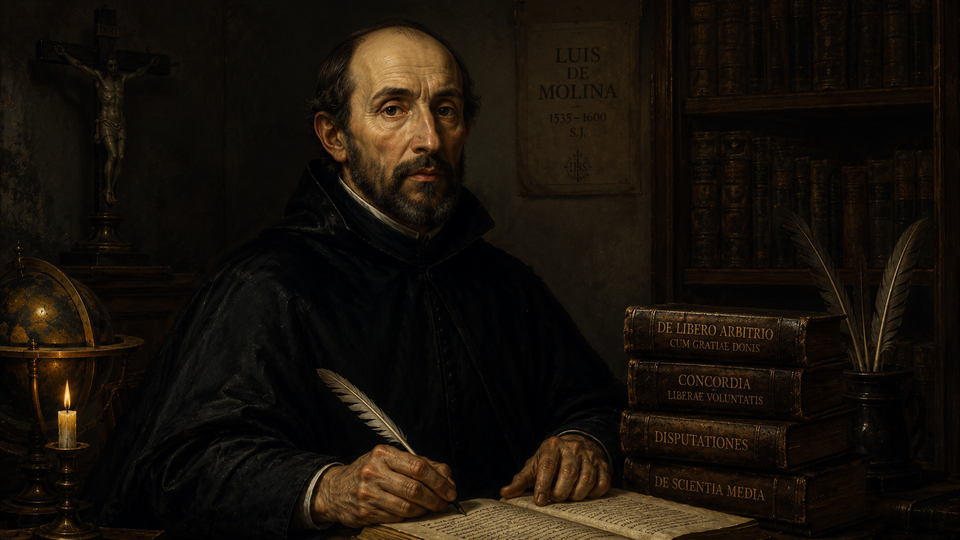
Why does God allow evil in your life specifically? Here's a strange possible answer: what if God arranges the circumstances of your life so that you get precisely the amount of hardship necessary for something incomparably good—your own free salvation—and no more than that? What would that even mean, and could it possibly be worth it? Let's dig into one of the most elegant, and most contested, theories in the philosophy of religion: Molinism.
Where We Are in the Series
Last time, we looked at reasons to doubt premise 2 of the logical problem of evil—the claim that God, if good, would necessarily prevent all evil. I argued that this premise assumes God is a moral agent just like us, when in fact His goodness might work analogically rather than univocally, the way "healthy" describes both vitamins and people without meaning quite the same thing in each case. If that's right, premise 2 isn't obviously true, and the problem of evil as a logical disproof of God already fails—full stop.
So, strictly speaking, we don't need to find an actual reason God allows evil in order to answer the logical problem of evil. But it would satisfy our curiosity to consider some candidates anyway. Today's candidate comes from a 16th-century Spanish Jesuit priest named Luis de Molina (1535–1600), whose theory is called, appropriately, Molinism.
The Question Molinism Was Built to Answer
Molina wasn't actually trying to solve the problem of evil. He was wrestling with a much older puzzle in Christian theology: how can God predestine people for salvation while those same people are also freely choosing to accept it? If God picks who gets saved ahead of time, in what sense do we have any real say in the matter? And if we do have real say, how can God's choice be settled in advance?
The Machinery: CCFs and Possible Histories
Here's how Molina's solution works. Imagine a complete list of every circumstance you've ever been in—conception, birth, your first day of school, a philosophy class you happened to take in high school, meeting your future spouse, hearing the Gospel preached for the first time, and on and on. At certain points along that timeline, you hit what we might call free will moments: forks where you could genuinely go one of several ways. Take that philosophy class, and maybe you become a philosophy YouTuber, or maybe you get a "real job," or who knows what else. Meet a pretty girl at a party, and you could ask her out, walk away, or (if you're feeling bold) go with the double-finger-guns-and-a-wink approach.
Molinists hold that there's an actual fact of the matter about what you would freely choose at each one of these forks—not that you're determined to choose it, but that it's simply true, even before it happens, that this is what you would freely do. Philosophers call these truths "counterfactuals of creaturely freedom," or CCFs for short: statements about what a free agent would choose in some circumstance, even a circumstance that never actually occurs. Change the circumstances even slightly at one of these forks, and you'd likely get a different result: take an engineering class instead of that philosophy class, and maybe you become an engineer and make real money instead. Take an art class, and, well, who knows—maybe you become a tormented painter and do something rash with your ear.
Sometimes, changing one choice ripples forward and changes everything downstream: become an engineer, and maybe you never meet your spouse, never have your kids, and an entirely different set of "alternate histories" opens up for everyone connected to you.
God, being omniscient, knows every single one of these CCFs—every possible circumstance, and exactly what every possible free agent would freely choose in it—along with how they all interact and cascade into complete alternate personal histories. This comprehensive knowledge of counterfactuals is traditionally called middle knowledge(positioned, in Molina's framework, between God's knowledge of all necessary truths and His knowledge of what He actually decides to create)—though the label itself isn't the important part.
The Payoff
Here's how this solves Molina's original puzzle. Before creating anything, God surveys every possible person, every possible circumstance, and every combination of free choices those circumstances would produce. He then chooses to actualize the specific set of circumstances and people in which those who would freely choose salvation actually do so. In other words, God predestines who is saved by selecting which world to create—a world already populated by the free choices its inhabitants would make—rather than by overriding anyone's will. You end up freely choosing salvation, and God ends up having predestined you for it, and neither one cancels out the other.
The Hard Question: Why Not Save Everyone?
The obvious next question is why God wouldn't simply choose to actualize a world where everyone freely chooses salvation. Molinism wasn't originally built to answer that, but here's roughly how a Molinist might extend it. Take someone like Bertrand Russell, the philosopher, who spent much of his life explicitly rejecting theism (his 1927 lecture "Why I Am Not a Christian" remains one of the most famous statements of that rejection). Maybe there's no possible circumstance in which Russell would have freely chosen salvation—no CCF where he says yes—yet his existence still turns out to be necessary background for other people's paths to salvation. Or, alternatively, maybe there are circumstances where Russell would have said yes, but his conversion would have derailed someone else's path to faith. Imagine, purely hypothetically, that if Russell had converted, a young William Lane Craig never gets provoked into building his career defending Christianity against skeptics like Russell—and countless people who were moved by Craig's work never come to faith as a result. Either way, on the Molinist picture, God is maximizing something like the total amount of freely chosen salvation across every actual and possible person.
The Grounding Objection
Here's the sharpest challenge to the whole framework, and I think it's a real problem: what makes any of these CCFs true in the first place? Before God creates anything, nothing exists yet—including Bertrand Russell. Suppose God considers a possible counterfactual circumstance: Russell, on his deathbed, receives one last visit from Alvin Plantinga, who shares the Gospel with him one final time. What does God "see" when He looks at this scenario? Since it never actually happened, there's nothing about the real Russell (who never had this deathbed conversation) that could settle the matter one way or the other.
Here's the deeper issue: if it's genuinely undetermined what a merely possible Russell would do in this scenario, isn't it also possible that there's a different possible person, exactly like Russell in every respect, except that this version would say yes at the deathbed? If there's no fact yet grounding the answer, both versions seem equally possible—so why would God have created the Russell who says no rather than the qualitatively identical version who says yes?
The same problem multiplies when you consider how one person's choice can be tangled up with someone else's. Imagine Russell has a hypothetical estranged cousin, we'll call him Ernie, who secretly resents Russell and only turns to faith out of relief when Russell dies unconverted—but who would have rejected the Gospel out of spite if Russell had converted instead. Fine, so maybe that particular pairing gets us to only one convert instead of two. But isn't there also a possible version of Ernie who would choose salvation regardless of what Russell does? If both versions of Ernie are equally "possible" before either is actual, why would God pick the version whose salvation depends on someone else's damnation?
The only way to escape this objection is to insist that these alternate, more cooperative versions of Russell and Ernie simply aren't possible at all—but it's hard to see what could possibly make that true, since nothing about them seems to involve any contradiction.
Back to the Problem of Evil
Set the grounding objection aside for a moment and go back to why we're here. Molinism, applied to the problem of evil, would say: God allows exactly the evil necessary for the greatest possible amount of freely chosen salvation, and no more. Remember Ernie: in that scenario, he needed Russell's evil choice (rejecting God) in order to make his own good one. But here's the problem this objection exposes: if there's a version of Ernie who would choose salvation without needing Russell's rejection as a trigger, then God didn't actually need that particular evil after all—He could have created the version of Ernie who doesn't require it. Once you press on this hard enough, it looks like Molinism can't actually guarantee that any specific evil was strictly necessary for any specific good. And if it's not necessary, what was it for?
Where This Leaves Me
Here's an honest, personal aside. I didn't become a Christian through suffering. I became a Christian because I met my wife—she was a thoughtful, intelligent person who believed for reasons that struck me as serious, and that was enough to make me actually investigate the faith for myself. But my friend Dallas came to Christ through real evil: he was diagnosed with a brain tumor, started attending Bible study mostly to placate his wife, and then one night got a phone call that she might lose their unborn child. Something broke open in him that night, and he gave control over to God. The rest, as they say, is history.
Both paths were real. Some people come to God through good things; some come to Him through terrible ones. I don't think Molinism, strictly, is right that God needs evil as a means to bring about salvation—the grounding objection gives good reason to doubt that. But I do think something is right in the neighborhood of Molinism's basic insight: God doesn't need evil to accomplish anything. He allows us to make evil choices. He allows terrible things to befall us that aren't anyone's choice at all. And then, somehow, He takes what was genuinely evil and works it toward something good. That's a subtly different claim than Molinism's, and I think it's the more defensible one—but we'll have more to say about it in future episodes.