
What If God Just Isn't That Good?
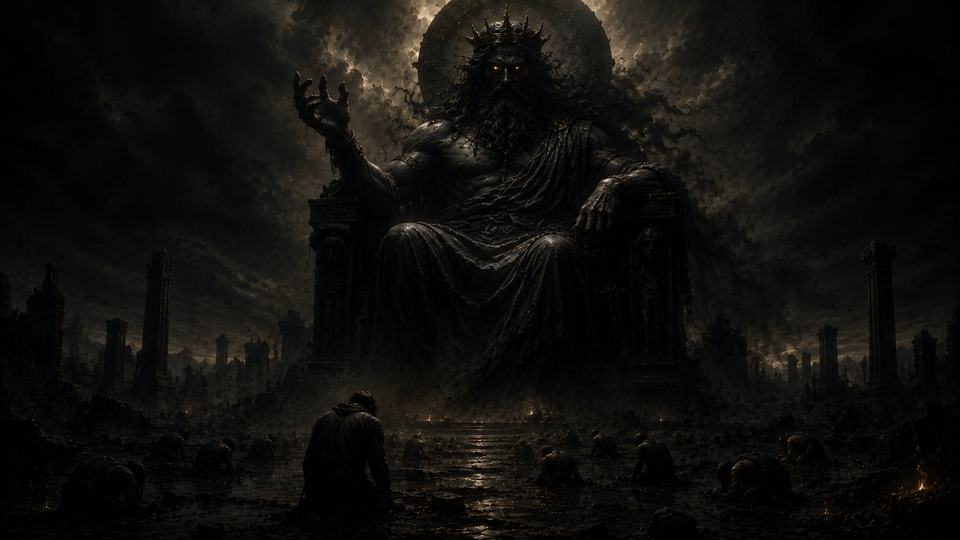
One of the biggest questions anyone can ask is how a good God could allow evil. But here's an uncomfortable thought experiment: everyone we know does something wrong sometimes. Nobody's perfect. So why do we assume, without a second thought, that God must be a special exception? What if the existence of evil is simply God's fault—because God isn't actually all good?
This post starts a run of several episodes exploring responses to the problem of evil that all attack the same premise: premise 2.
- If God exists, God could prevent evil.
- If God exists, God would prevent evil (because He's all-good).
- So, if God exists, evil doesn't exist.
- Evil exists.
- So, God doesn't exist.
The supporting argument behind premise 2 quietly assumes two things: that God is 100% good, and that God couldn't possibly have any good reason for allowing evil to exist. Today we're only tackling the first assumption. Why, exactly, should we believe God has to be entirely, unqualifiedly good?
Isn't This Just Atheism With Extra Steps?
Before getting into the substance, there's an obvious objection worth clearing up front: doesn't saying "God might not be good" sound like something an atheist would say, not a theist? Actually, a little thought shows this can't be quite right. Saying "God is evil" presupposes that God exists—an atheist has nothing to be angry at, because on her view there's no one there. You can't shake your fist at a being you don't think exists.
More importantly, if this response works, it actually defeats the whole problem of evil, rather than supporting it. If premise 2 is false—if God, should He exist, wouldn't necessarily prevent all evil—then the argument's third step never gets off the ground, and the whole logical problem of evil collapses. So what the atheist would actually need to say isn't "God is evil," but something more like "if God existed, He would be evil"—which, notice, is exactly what the problem of evil is already claiming when it says God would prevent all evil if He were good. The real question isn't whose "side" this idea is on. It's whether it's actually reasonable to think God could be anything less than fully good.
Reason One: God Has No Motive to Be Evil
Here's an argument for thinking a "not-good God" doesn't actually make sense. If God exists, He's the kind of being who brought everything else into existence out of nothing. That means He's all-powerful and all-knowing, and if He's existed for an eternity past, He's also fully self-sufficient—He doesn't lack anything and never has.
Now think about why creatures like us actually do evil things. Nearly every evil human action traces back to some kind of shortcoming: temptation, insecurity, ignorance, fear, a corrupted desire, wanting something we don't have. But God, by definition, has none of these deficiencies. He's not missing anything, tempted by anything, or threatened by anything. So what would His motive for evil even be? Evil actions generally serve some purpose for the agent committing them—even cruelty usually satisfies some twisted psychological need. Strip away every possible motive, and you're left with a being who simply has no reason to do wrong. That doesn't prove God can't be evil with metaphysical certainty, but it makes "God is evil" look like a much weaker hypothesis than it first sounds.
Reason Two: God as the Standard, Not the Student
Here's a second argument, and it draws on a much older puzzle: the Euthyphro Dilemma, which goes back to Plato's dialogue of the same name, written around 380 BC. Socrates asks whether something is good because the gods love it, or whether the gods love it because it's already good. Take the first horn, and goodness looks arbitrary—God could have called cruelty "good" and it would have been so. Take the second horn, and goodness exists independently of God, sitting above Him as a kind of external rulebook He has to measure up against, which seems to compromise God's supremacy.
Classical theism's typical way out (which I explored more thoroughly in an earlier video on the Euthyphro Dilemma) is to argue that God doesn't invent moral facts arbitrarily, nor does He answer to some independent moral law floating above Him—rather, He is the standard. Here's the analogy I like: vitamins are healthy, and people are healthy, but not in exactly the same sense. Vitamins are healthy because they cause health in people. Similarly, on this view, God is good not because He measures up to some external checklist, but because He's the ultimate reference point that goodness itself is measured against.
If that's right, it changes the logic of premise 2 substantially. That premise assumes we can read off what God would do based on what a good human would do in His position—if you or I could stop suffering at zero cost to ourselves and didn't, we'd rightly be called monstrous, so surely God would act the same way. But if God's goodness works analogically rather than univocally—if He isn't good the way we're good, but is instead the source and standard of goodness itself—then we can't simply project human moral reasoning onto Him and expect it to hold. God does what He does, and that just is good, by definition, rather than being good because it matches some independent rule we could check His actions against.
I'll admit that's not going to satisfy everyone, and there are two reasons it might rub you the wrong way.
First worry: doesn't this mean God could do literally anything and it would automatically count as "good"? What if He made an absolutely horrific world—could that possibly count as good too, just because He made it? Here the same Euthyphro discussion helps again: God's nature doesn't change, and it has never included cruelty for its own sake. A world where helping others is good is the kind of world consistent with who God has always been. He has the raw power to do otherwise, in one narrow sense, but a genuinely different, malevolent world was never really on the table, because it isn't consistent with a nature that has never changed and never will.
Second worry: if God dictates what's good or evil, doesn't He presumably still select those values in a way that reflects His own nature? Surely He chose love as a good thing, for instance, because love is somehow built into what He is. If that's right, we shouldn't expect God's decisions to be totally alien to us—we should expect at least some resemblance between what's good for us and what's good in itself, since our goodness derives from His. Even though we can't judge God's actions the exact way we judge each other's, there's still likely some connective tissue between His nature and the moral order He's set up. Which raises the very natural next question: even if it's true that God isn't a moral agent exactly like us, and even if we can't simply demand He act the way a good human would, doesn't it still seem like there should be some good reason behind whatever evil He allows?
The Uncomfortable Symmetry
There's a deeper wrinkle worth being honest about. If we can't independently evaluate whether God is evil—because there's no external standard to measure Him against—then by the very same logic, we can't independently evaluate whether He's good either. The move that gets God off the hook for evil is the same move that would prevent us from praising Him for good. That's a genuinely uncomfortable symmetry, and I don't think it's fully resolved just by pointing to God's unchanging nature; it's part of a bigger conversation about the Euthyphro Dilemma that deserves its own treatment.
Where This Leaves Us
So here's where we've landed after two arguments: there's good reason to think God, if He exists, has no motive to do evil, and separately, good reason to think the very concept of judging God against some external moral yardstick doesn't apply the way it applies to us. Together, these give us real reason to doubt premise 2 in its original form—the assumption that we can simply read off "God would prevent this evil" the way we'd expect a good person to.
But notice what this discussion has actually set up rather than settled: even granting that God isn't a moral agent exactly like us, it still seems reasonable to expect some kind of resemblance between what's good for us and God's own nature. And that means the door is now open to a different, and I think more interesting, question: even if we've shown God doesn't have to prevent every evil, are there specific, positive reasons He might have for allowing the evils we actually see? That's exactly where this series goes next—looking at candidate reasons God might have for allowing evil, from Molinism to the Free Will Defense to Character Building, each one a hypothesis about what good might be worth the cost.