
What If God Just Isn't Strong Enough?
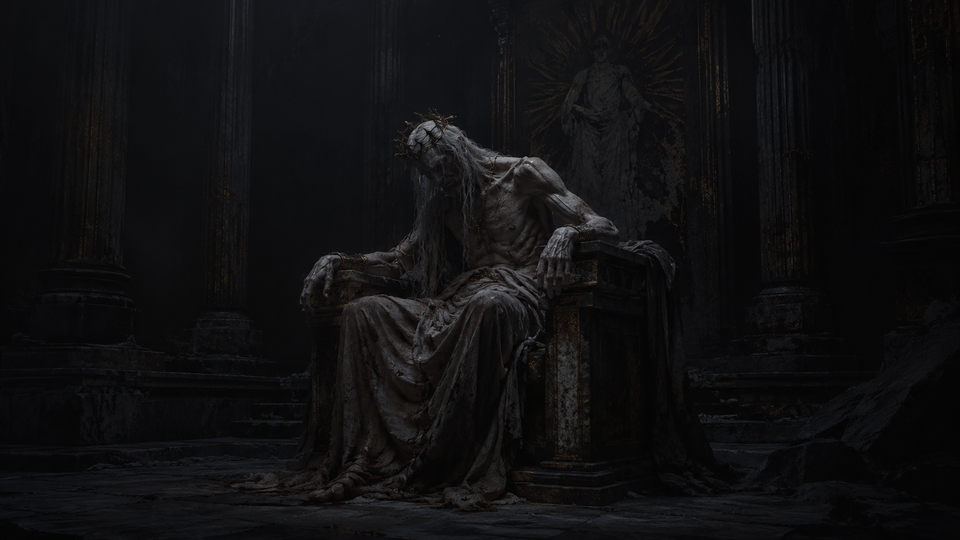
What if God couldn't prevent evil—not because He chose not to, but because He simply isn't powerful enough? What if God isn't as powerful as we've always assumed?
Before I get into it, I want to say two things clearly. First, I know that "Mormon" and "LDS" aren't the terms the Church of Jesus Christ of Latter-day Saints currently prefers—its president, Russell M. Nelson, asked members and non-members alike to stop using those terms back in 2018. I've explained on this website why I'm going to keep using the traditional shortened names anyway, and I mean no disrespect by it; if you want the full explanation, it's a click away. Second, and more importantly: I am not LDS, and I disagree with some fundamental tenets of the faith. But Latter-day Saints get unfairly mocked by a lot of people, and I don't like being mocked for my own faith, so I'm not going to do that to anyone else's. This is a serious attempt to understand and engage a view many Christians dismiss without ever really learning it. If any LDS viewers spot something I've gotten wrong, please correct me—I did my homework, but I'm not a member, and I'd rather be corrected than misrepresent the view.
Randy
My wife's uncle, Randy Castillo—the pride of Albuquerque, by all accounts—died of cancer. Her grandmother stopped going to church for years afterward. She was furious at God. Why? Because she believed God could have saved Randy, and simply didn't.
That anger only makes sense on a certain assumption: that God had the power to stop it and chose not to use it. But what if that assumption is false? What if God genuinely couldn't have saved Randy—not because He didn't want to, but because the power just wasn't there? Would Randy's grandmother still have a reason to be angry at God? This is the question the LDS response to the problem of evil forces us to sit with.
Back to the Argument
Recall the logical problem of evil:
- If God exists, God could prevent evil (because He's all-knowing and all-powerful).
- If God exists, God would prevent evil (because He's all-good).
- So, if God exists, evil doesn't exist.
- Evil exists.
- So, God doesn't exist.
And recall that premise 1 rests on a supporting argument built from God's omniscience and omnipotence—among other things, the premise "God is all-powerful" (premise 10 in the fuller version of the argument). The LDS response we're looking at today attacks exactly that premise. If God isn't all-powerful, the argument that "God could prevent evil" collapses, and the whole logical problem of evil falls apart before it gets off the ground.
The LDS View of God
Latter-day Saint theology, rooted in the teachings of Joseph Smith, presents a strikingly different picture of God than the classical theism most Christians, Jews, and Muslims share. In LDS theology, God the Father was once a mortal man, like us, on another world. Through obedience to his own God, he progressed and was exalted—made a god himself, with the power to organize a universe of his own out of pre-existing eternal matter and pre-existing "intelligences." This isn't a fringe idea within Mormonism—Joseph Smith laid it out explicitly in what's known as the King Follett discourse, a funeral sermon he delivered in Nauvoo, Illinois in April 1844, just months before his death. In it, Smith declared, "God himself was once as we are now, and is an exalted man." Humanity, on this view, is engaged in the very same process: what LDS theology calls eternal progression, the doctrine that righteous humans can themselves progress toward godhood.
And it doesn't stop there. That God had his own God before him, who had a God before that, stretching backward into an infinite regress of gods—an idea sometimes summarized as "as man is, God once was; as God is, man may become." (If you want a secular philosophical cousin of this picture, it's worth glancing at process theology, developed by thinkers like Charles Hartshorne in the 20th century, which also imagines a God who grows, changes, and is not classically omnipotent—though the two systems come from very different roots and shouldn't be conflated.)
Redefining "All-Powerful"
Here's where the terminology gets slippery, and I want to be careful, because I think a lot of confusion in these debates comes from equivocating on words. In traditional theology, "omnipotent" and "all-powerful" both mean the same thing: unlimited, infinite power. In LDS usage, "all-powerful" more often means something like "can eventually accomplish all of his purposes"—while "omnipotent" gets used inconsistently, sometimes meaning unlimited power and sometimes meaning that more modest "can accomplish his purposes" idea.
That second definition, though, doesn't actually tell you much. If a being knows exactly what he's capable of, and simply never sets a goal beyond his own capability, then by that definition he counts as "all-powerful" automatically—no matter how limited his actual power is. A cat that only ever chases birds it's fast enough to catch would be "all-powerful" in this sense too. That's not a meaningful attribute; it's an empty one. So, for clarity, I'm going to keep "omnipotent" and "all-powerful" meaning the traditional thing—infinite power—and use "LDS-all-powerful" for the more modest LDS sense: something like "the most powerful being in this universe."
Given that distinction, the Mormon God can't be omnipotent in the traditional sense, for at least two reasons. First, if there's an infinite chain of gods stretching backward, each presumably possessing enormous power, then no single one of them can have truly infinite power—two beings with genuinely unlimited power is a contradiction (what happens if they were ever to conflict? An unstoppable force can't also be stoppable). Second, the LDS God is Himself a created, progressed being. He didn't always exist as God; He became God. And whatever comes into being through a process has limitations built into that process—He couldn't, for example, uncreate or destroy the co-eternal "intelligences" and primordial matter that predate His own godhood, since those are held to be beginningless and independent of Him.
So the Problem of Evil Isn't Even a Problem?
If premise 10—"God is all-powerful" in the traditional, infinite sense—is false, then the whole logical problem of evil never gets off the ground. There's no contradiction to explain, because the LDS God was never claimed to be capable of preventing all evil in the first place. Randy's grandmother's anger, on this view, rests on a mistaken assumption about what God could have done.
Circling back to the very first post in this series, I laid out four broad kinds of answers to "why is there evil?": some purpose for evil, some natural law that accounts for it, no explanation at all (though it exists), or evil doesn't really exist. The LDS response is interesting because it mostly rejects the "some purpose" answer as the complete story—though, as we'll see, it doesn't rule out some evils serving a purpose too. Evil, on this view, wasn't created by God at all; it's treated as something that has simply always existed, in some form, alongside the eternal matter and intelligences that predate any particular god's existence—whether as a cosmic law, a preexisting force, or something each god gets to define for the universe he organizes. Which of those it is remains genuinely unsettled even within Mormon thought.
An Objection: Some Evils Still Look Preventable
Here's the sharpest objection to this response, and I think it's a good one. Even if the LDS God isn't infinitely powerful, He's still supposed to be enormously powerful—powerful enough to organize a universe out of existing matter. Surely a being with that kind of power could stop a major earthquake, or cure a single case of cancer, even without infinite power and even without perfect knowledge of the future. So why doesn't He?
The natural LDS reply is that God has good purposes for allowing those evils too. But wait—isn't that exactly the answer traditional, classical theists give? If so, this response hasn't actually avoided the hard question; it's just relocated it. The finite-God view was supposed to get us out of having to explain God's reasons for allowing evil, and now it turns out we need those reasons after all, at least for the evils a finite-but-powerful God could have stopped.
I think the deepest issue lurking here is actually about what omnipotence even means. People sometimes think an all-powerful being should be able to do absolutely anything you can put into a sentence—including bringing about all the good things in existence without any accompanying potential for evil. But that's not really what omnipotence has ever meant, even in classical theology. Consider the old chestnut: "Could God create a rock so heavy that He, an omnipotent being, couldn't lift it?" The phrase "a rock so heavy that an omnipotent being couldn't lift it" isn't describing anything coherent—it's a contradiction wearing a costume, no different from asking "what does purple taste like?" or "could God create a momerath?" (What's a momerath? Nothing—there's no such thing, so the question isn't really asking anything at all.) Omnipotence has traditionally meant the power to do anything that is logically possible—not the power to make contradictions true. And it may simply be that some of the good things worth having in a universe—free will chief among them—logically require the possibility of evil alongside them. If that's right, then even an infinitely powerful, classically omnipotent God might have had good reason to permit certain evils, not because He lacked the power to stop them, but because stopping them would have meant not creating certain goods at all.
That's actually where this series is headed next: if even an omnipotent God might have reasons for allowing evil, what might those reasons be?