
What If Evil Is Just an Illusion?
I hate-watched season 5 of Marvel's Agents of S.H.I.E.L.D. in the most literal sense possible—as in, I got genuinely, viscerally angry at the villains. Kasius. General Hale. Her insufferably smug daughter. When they destroyed things and hurt people on screen, some part of my brain reacted like it was watching something real. "How could this happen?!" But of course, none of it happened. Kasius doesn't exist. There is no General Hale. It's pixels arranged to look like injustice. And once you remember that, the question "how could this happen?" simply stops making sense, because there's no "this" to explain in the first place.
Here's the question I want to sit with today: what if the evil in our world worked the same way? What if it's not that God allows real evil for some purpose, but that evil isn't real to begin with—just a very convincing illusion? Would there still be a problem of evil at all?
A Necessary Caveat
Hinduism is enormous—by most estimates the third-largest religion in the world, with roots going back at least 3,500 years—and it is in no way monolithic. The name "Hindu" actually comes from the Indus Valley; it started as an outsider's label for the people living there and eventually got adopted by those people themselves. There is remarkably little that all Hindus agree on: which gods are which, how you achieve liberation, whether the gods are even personal beings or symbols of something deeper. So there is no single "Hindu response to the problem of evil." What I'm describing today is one specific, historically influential strand of Hindu philosophy, not "the" Hindu view.
Which Hinduism, Then?
The problem of evil, recall, assumes some very specific things about God:
- If God exists, He could prevent evil (because He's all-powerful and all-knowing).
- If God exists, He would prevent evil (because He's all-good).
- So, if God exists, evil doesn't exist.
- Evil exists.
- So, God doesn't exist.
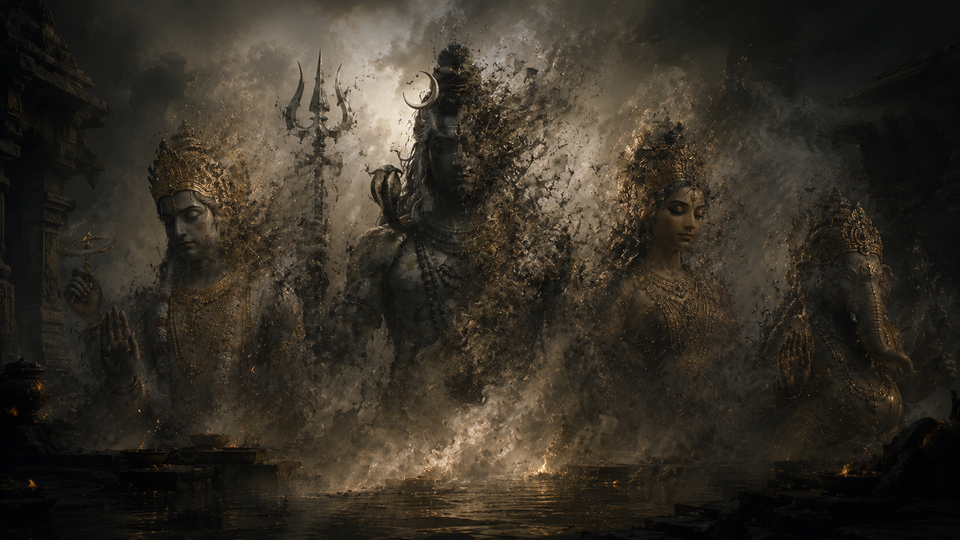
For this argument to even get going, you need a God who is genuinely all-powerful, all-knowing, and all-good. Within Hinduism, the popular pantheon most people picture—the trimurti of Brahma, Vishnu, and Shiva (creator, sustainer, destroyer)—doesn't quite fit that bill if taken literally as three separate gods. None of the three has unlimited power over the other two; Shiva might be the most formidable of the bunch, but he couldn't simply overwhelm the other two outright. And logically, you can't really have two or more beings each possessing genuinely infinite power—if they were ever to conflict, you'd need one to be stoppable and unstoppable at the same time, and that's a contradiction. So true omnipotence can only belong to one being at most.
That's why we need to look toward a different concept entirely: Brahman, the ultimate, formless reality that some schools of Hinduism treat as underlying and unifying everything, including the personal gods themselves, who become understood as aspects, incarnations, or expressions of Brahman. This is where the philosophical tradition of Advaita Vedanta comes in—"advaita" meaning "non-dual." Its most important systematic philosopher is Adi Shankara, who lived and wrote in the 8th century AD and built much of his system as a commentary on the ancient Upanishads (Sanskrit philosophical texts, some going back to around 800 BC, that form the philosophical core of later Vedanta). It's this Advaita reading of Brahman—as a genuinely infinite, unified reality—that gives us the best candidate for the kind of God the problem of evil is actually targeting.
Can Brahman Dodge the Argument?
So which premise does this view attack? Not "all-powerful"—Brahman, as the one true infinite reality, isn't limited the way the LDS God is (see the previous post for that debate). Not "all-good," either, at least not in this strand of Hindu thought—though I'll flag that some Hindus do treat Brahman as beyond moral categories entirely, neither good nor evil, which is itself a fascinating response we'll explore in a future video. And not "all-knowing"—though here too there's a genuine split. Some scriptures depict Brahman as an impersonal force pervading everything, in which case it wouldn't be all-knowing because it wouldn't be a knowing subject at all (a view that would take us out of the problem of evil entirely and into a totally different question, more like asking why gravity doesn't politely pause before someone falls). Other scriptures depict Brahman as personal, and for today's purposes, that's the strand we're considering, since a personal, all-knowing, all-good, infinitely powerful Brahman is the one that actually walks into the same argument the God of classical theism does.
Which leaves premise 4: evil exists. This is the premise Advaita Vedanta rejects.
Maya, Samsara, and Moksha
Nearly all forms of Hinduism share the belief that we are trapped in samsara—an ongoing cycle of death and rebirth. You die, you're reborn as a new person (or, depending on your karma, some other kind of living creature), you die again, and the cycle continues. In a lot of pop culture, reincarnation gets romanticized—"life is full of puppies and ice cream, sign me up for round two." But that's not how most Hindu philosophy actually treats it. Tupac Shakur, famously, did not want to come back. Life is full of suffering, and an endless cycle of it is not a gift; it's the problem to be solved.
The goal, then, is moksha: liberation from the wheel of samsara. Liberated into what, though? This is where Advaita Vedanta makes its central metaphysical claim. Each of us has a true self, called the atman. And the great realization at the heart of moksha is that the atman just is Brahman—not similar to it, not part of a team with it, but identical to it. Achieving moksha means waking up to a fact that was always true: you were never actually separate from the ultimate reality in the first place. The classic image is a drop of water returning to the ocean—not two things joining, but the illusion of separateness finally dissolving to reveal there was only ever one ocean. Another traditional image Advaita philosophers use is a person walking at dusk who mistakes a coiled rope on the ground for a snake and recoils in fear—the fear is real, the mistake is understandable, but there was never actually a snake there at all.
That felt separateness—the sense that "I" am a distinct thing, cut off from Brahman and from everyone else—is called maya, usually translated as illusion. And here's the payoff for our topic: maya just is the essence of evil, on this view. Evil isn't some separate thing that exists alongside Brahman; it's what mistaking the illusion of separateness for reality feels like from the inside.
Which means the Hindu response to premise 4 is refreshingly direct: evil doesn't actually exist. It's maya. And if evil doesn't exist, there's no problem of evil to solve in the first place.
Objections
"My friend really got hit by a boat." This is the obvious pushback—try telling someone in a hospital bed that their suffering isn't real. The Advaita answer, to be fair to it, is more radical than it first sounds: it's not just that the physical world is illusory, it's that the entire individual life and story—birth, boat, hospital bed, death—is part of maya too. It's all Brahman, appearing to itself as multiplicity. That's a genuinely coherent position, even if it's a hard one to sit with.
"That's a bleak thing to tell someone." Not wanting to cease existing as a separate self is a very natural reaction, but Advaita philosophers would say you don't cease to exist so much as realize you never were separate to begin with. Think of it this way: if your finger somehow gained its own consciousness, it would still be materially part of you, under your ultimate control, even while doing its own thing. It's an odd analogy, admittedly, and even Advaita philosophers admit that speaking about this precisely from outside the experience of moksha itself is difficult. But regardless—just because a view is uncomfortable doesn't make it false. Discomfort isn't a counterargument.
"Okay, but even if the cause of pain is illusory, the experience of pain isn't." This, I think, is the strongest objection, and it's worth sitting with. Imagine your colon is twisted in terrible pain, and it turns out this was all "in your mind" in some deep metaphysical sense. Does that make the pain any less real? It doesn't seem like it. Even if what's causing the pain is illusory, the pain itself is a real experience, and its existence still needs explaining. A careful Advaita philosopher would clarify here: it was never quite right to say "evil is an illusion" full stop. What's illusory is the sense of separateness from Brahman. The suffering that flows from that illusion is a real experience, even if its ultimate metaphysical status is different from what it appears to be.
Does This Make the Problem Worse?
Once you make that clarification, you're left with a live question: why would Brahman allow this kind of illusion-driven suffering to exist in the first place? Maybe for self-evolution—except Brahman is supposed to already know everything, so that doesn't quite fit. Maybe Brahman simply wanted parts of itself to gain individual consciousness (again, think of my finger example) and then guides those "parts" through trials for some deeper purpose. I don't think the maya response fully closes the case—it shows one interesting way to reject premise 4, but it doesn't yet tell us why Brahman would set up this elaborate, painful system of illusion in the first place. That doesn't make Advaita Vedanta false. It just means the deepest question—why evil (or the illusion of it)—hasn't actually been answered yet, only relocated.
There's an interesting parallel here to a very different debate in Western philosophy: Descartes versus Berkeley. René Descartes argued that God, being perfectly good, would never deceive us about the reality of the external world. George Berkeley, on the other hand, argued that a good, non-wasteful God wouldn't bother creating physical matter at all if all we actually need are the experiences themselves—why make the machinery when the show is what matters? I don't find Berkeley's argument fully convincing (an infinite God isn't working with scarce resources, so nothing is really "wasted" in the way it would be for us), but I don't think Descartes' point is airtight either. If we could have all the same meaningful experiences without any of the suffering, why does any of the underlying "stuff"—matter, or maya—need to exist at all? That's a real question the Hindu response has to reckon with, and I'm honestly not sure it fully does.