
Why Is There Evil?
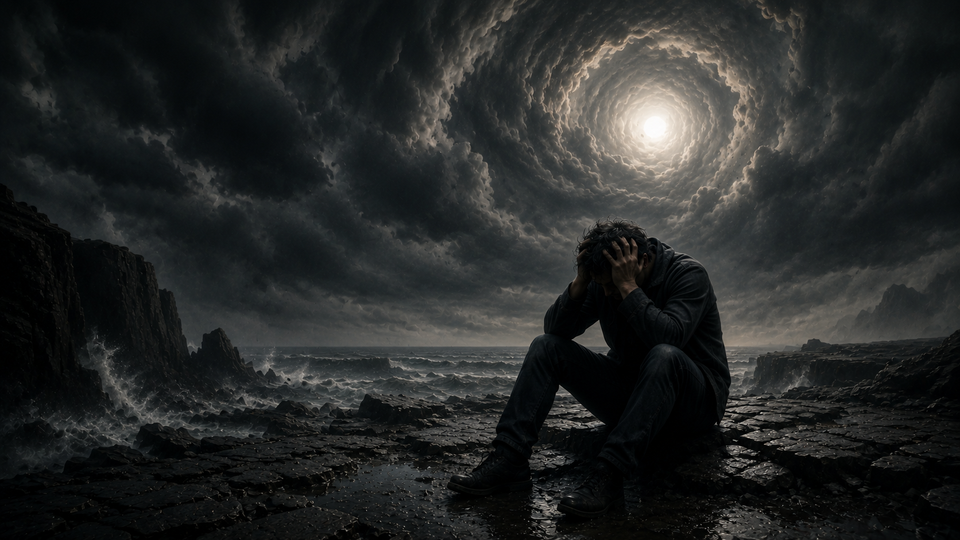
G.K. Chesterton once wrote in Orthodoxy that "the real trouble with this world of ours is not that it is an unreasonable world, nor even that it is a reasonable one. The commonest kind of trouble is that it is nearly reasonable, but not quite. Life is not an illogicality; yet it is a trap for logicians. It looks just a little more mathematical and regular than it is; its exactitude is obvious, but its inexactitude is hidden; its wildness lies in wait."
That passage has always struck me. You look at the world and it isn't just chaos and nonsense. Things make sense. Causes produce effects. Mathematics describes reality with eerie precision. Great, so we live in a rational universe!
Well, almost.
What's strange is that the world makes enough sense that you can see the way things should be — and yet, it's just not quite that way. Reality seems paradoxical. And of all the ways in which the world almost makes sense but doesn't quite, evil is the most striking. Nothing brings this home like standing at a funeral for someone who shouldn't be dead yet — someone young, someone good, someone whose absence rips a hole in the lives of everyone who loved them. You stand there and something in you revolts. This is wrong. This shouldn't be. And you can't help asking why.
That question — why is there evil? — is one of the oldest and deepest questions in all of philosophy. It shows up in every culture, every religious tradition, every era of human history. The Book of Job wrestles with it. The Buddha built an entire spiritual path around it. The ancient Greeks debated it. And we're still asking it today, because no answer has ever fully silenced the question.
In this post, I want to lay out the four fundamental kinds of answers that philosophers and theologians have given. Not to settle the question — that would take far more than a single blog post — but to map the territory, so you can see what the options actually are and what each one costs you.
A Personal Starting Point
I'll use a small example from my own life to make this concrete. Years ago, I was in the Air Force, flying the KC-10. I spent a lot of time in prayer discerning a decision I had to make, and I believe I made the right call. The result? I got sent to North Dakota and lost my pilot qualification. I did what I believed was the right thing, and I suffered for it. It wasn't the worst thing that's ever happened to anyone — I know that. But it was bad enough that the question hit me personally: why this evil?
That question can be asked at every scale. Why is there death? Why do innocent people suffer? Why did this specific bad thing happen to me? Why do people do terrible things to each other? The question reaches as far as reality itself. And the different ways you can answer it reveal fundamentally different visions of what kind of universe we live in.
Possibility 1: Evil Exists for Some Purpose
This is the answer that comes most naturally within theism, and it's where the question bites the hardest. If God exists — if there's an all-powerful, all-knowing, all-good being who created and sustains the universe — then why does He allow evil? He could stop it. It seems like He'd want to stop it. So why doesn't He?
This tension has a name in philosophy: the Problem of Evil. It's been called the most serious objection to the existence of God, and it has a long pedigree. The ancient Greek philosopher Epicurus (341–270 BC) is often credited with the earliest sharp formulation: if God is willing to prevent evil but not able, He's not omnipotent; if He's able but not willing, He's not good; if He's both able and willing, then where does evil come from? Centuries later, the Scottish philosopher David Hume put the same point with characteristic precision in his Dialogues Concerning Natural Religion (1779): "Is he willing to prevent evil, but not able? then is he impotent. Is he able, but not willing? then is he malevolent. Is he both able and willing? whence then is evil?"
Some people find this objection so powerful that they reject belief in God entirely on the basis of it. And that's an intellectually serious move — it deserves a real response, not a hand-wave.
But notice what kind of answer we're looking for here. When we ask "Why would God allow evil?", we're asking about the purposes of an intelligent agent. This is a fundamentally different kind of question than "Why does a rock roll downhill?" The rock question has a mechanical answer — gravity, slope, friction. The God question demands a purposeanswer. It's more like asking, "Why does a jazz musician allow dissonant notes in her song?" The dissonance isn't a mistake. It serves the music. The question is whether evil could serve some analogous role in God's purposes — and if so, what that role could possibly be.
The philosophical tradition has produced a rich body of responses here, collectively called theodicies — from the Greek theos (God) and dike (justice). Leibniz coined the term in 1710, arguing that God created the best of all possible worlds, and that what looks like pointless evil from our limited vantage point is actually a necessary part of a greater good we can't fully see. Augustine argued that evil is not a thing in itself but a privation — an absence of good, the way blindness is an absence of sight, not a substance of its own. Irenaeus of Lyon (2nd century AD) suggested that evil exists because God is in the process of forming our souls — that suffering is the forge in which character, virtue, and genuine love are made possible.
Each of these deserves its own deep dive (and they'll get one in future posts). For now, the key point is this:
Possibility 1: Evil exists for some purpose. This assumes there's an intelligent agent in charge of the universe who permits evil for reasons we may or may not be able to understand.
Possibility 2: Evil Is the Effect of Prior Evil (Karma)
Now suppose you set aside the idea of a personal God directing things toward a purpose. Is there another way evil could be explained — not by purpose, but by some kind of natural law?
This is where the concept of karma comes in. In the Hindu and Buddhist traditions, karma isn't a system of divine punishment. It's closer to a law of nature — a moral equivalent of Newton's third law. Every action has a consequence. Good actions generate good effects; harmful actions generate harmful effects. These effects may not show up immediately or obviously, and in many traditions they can carry across lifetimes through the cycle of samsara (rebirth), but the connection is real and law-like.
Applied to my North Dakota example: a karmic explanation would invite me to look at my own past actions and ask whether the suffering I experienced was the natural consequence of something I'd done — even something seemingly unrelated. Maybe I harmed someone in a way I've forgotten. Maybe the connection runs deeper than I can trace.
There's something initially appealing about this. It makes the universe morally ordered. Nothing is random. Everything connects. But it also raises hard questions. What about a child born into suffering? What about evils that seem wildly disproportionate to anything the sufferer could have done? The doctrine of reincarnation is one traditional answer — the relevant actions may have occurred in a previous life — but that pushes the question back rather than resolving it, and it can slide into a troubling tendency to blame victims for their own suffering.
Possibility 2: Evil suffered is always the effect of prior evil action. This assumes a law-like moral connection between what you do and what happens to you, whether or not any divine agent is orchestrating it.
Possibility 3: Evil Is Inexplicable
Here's a third option. You might reject both of the above. You don't believe in a God who has purposes for evil, and you don't believe in a karmic law connecting your actions to your fate. No purpose, no law-like explanation. So what's left?
What's left is absurdity.
I like to think of it this way. Imagine a cheeseburger appears on the roof of your house. Not assembled from existing ingredients. Not teleported there by some device. Not conjured by a magician — that would at least be some kind of explanation. No, this cheeseburger simply is there, with no explanation whatsoever. Not even an explanation that's beyond our ability to discover. There is, in principle, no reason for it. Its existence is absurd.
This is the position associated most famously with Albert Camus, the French-Algerian philosopher and novelist. In The Myth of Sisyphus (1942), Camus argued that the universe is fundamentally indifferent to human concerns, and that our desperate need for meaning and explanation is met with cosmic silence. The gap between our demand for reason and the world's refusal to provide it — that gap is what Camus called "the absurd." Evil, on this view, doesn't happen for a reason. It just happens. Your suffering isn't punishment, isn't a lesson, isn't a test. It's a brute fact in an indifferent universe.
Applied to my situation: why was I sent to North Dakota? No reason. Totally arbitrary. Like the cheeseburger on the roof. Only worse, because this was a bad thing.
Now, here's what I find interesting about this position. We almost never accept absurdity as an explanation for anything else. Why did the bridge collapse? We investigate. Why did the patient get sick? We run tests. Why does the planet orbit in an ellipse? We do the math. In every other domain of life, we assume that things are explicable — usually through science, sometimes through other means. We never shrug and say, "Oh, it's just absurd." So why would we accept that answer here, at the very point where the question matters most? That tension deserves serious attention.
Possibility 3: The existence of evil is absurd. There is no reason, no explanation, no purpose — not even a hidden one. Things just happen.
Possibility 4: Evil Doesn't Exist
There's one more option. You deny that God exists. You reject the law-like connection of karma. You refuse to accept absurdity — after all, you're a reasonable person, and reasonable people don't accept that things just pop into existence for no reason. So where does that leave you?
It leaves you denying the premise. Maybe evil doesn't actually exist.
Think of it like a lake in the middle of the desert. You see it shimmering on the horizon. You'd swear it's real. But as you get closer, it vanishes — it was a mirage all along. It appeared to be something, but it was really nothing.
On this view, evil is like the mirage. What we call "evil" is just a label we attach to experiences we dislike. There's no real moral fabric to the universe that's being violated. There's no way things should be that's being contradicted. There are just events, and our emotional reactions to them. Pain is real as a sensation, but "evil" as a moral category? That's a projection. We paint it onto a universe that is, at bottom, morally blank.
This position shows up in various forms. Certain strands of moral anti-realism in analytic philosophy argue that moral facts don't exist in the way physical facts do — they're expressions of attitude, not descriptions of reality. Some readings of Buddhist philosophy hold that suffering (dukkha) arises from attachment and illusion, and that seeing through the illusion dissolves the problem. Benedict de Spinoza argued in his Ethics (1677) that good and evil are not properties of things in themselves but only expressions of how things affect us — "nothing is good or bad but thinking makes it so," as Shakespeare put it in a different context.
But notice the cost: if evil doesn't exist, then you have to explain why it seems so real. The mother grieving her child, the victim of cruelty, the witness to injustice — they aren't confused about a minor point. The experience of evil is among the most vivid and undeniable experiences human beings have. Explaining that away is no small task.
Possibility 4: Evil doesn't exist. What we call evil is a mirage — it appears real, but it's ultimately an illusion or a projection.
The Question We Don't Ask
Here's something curious. We spend enormous philosophical energy asking why bad things happen, but we almost never ask the corresponding question: why do good things happen? Maybe we don't notice good things the way we notice bad ones — the way you don't notice the light until someone turns it off and you're sitting in the dark. Maybe we assume that good is the natural state of affairs, so it doesn't require explanation. Or maybe — and this is worth sitting with — the existence of good is just as mysterious as the existence of evil, and we've simply gotten used to not asking about it.
Shock Into Wonder
There's a final point I want to make, and it's not about the answer to the question but about the question itself.
Aristotle opens his Metaphysics by observing that philosophy begins in wonder — in thaumazein, that experience of being struck by something you can't explain. We go along with life not thinking very deeply about anything. We eat, we work, we scroll, we sleep. And then something breaks through. A disaster. A loss. A moment of suffering so sharp that it pulls you up out of the mundane and forces you to ask: why?
I'm not saying this is the reason bad things happen. I'm not saying suffering is "worth it" because it makes us philosophical. I'm just pointing out that the encounter with evil is one of the oldest and most powerful beginnings of philosophy itself. It's an existential shock that cracks open the surface of everyday life and reveals the deep questions underneath.
And those questions — about God, about justice, about the nature of reality itself — are what we'll be exploring in the videos and posts to come.