
Is Time Infinite? The Beginning and End of Everything
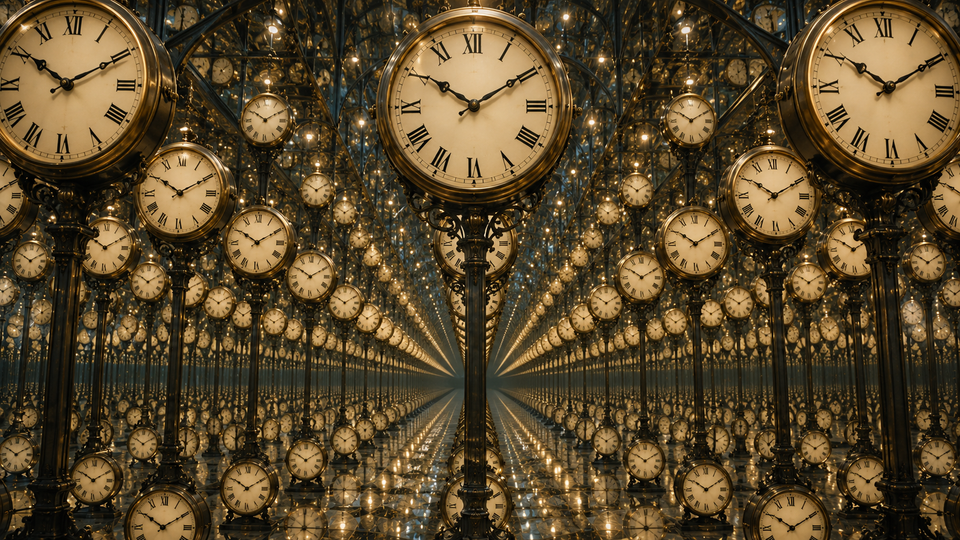
Does time have a beginning? Will it have an end? Could time stretch back forever and forward forever? Or must there be a first moment and (perhaps) a last? These are among the most profound questions human beings have ever asked, and they sit at the intersection of philosophy, physics, and theology.
The Significance of the Question
This question is not merely academic. If time had a beginning, then the universe came into existence, and we can ask why. If time is infinite in the past, then infinitely many events have already occurred, which raises paradoxes about the completion of infinite series. If time will end, everything we know will eventually cease. If time goes on forever, the ultimate fate of the universe becomes a pressing question.
Arguments That the Past Must Be Finite
Several traditions have argued that time cannot be infinitely old.
The traversal argument: if the past is infinite, then an actually infinite number of moments have elapsed before the present. But an actual infinity cannot be traversed by successive addition (you cannot count to infinity). Therefore, an infinite past is impossible, and time must have had a beginning.
This argument was deployed by the medieval Islamic philosopher al-Ghazali (1058-1111 AD) and has been revived in modern philosophy of religion by William Lane Craig as part of the Kalam cosmological argument. The structure is: (1) whatever begins to exist has a cause; (2) the universe began to exist; (3) therefore, the universe has a cause. The argument for premise (2) includes the claim that an infinite past is impossible.
The successive addition argument: the past is built up moment by moment, each moment added to the ones before it. But you cannot build an actual infinity by successive addition. No matter how many moments you add, you always have a finite number. Therefore, the past cannot be actually infinite.
Arguments That the Past Could Be Infinite
Opponents respond on several fronts.
The B-theory response: the traversal argument assumes that the past was built up moment by moment (the A-theory of time). But on the B-theory (the block universe), all moments exist equally. The past is not "traversed" from some starting point. It simply is. The question of how you "get to" the present from an infinite past does not arise, because the block universe has no process of getting anywhere. All times exist tenselessly.
The mathematical response: actual infinities are mathematically consistent (Cantor showed this). There is nothing logically contradictory about an infinite sequence of past moments. The traversal argument relies on the assumption that actual infinity is impossible, which is a philosophical claim, not a mathematical one.
The cosmological response: some cosmological models (eternal inflation, cyclic cosmologies) posit a past without a first moment. While the standard Big Bang model implies a finite age for the observable universe (about 13.8 billion years), the Big Bang may not represent the absolute beginning of time. The singularity at the Big Bang may be an artifact of our current theories breaking down, not a genuine first moment.
The Future: Infinite or Finite?
The question of the future is equally interesting. If the universe will expand forever (as current observations suggest), then time may be infinite in the future even if it is finite in the past. But an eternal future raises its own puzzles.
In an infinitely long future, anything that is physically possible will happen (given enough time and the right conditions). This leads to strange consequences: Boltzmann brains (random fluctuations producing conscious observers in the far future), Poincare recurrences (the universe eventually returning to any given state), and the heat death (the universe reaching maximum entropy and ceasing to do anything interesting, perhaps forever).
Some philosophers have argued that the asymmetry is significant: the past is finite but the future is infinite. This would make the universe a one-sided infinity, stretching from a definite beginning into an endless future. Whether this is more or less puzzling than a two-sided infinity (no beginning and no end) is itself a philosophical question.
Theology and Infinity
The question of time's infinity has deep theological connections. If time had a beginning, this is consistent with creation accounts in Judaism, Christianity, and Islam. If time is infinite, it complicates (though does not necessarily refute) these accounts.
Thomas Aquinas (1225-1274 AD), interestingly, argued that the finitude of the past cannot be proven by reason alone. He believed the universe had a beginning (because the Bible says so), but he thought Aristotle's arguments for an eternal universe were not logically refutable. For Aquinas, the beginning of time is a matter of faith, not philosophical demonstration.
Suggested Reading
William Lane Craig and Quentin Smith, "Theism, Atheism, and Big Bang Cosmology" (Oxford University Press). A debate covering the philosophical and cosmological arguments.
A.W. Moore, "The Infinite" (Routledge). Historical and philosophical overview.
Paul Copan and William Lane Craig, "The Kalam Cosmological Argument" (multiple volumes). Comprehensive defense and critique of the argument from the finitude of the past.
Sean Carroll, "From Eternity to Here" (Dutton). A physicist's perspective on the beginning and end of time.