
"The Republic" by Plato
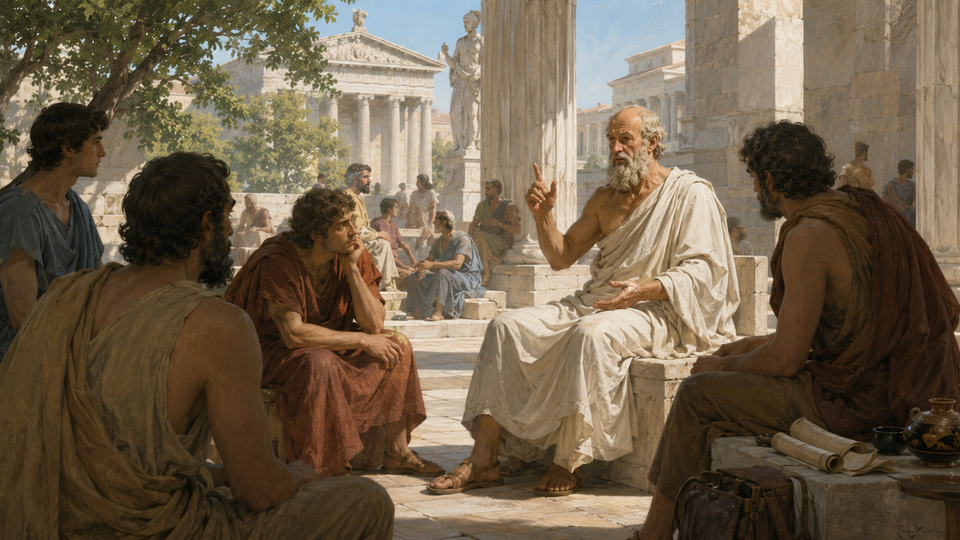
The Republic is, on most lists, the most important work of philosophy ever written. It is the cornerstone of Western political thought, the source of more ideas than most readers realize they already hold, and the book against which every later political philosophy has had to define itself. Aristotle wrote against it. Augustine adapted it. Aquinas synthesized it with Christian theology. The American founders were haunted by it. Marx wrestled with it. Popper attacked it. Two and a half millennia after Plato wrote it, the book is still doing the philosophical work that books are supposed to do — provoking, challenging, refusing to settle.
It is also long, sometimes strange, and occasionally hard to follow. Many people start it and quit. This post is the case for actually finishing it.
The Moment Plato Was Writing From
You cannot read The Republic well without knowing what Plato had just lived through.
He grew up in Athens during the golden age — the era between roughly 500 and 300 BC when an unprecedented concentration of human flourishing in a single small city produced sculpture, theater, music, the Olympics, mathematics, the first democracy, and philosophy as we know it. The Parthenon was being built when Plato was a child. He breathed the same air as Sophocles, Euripides, Aristophanes, Thucydides.
But the city was also at war. The long Peloponnesian War with Sparta ground on for twenty-seven years and ended, in 404 BC, with Athens losing. Sparta installed a brutal short-lived oligarchy known to history as the Thirty Tyrants. When democracy was restored, the city was traumatized, suspicious, and looking for someone to blame.
In 399 BC, that someone was Socrates — Plato's teacher, the most provocative philosopher in the city, a man who had spent decades publicly questioning the assumptions Athenian democracy was built on. A jury of five hundred citizens voted to execute him for impiety and corrupting the youth. He drank the hemlock in front of his friends. Plato was about twenty-eight years old.
This is the experience The Republic is processing. Plato had watched a direct democracy lose a war through inefficient decision-making and then put his teacher to death because the philosopher was annoying the mob. He spent the rest of his life building an alternative.
The Democracy Critique
This is the part of The Republic that has shaped Western politics the most.
Plato's critique is not that democracy is evil. It is that democracy is unstable, and the form of its instability is predictable. He sketches a sequence of regimes that decay into one another: an aristocracy of the genuinely best degrades into a timocracy that prizes honor over wisdom, which degrades into an oligarchy that prizes money over honor, which degrades into a democracy that prizes freedom over everything else — and democracy, having tilted toward freedom so far that nothing holds the community together anymore, finally collapses into tyranny when an exhausted citizenry hands power to a strong leader who promises to fix it.
The argument is not merely abstract. Plato grew up watching it. The 20th century watched it again in Weimar Germany. Every wave of populism in democratic countries is partly a vindication of Plato's worry.
Plato also has a more famous argument that hits even harder: the ship of state. Imagine a ship at sea. The crew quarrels about who should steer. They are loud, the discussion is long, and the question they keep arguing about is who can flatter them most effectively into thinking he should be captain. Meanwhile the one person on board who actually knows how to navigate is sitting quietly to the side, dismissed as impractical because he refuses to compete in the flattery contest. The ship is in trouble. Plato thought democracy was that ship. The captaincy goes to the best campaigner, not to the person who actually understands what is happening. (This was well-depicted in the classic television special Race for Your Life, Charlie Brown).
This argument is the reason Plato's political philosophy was treated as suspicious of democracy for most of two thousand years. The American founders read Plato carefully and built explicit checks against pure majority rule: an electoral college, an unelected judiciary, a bicameral legislature, a written constitution that majorities cannot easily change. Madison's Federalist 10 is a direct response to Platonic worries about factions and mob rule. Across the ocean, the French Revolution proceeded with less Platonic caution and produced, almost immediately, Robespierre's Reign of Terror — exactly the cycle Plato had warned about.
You can disagree with Plato's solution. (I do, partially — more on that below.) But if you live in a democracy, you cannot afford to be ignorant of his critique of it. The dangers are real. The arguments are still good.
The Justice Question
The other reason to read The Republic is that it is the most thorough engagement Western philosophy has ever produced with two questions you cannot afford to ignore: What is justice? And why should you care?
The first question runs through Book 1 like a search party. Socrates' interlocutors offer answers and Socrates demolishes them one by one. Cephalus, an elderly merchant, suggests justice is paying your debts and telling the truth. Socrates points out that returning a borrowed weapon to a friend who has gone mad would meet that definition and obviously is not just. Polemarchus tries "help your friends and harm your enemies." Socrates asks whether harming anyone could be the work of a just person at all. Thrasymachus, fed up with the niceties, declares that justice is just whatever the strong say it is — and the strong say what advances their interests. The first book ends without a satisfactory answer, but the negative results have cleared the ground.
Then in Book 2, Glaucon poses the challenge the rest of the book is trying to answer. Suppose, he says, you had a magic ring that made you invisible — the Ring of Gyges. Suppose you could do anything without being caught. Would you still be just? Or would you simply take what you wanted, harm whom you wanted, and become as the gods are: free of consequence?
This is one of the deepest questions in moral philosophy. (It also shows up in my post on The Hobbit, where the "can rational egoists be heroes?" question is the same question in a different costume.) Glaucon is essentially asking: is justice good in itself, or is it only useful as long as we are being watched? If the only reason to be just is to avoid punishment and earn social rewards, then justice is just a clever strategy — and once the strategy stops paying, anyone smart enough to escape detection should drop it. Glaucon does not believe this, but he wants Socrates to prove him wrong.
The rest of The Republic is Socrates' answer. To explain justice in a person, he says, we should first look at justice in a city — because the city is the soul writ large, and easier to see. He builds an ideal city in speech, populated by three classes (producers, soldiers, philosopher-rulers) corresponding to three parts of the soul (appetite, spirit, reason). Justice in a city is each class doing its proper work and not interfering with the others. Justice in a person is the same: each part of the soul doing its proper work, with reason ruling, spirit supporting reason, and appetite kept in its place.
The argument is that justice is the right ordering of a soul, and an unjust soul is a disordered one — a soul where appetite rules reason, or where the spirited part rebels against reason's leadership. Such a soul is not just unfortunate; it is internally at war with itself. The unjust person is unhappy not because they get caught but because they are a mess on the inside, regardless of how much they get away with on the outside.
You do not have to accept the whole framework to feel the force of the argument. The claim that being a certain kind of person matters in itself, independent of whether the world rewards or punishes you for it, is one of the most important moves in moral philosophy. Plato was the first to make it cleanly.
The Cave
You cannot introduce The Republic without mentioning the Cave allegory in Book 7, even briefly.
Picture prisoners chained in a cave from birth, facing a wall, unable to turn their heads. Behind them is a fire, and between the fire and the prisoners is a walkway where people carry objects that cast shadows on the wall. The prisoners have seen nothing but the shadows their entire lives. To them, the shadows are reality.
Now imagine one of them is freed, turned around, dragged out of the cave, and shown the sun — the source of light, the source of seeing itself. He resists; the light hurts his eyes. Eventually he adjusts. When he returns to the cave to tell the others, they reject him, mock him, and (if they could) kill him for trying to drag them out of what they take to be the real world.
This is Plato's image of the philosopher, but it is also his image of what knowledge actually is. We mostly live among shadows. Genuine understanding requires being turned around, dragged toward something painful, and coming back to a world that is unlikely to welcome the new perspective. The Athenians killed Socrates partly because he insisted on doing exactly this.
The Cave is the most influential image in Western philosophy. You cannot read modern political philosophy, theology, or even much serious fiction without bumping into it.
The Honest Objection
I would be doing you a disservice if I sold The Republic without acknowledging the most serious modern objection to it.
Karl Popper, writing during the Second World War, argued in The Open Society and Its Enemies (1945) that Plato was the intellectual ancestor of 20th-century totalitarianism. The ideal city Plato describes has censorship of the arts, a controlled education system, eugenic breeding, the "noble lie" told to citizens for their own good, and the abolition of family life among the guardian class. The philosopher-king who knows what is best and rules accordingly is, on Popper's reading, the prototype of every Hegel-, Marx-, or Lenin-inspired tyrant who claimed to be implementing reason against the resistance of the ignorant masses.
This is a serious objection. Plato's city is not somewhere most of us would want to live. The whole apparatus of the Guardian class is unsettling. The noble lie is the kind of move modern readers should be suspicious of.
But Popper's reading is also partial. Plato was almost certainly not designing a literal blueprint. The city in speech is, by his own framing, an analogy for the soul. He says so explicitly. He is using the city to make a point about the inner ordering of the person, not handing out a manifesto for ancient social engineering. Whether the ideal city would be good if implemented is a real question; whether Plato thought it should be implemented is a different question, and the answer is much less clear than Popper allows.
The serious modern reader of The Republic has to hold two things at once: the book contains real wisdom about politics and the soul, and it contains political proposals that should make us nervous when taken at face value. Reading it well requires the ability to take an argument seriously without endorsing every conclusion. This is, not coincidentally, the kind of reading philosophy is supposed to train you to do.
What You Actually Need to Read It
If you are going to read The Republic, do not just open a copy and start.
For a free public-domain version, the Benjamin Jowett translation from 1888 is online and serviceable. The English is slightly old-fashioned but it reads cleanly and the philosophy comes through. Link in the description.
For a modern translation with significantly clearer English and better notes, C. D. C. Reeve's translation (Hackett, 2004) is excellent. Reeve also wrote Philosopher-Kings, an interpretive companion.
If you want a one-volume guide before you start, Julia Annas's An Introduction to Plato's Republic (1981) is rigorous but readable, and will save you weeks of confusion.
A practical reading plan: do not try to power through all ten books at once. The book is built like an argument with detours, and the detours are sometimes where the deepest material is. Read Book 1 for the failed definitions of justice. Read Book 2 for Glaucon's challenge — this is the most important passage in the book. Read Book 7 for the Cave. Then go back and fill in the rest. The middle books on education, the philosopher-king, and the line analogy are dense; the late books on the decay of regimes (Books 8 and 9) are the ones that have shaped political thought most directly.
The Bottom Line
The Republic is the right book if you want to understand the foundations of Western political and moral philosophy from the source, if you want to see the questions that have organized our thought for 2,400 years asked for the first time, and if you are willing to wrestle with a writer who is smarter than you are and is not going to let you off easily.
It is the wrong book if you want quick answers, if you cannot tolerate having your assumptions challenged, or if you want a writer who shares all of your modern intuitions. Plato does not. That is part of why he is worth reading.